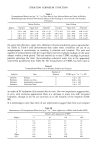
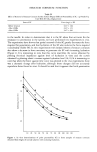
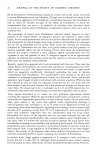
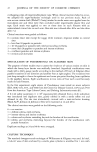
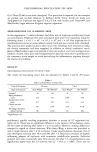
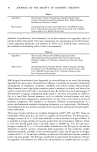
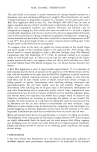
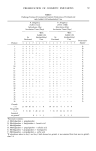
PSEUDOMONAS INOCULATION ON SKIN 23 0.1% Triton X-100 (a non-ionic detergent). This procedure is repeated, the two samples are pooled and ten-fold dilutions in buffered 0.05% Triton X-100 are made and drop-plated on Tripticase Soy Agar (T.S.A.), T.S.A. with lecithin and Tween-80 ©, and MacConkey's agar selection for gram negative organisms. DOSE-RESPONSE ON SCARIFIED SKIN In this experiment, 15 male volunteers had three sets of duplicate scarifications made on each forearm. Duplicate sites were inoculated with strain 9171 organisms using the following doses: 1 x 10³ , 1 x 10⁵ , 1 x 10⁷ , 1 x 10⁸, and 1 x 10⁹. One duplicate set of scarifications served as an uninoculated control. Each site was covered with a Bandaid. The reactions were graded as above after 6 and 24 hr. Dressings were removed to make the clinical assessment and then reapplied. In addition to clinical evaluation, touch plates of MacConkey's agar were pressed to each site at the 6- and 24-hr readings in ten subjects. At best, these give only semiquantitative data, but were used in preference to the customary scrub sample to avoid intensifying the inflammatory response through the trauma of scrubbing. RESULTS PSEUDOMONAS INOCULATION ON INTACT SKIN The results of inoculating intact skin are tabulated in Tables I and II. All strains Table I Effects of Pseudomonas on Intact Skin Time of Occlusion: 48 hours 7 days Type of Occlusion: Saran Wrap © Wet Webril © Saran Wrap © Wet Webril © Sample # 20 118 20 128 Mean pseudomonas • count 6.20 6.93 6.185 6.98 Standard error of the mean 0.17 0.05 0.23 0.10 Clinical reaction +/-- 0/0 27/91 1/19 87/41 Percentage of positive clinical reaction 0% 22.9% 5% 68% •Logarithm per cm 2. proliferated, quickly reaching population densities in excess of 106 organisms/cm 2 within 48 hr. There was no significant difference in the density of Pseudomonas under the two types of dressing after either 2-7 d of occlusion. However, striking differences emerged in regard to clinical reactions. With Saran Wrap, a lesion was provoked in only a single instance after 7 d of occlusion. Under superhydration dressings, 23% of sites developed reactions after 48 hr and 68% after 7 d. Reactions consisted of slightly infiltrating plaques of erythema with numerous nonfollicular pustules. Follicular pustules were only occasionally seen. The reaction rate after 7 d of superhydration was significantly higher than the 2-d reaction rate (X 2 = 48.4, p 0.001). There was no

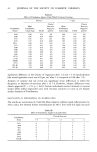
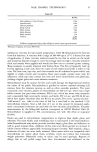
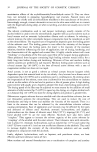
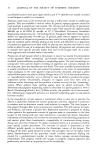
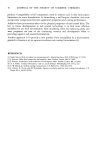
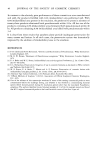
24 JOURNAL OF THE SOCIETY OF COSMETIC CHEMISTS Table II Effect of Pseudomonas Species Under Webril Occlusive Dressings 48 hours 7 days Clinical Mean Reaction Mean Pseudomonas Pseudomonas Negative/ Pseudomonas Strains Count (log) S.E.M. positive Count (log) S.E.M. Clinical Reaction Negative/ positive 9104 6.98 0.25 9106 6.96 0.18 9151 6.91 0.15 9152 6.75 0.18 E1A 6.96 0.13 9171 6.93 0.25 9190 7.25 0.16 9206 7.17 0.20 9220 6.98 0.08 9436 7.04 0.15 10752 6.84 0.27 17759 6.42 0.31 205608 6.52 0.33 27515 6.66 0.16 D.L.#I 7.03 0.O9 D.L.#2 7.16 0.04 9/1 10/0 11/1 10/0 11/2 6/3 3/3 4/4 5/1 4/3 4/3 6/0 5/0 3/0 0/3 2/1 6.99 0.27 2/8 7.47 0.31 4/6 6.82 0.32 2/8 7.03 O.29 2/4 7.32 0.29 2/7 7.49 O.33 2/6 7.60 0.20 1/6 7.26 0.25 3/8 6.79 0.36 3/4 7.76 0.38 2/4 6.36 0.26 4/4 5.77 0.35 2/5 6.07 0.48 4/1 6.73 0.24 4/5 6.99 0.24 2/6 6.85 0.30 2/5 significant difference in the density of organisms after 2 d and 7 d of superhydration (the mean logarithm count was 6.93 per cm 2 after 2 d compared to 6.98 after 7 d). Analysis of variance did not reveal any significant strain differences in either the frequency or intensity of reactions after 2 or 7 d. However, subject differences were clearly apparent (F = 2.52, p 0.01). Certain individuals reacted intensely to several strains while others responded only with minimal reactions or none at all, despite similar densities of Pseudomonas. INOCULATION OF PSEUDOMONAS ON SCARIFIED SKIN The results are summarized in Table III. Most subjects exhibited peak inflammation by 24 hr only a few showed further intensification by 48 hr. Even with this high inoculum Table III Effect of Pseudomonas Applied to Scarified Skin Pseudomonas Clinical Reaction Strain +4 + 3 + 2 + 1 E1A 0 1 3 7 3 9106 0 2 2 6 4 9152 0 2 2 7 3 9171 0 3 2 5 4 9436 0 1 1 9 3 10752 0 2 2 1 9 27515 0 2 2 6 4 D.L.#I 1 2 4 3 4
Purchased for the exclusive use of nofirst nolast (unknown)
From: SCC Media Library & Resource Center (library.scconline.org)