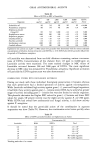
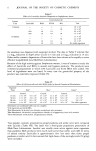
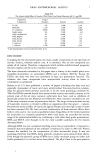
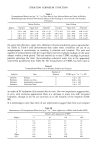
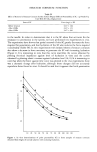
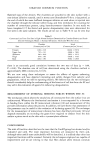
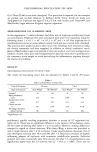
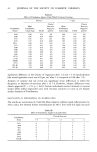
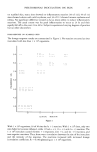
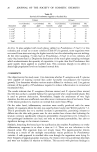
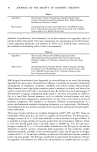
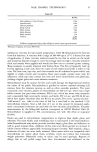
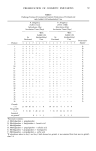
PRESERVATION OF COSMETIC EMULSIONS 39 Table I Challenge Testing of Commercial Cosmetic Emulsions as Purchased and with Added 0.3% Imidazolidinyl Urea Product P. Aeruginosa (ATCC 15442) Subcultures After Incubation Times (Days) P. .deruginosa (ATCC 13388) Subcultures After Incubation Times (Days) With With Added 0.3% Added 0.3% As Imidazolidinyl As Imidazolidinyl Purchased Urea Purchased Urea Preservative I 2 3 7 I 2 3 7 1 2 3 7 I 2 3 7 System • 1 2 3 4 5 6 7 8 9 10 11 12 13 14 15 16 17 18 19 20 21 22 23 24 25 26 Growth (+) No growth (-) Assumed no growth + + + + + + + + - - -- A + + + + + + - - - B + + + + + - - A + + + + + + + - -- C + + - C + + + + + + + + - A + + + - - A + + + + + + - A + + + + + + + + -- C + + + + - -- D + + + + -- A + - A + + + + + + -- C + + + + - A + - A + + + + - E + + + - + + - + + + - A + + + + + + + - A + + + + + + + -- -- C C + - - - E F + + + + + .... A + + + + + + + + -- -- -- C E + + + + + + + .... A 21 18 16 13 3 1 0 19 13 11 4 1 0 0 5 8 10 5 20 22 23 7 13 15 14 22 23 23 8 3 3 3 8 3 3 3 •Preservative systems: A. Methylparaben + propylparaben B. Methylparaben + butylparaben + benzoic acid C. Methylparaben D. Methylparaben + propylparaben + salicylic acid E. Methylparaben + propylparaben + butylparaben F. Methylparaben + propylparaben + sorbic acid 2If subcultures taken on day 2 and day 3 both showed no growth, it was assumed that there was no growth after 7 d.

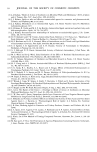
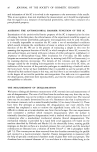
40 JOURNAL OF THE SOCIETY OF COSMETIC CHEMISTS In contrast to the relatively poor performance of these cosmetics as now manufactured and sold, the products fortified with 0.3% imidazolidinyl urea performed well. With 0.3% imidazolidinyl urea present in the emulsion, the preservative system in nineteen of twenty-three products eliminated both pseudomonads within 24 hr. All but one of the products containing 0.3% imidazolidinyl urea eliminated both pseudomonads within 48 hr. All products containing 0.3% imidazolidinyl urea killed both pseudomonads within 3d. It is clear from these results that parabens alone provide inadequate preservation for many creams and lotions. In all such cases, the preservative system was dramatically improved by the addition of imidazolidinyl urea to the emulsion. REFERENCES (1) P. H. Clarke and M. H. Richmond, "Genetics and Biochemistry of Pseudomonas," Wiley Interscience: London, England, 1975. (2) M. R. W. Brown, "Resistance of Pseudomonas aeruginosa," Wiley Interscience: London, England, 1975. (3) P. A. Berke and W. E. Rosen, Imidazolidinyl urea activity against Pseudomonas, J. Soc. Cosmet. Chem., 29, 757-766 (1978). (4) E. L. Richardson, Preservatives: frequency of use in cosmetic formulas as disclosed to FDA, Cosmetics and Toiletries, 92, 85-86 (1977). (5) W. E. Rosen, P. A. Berke, T. Matzin and A. F. Peterson, Preservation of cosmetic lotions with imidazolidinyl urea plus parabens,J. Soc. Cosmet. Chem., 28, 83-87 (1977). (6) American Type Culture Collection, 12301 Parklawn Drive, Rockville, Md. 20852. (7) "O•cial Methods of Analysis," 12th Ed., Association of O•cial Analytical Chemists: Washington, D.C., 1975. (8) One of the referees of this manuscript wondered if some of the starting commercial products were contaminated before the challenge testing, and whether it was therefore a contaminating bacterial species which showed growth during the incubation period rather than the inoculated Pseudomonas aeruginosa. The authors therefore located retained samples of 23 of the 26 materials tested, and found that all 23 original commercial products had total bacterial counts of less than 10 per mi.
Purchased for the exclusive use of nofirst nolast (unknown)
From: SCC Media Library & Resource Center (library.scconline.org)