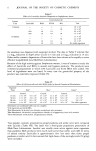
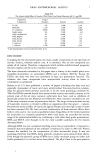
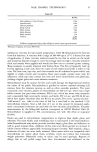
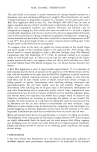
NAIL ENAMEL TECHNOLOGY 31 Table III w/w% Nitrocellulose 1/2 Sec RS (dry) 15.00 Santolite resin • 12.00 Dibutyl phthalate 3.00 Butyl Acetate 21.50 Ethyl Acetate 9.00 Ethyl Alcohol 6.40 Butyl Alcohol 1.10 Toluene 22.00 100.00 Addition of pigmented color chips will give a tinted cream type nail enamel. •Monsanto Company, St. Louis, MO 63166. satisfactory viscosity for nail enamel preparations. Table III demonstrates the formula from this reference. A viscosity with a range of 300-400 cps at 25 ø C is desired for ease of application. A lower viscosity material would be too thin to remain on the brush and would not deposit enough to cover the average nail too high a viscosity would be thick and streaky when applied and would not flow out to a smooth glossy coating. Wear resistance is usually obtained with thicker films. The film is frequently built up by first applying a base coat, then two coats of nail enamel and finally a sealer or top coat. The base coat, top coat, and clear enamels are all colorless lacquers which vary slightly in solids content and viscosities. Base coats usually contain more resin for adherence, while top coats contain less resin and more nitrocellulose and plasticizer, yielding a higher gloss with more abrasion resistance. Nitrocellulose must be neutral, for free acid could damage the fingernail and destroy the colors of the polish. Nitrocellulose is purified to remove retained nitrating acid mixture from the nitration process as well as other unstable products. The most commonly used viscosity grades of nitrocellulose are RS 0.25 sec, which has a high solids content, but poor wear resistance, RS 0.5 sec, which has better wear resistance and a reasonable high nonvolatile content, and lastly, RS 5-6 sec, and RS 60-80 sec, which have higher viscosities than the RS 0.5 sec grade. The terms "quarter-second," "half-second," etc., refer to the time of fall for a steel ball in the standard 12.2% nitrocellulose solution. Since a fall time of 1 sec or less cannot be measured easily, more concentrated solutions are used with the low viscosity nitrocellulose. Viscosity measurements by the falling-ball method correspond to ASTM Method D301-56. Nitrocellulose is supplied in 70% concentrations, wet with 30% ethyl or isopropyl alcohol. Resins are used in nitrocellulose compositions to improve their depth, gloss, and adhesion. The most widely used modifying resin in nail enamel is the toluenesulfona- mide/formaldehyde resin which provides excellent depth, gloss, flow, and adhesion, as well as good resistant films. Addition of this resin and others permits an increase in solids content without appreciably increasing lacquer viscosity. Nail enamels, using a minimum of coats, are more easily attained. Other resins which are compatible with nitrocellulose are maleic alkyd resins, acrylates, vinyls and certain low molecular weight polyesters. Polyamide resins, or nylon, may be used sparingly. Reports of allergy due to nail polish usage have been documented and attributed to the

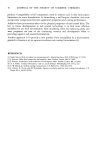
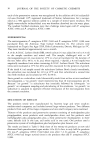
32 JOURNAL OF THE SOCIETY OF COSMETIC CHEMISTS sensitization effects of the arylsulfonamide/formaldehyde resins (4). They are there- fore, not included in preparing hypoallergenic nail enamels. Natural resins and polyesters are chiefly used as nitrocellulose modifiers in the manufacture of the above. Interestingly enough, contact dermatitis occurs on the skin areas which are in contact with the fingernails during sleep, or when scratching, and does not usually occur in the nail folds. The solvent combination used in nail lacquer technology usually consists of the alcohol which is used to wet the nitrocellulose, together with an active solvent such as butyl acetate and an aromatic hydrocarbon diluent such as toluene. In selecting a solvent mixture, the other nonvolatile lacquer components must be considered, as well as the nitrocellulose. The required rate of evaporation depends upon the boiling points of the solvents used. The boiling points in turn affect the viscosity of the lacquer solutions. The lower the boiling point, the lower is the viscosity of the resultant solution, therefore influencing the ease of application, rate of drying, hardening, and the characteristics of the applied nail enamel film. A highly volatile solvent will cause "blushing" or cloudiness of the film and a poor flow of the lacquer during application. Films produced from lacquers containing high boiling solvents remain sticky for a fairly long time before drying and hardening. Mixtures of low and medium boiling solvent systems are preferred in nail enamels. Medium boiling point solvents such as n-butyl acetate (bp 110-130øC) is the best all-round active solvent with a rate of evaporation neither too slow nor too rapid. Amyl acetate, is not as good a solvent as n-butyl acetate because lacquers solely dependent upon this material tend to dry too slowly. Amyl acetate has a slower rate of evaporation (bp 120-150øC) and is sometimes used in combinations. By slowing down the evaporation of the solvent, more time is allowed for the nitrocellulose to coalesce and set on the surface of the nail and to produce a film of greater gloss. A high boiling point solvent will usually give a brighter, glossier film than a low boiling point solvent. The drying speed of the film may be adjusted to some extent by the addition of small amounts of ethyl acetate (bp 75-83øC) to speed up the drying, or a higher alcohol such as n-butanol (bp 116-118øC) to slow the drying slightly and produce a glossier film. Diluents are organic solvents that are miscible with the nitrocellulose solvents, but are not themselves solvents for nitrocellulose, They are used to reduce the cost of formulation and help to lower and stabilize the viscosity of the enamels. There is a limit to the amount that can be tolerated by the nitrocellulose solution without causing precipitation. Ease of application and viscosity may be affected by the types and amounts of diluent used. Alcohols, aromatic hydrocarbons, and aliphatic hydrocarbons are the classes of diluents used. Ethyl (78 ø C), isopropyl (82.3 ø C), and butyl alcohol (118 ø C) are the most efiqcient. Alcohols have also been called "couplers." They appear to increase the solvent capacity of the active solvents by "coupling" of the alcohol with the ester solvent. Their tolerance ratio with nitrocellu- lose is about 9:1. Aromatic hydrocarbons, such as toluene (bp 111 ø C) and xylene (bp 139.3 ø C) have a ratio of 3:1 and are not as efiqcient diluents as the alcohols. They tend to increase slightly the viscosity of the nitrocellulose solutions and are usually employed in conjunction with the alcohols. Lastly, aliphatic hydrocarbons, such as heptane, and petroleum ethers, are least efiqcient and have tolerance ratios of 1•:1. Most modern nail enamel formulations use a combination of camphor and another
Purchased for the exclusive use of nofirst nolast (unknown)
From: SCC Media Library & Resource Center (library.scconline.org)