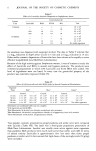
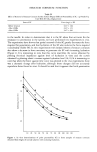
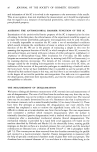
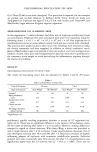
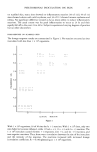
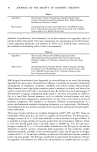
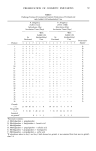
PSEUDOMONAS INOCULATION ON SKIN 25 on scarified skin, many sites showed no inflammatory reaction (34 of 112), 44 of 112 sites showed edema with mild erythema, and 34 of 112 showed intense erythema and edema. No significant difference existed as far as strain ability to induce inflammatory reactions. The usual course was for peak inflammation to occur at 24 hr and then rapidly fall off in the next 24 to 48 hr. Subjects experienced varying degrees of pruritus but no other discomfort. DOSE-RESPONSE ON SCARIFIED SKIN The dosage-response results are summarized in Figure 1. No reaction occurred at sites inoculated with less than 1 x 10 • organisms. 9.0 8.0 7.0 6.0 5.0 4.0 3.0 ß o . o o { I " CLINICAL REACTION Figure 1 With 1 x 10⁷ organisms, 18 of 30 sites had a + 1 reaction. With 1 x 10⁸ dose, only two sites failed to become inflamed, while 11 had a q-1, 11 a q- 2, and 6 a + 3 reaction. The 1 x 10⁹ inoculum caused thirteen + 1 responses, nine +2, and six + 3 reactions, and two negative reactions. Thus, there was a correlation between the size of the inoculum and the intensity of the response. The reactions increased with increased dosage (correlation coefficient, R = 0.728) plateauing at 1 x 10⁸ organisms.

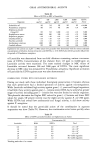
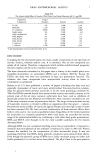
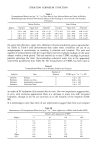
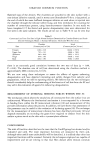
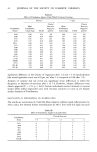
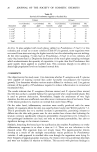
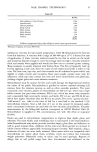
26 JOURNAL OF THE SOCIETY OF COSMETIC CHEMISTS Table IV Survival of Pseudomonas Applied to Scarified Skin Inoculum 6 hours 24 hours 12 Colonies/ 12 Colonies/ No 12 Colonies/ 12 Colonies/ No plate plate Growth plate plate Growth 1 X 10⁹ 7 4 9 2 12 6 1 X 10⁸ 8 9 3 2 4 14 1 X 10 ? 4 6 10 0 6 14 1 X 10⁵ 2 4 14 0 1 19 1 X 10³ 0 2 18 0 0 20 Total 21 25 54 4 23 73 At 6 hr, 54 sites sampled with touch plates yielded no Pseudomonas 25 had 12 or less colonies and 21 had 12 or more colonies (Table IV). In general, more organisms were recovered from sites receiving the higher inocula, but this relationship was not striking. At the 24-hr sampling, 73 sites had no Pseudomonas, 23 had 12 or less colonies, and only 4 had more than 12. Despite the limitations of the touch plate sampling technique which underestimates the quantity of organisms, it is quite clear that Pseudomonas dies quite rapidly when applied to scarified skin. This contrasts sharply to its ability to attain high population levels on hydrated normal skin. COMMENTS Our objectives in this study were: 1) to determine whether P. aeruginosa and P. cepaciae were capable of injuring normal skin under favorable circumstances for bacterial growth 2) to determine whether various strains differed in virulence and 3) to gain an estimate of the quality of Pseudomonas required to induce inflammation in normal and traumatized skin. The results indicate that P. aeruginosa (thirteen strains) and P. cepaciae (three strains) find the skin surface a suitable habitat for rapid growth when impermeable plastic film is used to prevent desiccation. Nevertheless, despite the attainment of very high densities, the skin was unaffected even after seven continuous days of occlusion. None of the strains produced a reaction on normal skin under Saran Wrap. On the other hand, inflammatory reactions were readily produced with the same density of organisms when the skin was superhydrated under wet Webril pads for 7 d. This is presumably due to a marked increase in permeability, permitting irritants to diffuse into the skin with greater ease. In vitro studies have shown that hydrating the stratum comeurn significantly enhances permeability characteristics (16). Certainly in vivo prolonged immersion can lead, not only to increased permeability, but also to significant damage to the stratum corneum. Similarly, breaching the horny layer by scarification also enables Pseudomonas to evoke inflammatory responses in as short a time as 1 d. These are not infections in the classical sense. The organism does not invade tissue. The papulo-pustular lesions develop as a result of the multiple extracellular toxins produces by Pseudomonas varieties. A rash appeared in scarified skin even though the organisms were dying. In three biopsies of papulo-pustular reactions, the lesions were intra-epidermal abscesses and were not localized in relation to follicles. This accords with previous findings in
Purchased for the exclusive use of nofirst nolast (unknown)
From: SCC Media Library & Resource Center (library.scconline.org)