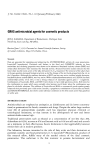
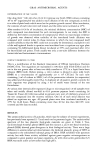
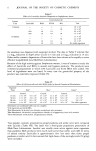
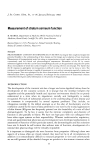
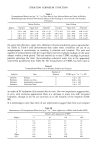
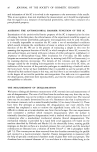
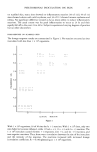
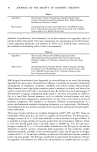
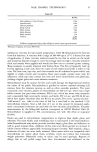
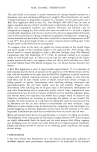
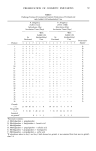
GRAS ANTIMICROBIAL AGENTS 3 DETERMINATION OF MIC VALUES One drop (0.04 ñ 0.01 ml) of an 18-24 hr trypticase soy broth (TSB) culture containing 109 to 10 •2 organisms/ml was added to each dilution of the test compound, as well as to a tube of plain broth which served as the positive growth control. After inoculation, the contents of each tube were well mixed, and the tubes were incubated at 35øC. After another 18-24 hr of incubation, the minimal inhibitory concentration (MIC) of each compound was determined for each microorganism. In our study, the MIC is defined as the lowest concentration of compound at which no macroscopic evidence of growth was observed when trubidity of the inoculated broth dilutions was compared with control tubes. In those instances in which the test compound itself caused turbidity so that the MIC could not accurately be determined, a sample (0.1 ml) of the well-agitated broths in question was inoculated into a trypticase soy agar plate containing 5% defibrinated sheep blood, incubated at 35øC, and examined after 24 hr for bactericidal end points. There usually was only a one-tube difference between the bactericidal and bacteriostatic concentrations. CONTACT INHIBITION VS TIME This is a modification of the Standard Association of Official Agriculture Chemists (AOAC) Test. Test organisms are maintained in 10% skim milk broth (Difco) and for use in the test grown after at least two daily transfers at 37øC in a liquid brain-heart infusion (BHI) broth. Before testing, a 24-hr culture is diluted in skim milk broth (SMB) to a concentration of approximately 2.0 x 10⁶ CFU/ml. To each tube containing 3 ml of culture in SMB 3 ml of the preservative solution (or suspension) was added and thoroughly mixed (To). A duplicate set of positive growth controls for each organism was prepared by using 3 ml of sterile water instead of the test formulation. At various time intervals after exposure (drugs vs microorganism) 1.0 ml samples were taken and serially diluted ten-fold in 0.1% proteose peptone broth containing 2% Tween 80. Tween 80 (1.0%) was added to prevent carry over of inhibitory amounts of the test compound into the recovery medium. One ml of each serial dilution was plated on trypticase soy agar. All poured plates were then incubated aerobically at 37øC for 24-48 hours. Plates containing more than 30 but less than 300 CFU were counted and the data recorded. RESULTS The antimicrobial activity of Lauricidin, which'was the subject of several experiments, has previously been reported (1-7) and need not be presented again. The antimicrobial spectrum of the two phenolic food-grade materials are given in Table I. Two, six-di-tert-butyl-4-methyl phenol (BHT) and the mixture 2, and 3-tert-butyl-4-methoxy phenol (BHA) showed great divergence in their biological activity. There was a large difference in antimicrobial activities between the hindered phenolic group of BHT as compared to the unhindered hydroxyl group of BHA. BHA exhibited wide spectrum activity but with lower activity exhibited against gram negative microorganisms as compared to gram positive and yeast organisms. As with other acidic germicides (6,7) BHA was more active at low rather than high pH's.

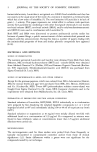
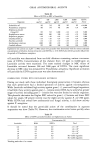
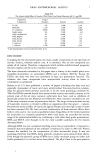
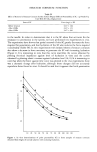
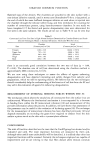
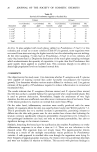
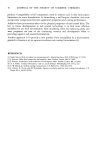
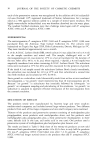
4 JOURNAL OF THE SOCIETY OF COSMETIC CHEMISTS Table I The Minimum Inhibitory Concentration (MIC) of BHT • and BHA 2 (pH 7.0) in Liquid Culture Medium Microorganism BHT BHA Escherichia coli 5000 •tg&ml 2000 •tg/ml Pseudomonas aeruginosa 5000 •tg/ml 5000 •tg/ml Streptococcus mutans 5000/•g/ml 125 •tg/ml Streptococcus agalactiae 5000 •tg/ml 125 •tg/ml Staphylococcus aureus 5000 •tg/ml 250 •tg/ml Corynebacterium sp. 500 •tg/ml 125 •tg/ml Norcardia asteroides 5000 •tg/ml 250 •tg/ml Saccharomyces cerevisiae 5000 •tg/ml 125 •tg/ml Candida albicans 5000 •tg/ml 250 •tg/ml •2,6-di-tert-butyl-4-methyl phenol. 22 and 3-tert-butyl-4-methoxy phenol. EFFECT OF STRUCTURE MODIFICATION OF BIOCIDAL ACTIVITY OF TEST-PHENOLS In order to determine how changes in the alkyl chain of BHT would effect antimicrobial activity of this phenolic compound, a number of n-alkyl derivatives para to the phenolic group were compared. Data are presented for a series of BHT derivatives where the R group was varied by carbon lengths from zero to the decyl derivative (Table II). The optimum length for the para alkyl chain of the 2,6- Table II Effect of Structural Changes on Antimicrobial Activity (MIC) of Some Tert-Butyl Phenol Derivatives 2,6-di-tert-butyl- Streptococcus Mutans -phenol 250 •tg/ml -4-methyl phenol (BHT) 1000 •tg/ml -4-ethyl phenol 62 •tg/ml -4-butyl phenol 31 •tg/ml -4-hexyl phenol 125 •tg/ml -4-octyl phenol 500 •tg/ml -4-decyl phenol 1000 •tg/ml -4-hydroxymethyl phenol 125 •tg/ml -4-methoxy phenol 1000 •tg/ml di-tert-butyl phenol was found in the four carbon chain derivative. Other structural changes strongly influenced biological activity. Hydroxylation of the -4- methyl derivative (BHT), lowered the MIC from 1000 to 125/ag/ml an increase in biocidal activity of ten-fold or more. A -4- methoxy derivative of 2,6-di-tert-butyl phenol was much less active than BHA which has a single tert-butyl group blocking the acidic phenol. That stearic hindrance plays an important part in compound antibacterial action was supported by testing a 2,5-di-tert-butyl phenol. In this case the bulky tert-butyl group is meta to the phenolic group instead of ortho, as in the case of BHT. The stearically blocked 2,6 derivative had a MIC of 250 /ag/ml against Streptococcus mutans while the unhindered 2,5 phenol derivative gave a value of 15.6/ag/ml. POTENTIATING EFFECT OF EDTA ON BIOCIDAL ACTIVITY The MIC for EDTA was determined against a number of organisms. The values for EDTA alone and in conjunction with Lauricidin are presented in Table III. The MIC
Purchased for the exclusive use of nofirst nolast (unknown)
From: SCC Media Library & Resource Center (library.scconline.org)