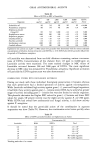
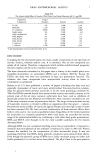
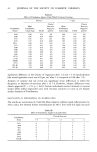
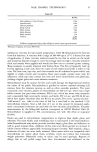
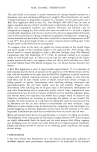
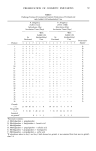
GRAS ANTIMICROBIAL AGENTS 7 Table VII The Antimicrobial Effect of Lauribic With Other Food-Grade Materials (pH 5.5,/•g/ML) Organism/ Propyl Compounds Parabens Sorbate Lauribic • E. Coli 625 5,000 1,250 Klebsiella 1,250 5,000 2,500 Ps. aeruginosa 10,000 10,000 5,000* Staph. aureus 313 5,000 62.5 Staph. epidermitidis 313 10,000 125 Strep. pyogenes 313 1,250 125 Strep. faecalis 625 10,000 250 Strep. mutans 625 5,000 250 S. cereviscae 313 10,000 125 C. albicans 1,250 10,000 1,250 •A special preparation of Lauricidin and Sorbic Acid. DISCUSSION In looking for the ideal preservation one must usually compromise on the spectrum of activity, toxicity, irritation and/or cost. It is axiomatic that no one compound can satisfy all of criteria. Therefore, compounds which exhibit multifunctional properties become of great interest to the cosmetic formulator. The three chemicals considered in this paper have a history in the market place as an emulsifier (Lauricidin), an antioxidant (BHA) and a chelator (EDTA). Except for EDTA, the other two were not considered to have any preservative function. The evidence that these compounds have antimicrobial activity alone or better in combination is substantial. Kabara et al. (1-7) have published a number of papers indicating that fatty acid and especially monoesters of lauric acid were antimicrobial. Structure-function relation- ships for glycerol esters showed Lauricidin to be the most promising candidate (6). That this GRAS material should have antimicrobial activity was totally contrary to the present state of the art since nonionic surfactants have been used as inhibitors of germicidal action (see our Materials and Methods). Also, nonionic emulsifiers are one of the most common causes of preservative failure. The range of antimicrobial activity of Lauricidin, however, is limited to effects on organisms other than gram (-) strains. Recently the antiviral effect of Lauricidin against Herpes and other lipid coated viruses has been reported (24). We have received confirmation of these antiviral effects from both in vitro and in vivo study (unpublished data). Regardless of the limited potential for Lauricidin as a cosmetic preservative when used alone, we extended the activity range of its antimicrobial affects by combining it with other food-grade preservatives. BHA and EDTA were thought to be the most suitable candidates for the reasons discussed below. Although BHA was not considered anything more than an antioxidant, it represents a chemical structure (phenol) of the antiseptic introduced by Lister in 1867 (25). Phenol remains the standard for the comparisons of other bactericidal drugs. It was not surprising therefore that BHA, being phenolic, produced some antimicrobial affects. Even though the phenolic group of BHA has a bulky tert-butyl group on either side (ortho positions), it is not less active than phenol. The alkyl chain in the para position

8 JOURNAL OF THE SOCIETY OF COSMETIC CHEMISTS strongly influences biological activity. Optimal antimicrobial activity is reached where the alkyl group is a butyl derivative. It should be noted that where no alkyl group exists in the para position or where the methyl group is replaced by a hydroxy methyl, the resulting 2,6-di-tert-butyl phenolic derivative is more active. The placement of the tert-butyl group from the 2,6- position to the 3,5- position unhinders the phenolic group and results in a more active isomer. When the methyl group of BHT was replaced by a methoxy group, a less active species resulted. The deactivating effect of the methoxy group was not apparent where the di-tert-butyl group of the 2,6- derivative was moved to single a 2- or 3- position, as in BHA. Although BHA was not the most active phenolic derivative tested, it is recognized as a GRAS (Generally Recognized As Safe) chemical suitable for addition to foods. The emphasis on the use of BHA instead of the butyl derivative of BHT was based on its acceptability by the Federal Drug Administration (FDA), and greater biological activity. During the course of our investigation many reports appeared on the antimicrobial role of BHT and BHA. Numerous phenolic antioxidants are currently being used as food preservatives (8). Kaufman and Ahmond (9) reported that 140 ppm of nordihydroguaiaretic acid (NDGA) inhibited growth of Saccharomyces cerevisiae. Epstein, et al. (10) reported that the LD50 for T. pyriformis was only 5 ppm for NDGA. Shih and Harris showed that this antioxidant was lethal at 400 ppm against E. coli. Only 50 ppm of NDGA were needed to inhibit S. aureus (11). Ward and Ward reported that the growth of S. senftenberg was restrained by 10,000 ppm of butylated hydroxy toluene (12). A recent patent by Trelease revealed that the phenolic antioxidant, BHA, showed similar but higher activity than BHT (13). Butylated hydroxy-anisole was shown to be active at 500 ppm. Chang and Branen (14) found that 250 ppm pf BHA could inhibit the growth of A. parasitious and 150 ppm could inactivate S. aureus. BHA at 20 ppm inhibited T. pyriformis growth by 50% (15). Virbio parahaemolyticus growing in TSBS was inhibited by 50 ppm of BHA (16). In addition to their action on bacteria and fungi, butylated phenols (BHT and BHA) are potent inactivators of lipid-containing viruses (17,18). Earlier a closely related derivative, thymol, was shown to inactivate influenza viruses, herpes viruses and several other lipid-enveloped viruses (19). The third multifunctional chemical used to enhance antimicrobial activity of Lauri- cidin was EDTA acid. While this chemical's primary utility is to sequester metals and may provide support for a metal-chelation theory for solubilizing cell walls, factors other than chelation may be involved. Some of these factors stem from the two observations. First, EDTA is as active at acidic pH's as in basic media second, other chelators, including ethylene glycol-bis (fi-amionoethyl ether) NN' tetraacetic acid (EGTA), were not active (unpublished data). The "enhancing" role of EDTA, which has poor antimicrobial action of its own, was noted by facilitating antimicrobial affects of other preservatives on cell walls. This observation is not original with us. In 1958 McGregor and Elliker discovered that mutants resistant to quaternary compound become sensitive when exposed to EDTA acid. Since that time many authors have shown that pretreatment of gram negative bacteria with EDTA renders the cells susceptible to antibacterial agents (20 and references therein). Sheu and Freese (21) showed that the E. coli to deconoic and
Purchased for the exclusive use of nofirst nolast (unknown)
From: SCC Media Library & Resource Center (library.scconline.org)