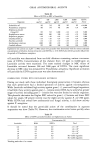
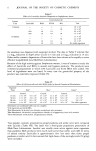
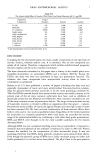
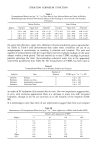
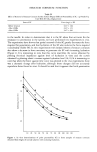
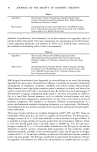
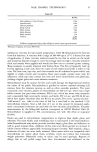
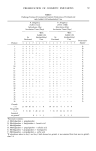
GRAS ANTIMICROBIAL AGENTS 9 linolenic acid was increased by treatment with EDTA. Shibasaki and Kato have reviewed the role of EDTA in extending the range of lipophilic preservatives (22). Hart has recently reviewed the role of EDTA in cosmetics and toiletry products and has emphasized various functional properties beyond its use as a water softner (23). The spectrum of activity of any preservative or biocide is limited. Thus enhanced antimicrobial effectiveness may result from the use of two or more preservatives. Mixed quaternium compounds and combinations of parabens are examples of preservatives of mixtures that are superior to individual family members. In the present report we investigated the combined effect of certain food-grade chemical agents on the antibacterial activity of Lauricidin. The agents picked to enhance the range and activity of Lauricidin were selected from the GRAS classifica- tion in order to assure safety. While a great number of agents have been screened, BHA and EDTA are representative of what can be done with wholly food grade materials and Lauricidin. The art which is presented can easily be extended to other phenolic compounds (parabens) and fatty acids (sorbic, lactic) in combination with Lauricidin and is not limited to the examples given. It also contradicts the notion that phenol compounds form inactive complexes with every nonionic surfactants (26). The specific combinations given in this report indicate that the limited spectrum of Lauricidin can now be extended to gram (-) organisms. Also the kill rate of Lauricidin in aqueous systems can be increased against most organisms in the presence of BHA and/or EDTA. In the example presented in Table VI the dispersion of Lauricidin in isopropyl alcohol greatly enhanced its ability to kill organism in a short period of time. Killing times of a minute or less have been measured for some topical and oral agents now under investigation (unpublished data). SUMMARY The antimicrobial activity of Lauricidin has been reported and found to be active against gram (+) bacteria, yeast, fungi, and some molds. Gram (--) bacteria were not affected by Lauricidin alone. In order to extend the usefulness of Lauricidin as a cosmetic preservative, a number of food-grade (GRAS) materials were examined as useful enhancers. Di-tert-butyl anisole (BHA) and ethylendiaminetetraacetic acid (EDTA) were found to enhance Lauricidin preservative qualities, Lauribic (a propri- etory product of Med-Chem Laboratories) was shown generally to be more active than parabens, or sorbic acid. Both the spectrum of activity and kill time of Lauricidin can be improved by the combination of this food product with other food additives. Examples with BHA and EDTA were given. REFERENCES (1) J. j. Kabara, D. M. Swieczkowski, A. J. Conley and J.P. Truant, Fatty acids and derivatives as antimicrobial agents, Antimicrob. Ag. and Chemother., 2, 23-28 (1972). (2) A.J. Conley and J.j. Kabara, Antimicrobial action of esters of polyhydric alcohols, Antimicrob. Ag. and Chemother., 4, 501-506 (1973).

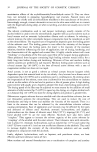
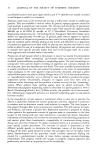
10 JOURNAL OF THE SOCIETY OF COSMETIC CHEMISTS (3) J.J. Kabara, "Mode of Action of Antibiotics on Microbial Walls and Membranes," M. R.J. Salton and A. Tomasy, Eds., N.Y. Acad. of Sci., 235,103 (1974). (4) J. J. Kabara, Lipids as safe and effective antimicrobial agents for cosmetics and pharmaceuticals, Cosmetics and Perfumery, 90, 21-25 (1975). (5) J. J. Kabara, Monolaurin as an Antimicrobial Agent, U.S. Patent Number 4,022,775. Med-Chem Laboratories, January 1977. (6) J.J. Kabara, R. Vrable and M. S. F. Lie KenJie, Antimicrobial lipids: natural and synthetic fatty acids and monoglycerides. Lipids, 12,753-759 (1977). (7) J. J. Kabara, Structure-function relationships of surfactants as antimicrobial agents. J. Soc. Cosmet. Chem., 29, 733-741 (1978). (8) D. F. Chichester and F. W. Tanner, Antimicrobial Food Additives in T. E. Furia, et al., "Handbook of Food Additivies," 2nd ed., Chemical Rubber Co.: Cleveland, OH, 1972 pp 175-184. (9) H. P. Kaufman and A. K. S. Ahmand, Effect of Antioxidants on the Growth and Lipid Metabolism of Saccharomyces Cerevisiae, Fette Seij•n Antrichm, 69, 837-839 (1967). (10) S.S. Epstein, I. B. Saporoscketz and S. H. Hunder, Toxicity of Antioxidants to Tetrahymena Pyriformis, J. Protozool, 14, 238-241 (1967). (11) A. L. Shik and N. D. Harris, Antimicrobial Activity of Selected Antioxidants. J. Food Protec., 40, 520-522 (1977). (12) M. S. Ward and B. Q. Ward, Initial Evaluation of the Effect of Butylated Hydroxytoluene upon Salmonella Senftenbert 775w, Poultry Sci., 46, 1601-1606 (1967). (13) R. D. Trelease, Retardation of Oxidation and Microbial Growth in Foods, U.S. Patent Number 3,955,005, May 4, 1976. (14) H. C. Chang and A. L. Branen, Antimicrobial Effects of Butulated Hydroxyanisole (BHA),J. Food Sci., 40, 349-351 (1975). (15) S. G. Surak, R. L. Bradley, A. L. Branen and E. Shrago, Effects of Butylated Hydroxyanisole on Tetrahymena Pyriformis, Ed. Cosmet. Toxicol., 14, 277-281 (1976). (16) M. C. Robach, L. A. Smoot and M.D. Pierson, Inhibition of Vibrio parahaemolyticus 04.' Kll by Butylated Hydroxyanisole,J. Food Pract., 40, 549-551 (1977). (17) ¾(/. Snipes, S. Person, A. Keith and J. Cupp, Butylated Hydroxytoluene Inactivates Lipid Containing Viruses, Sci., 187, 64-66 (1975). (18) P. Wanda, J. Cupp, W. Snipes, A. Keith, T. Rucinsky, L. Polish and J. Sands, Inactivation of the Enveloped Bacteriophage 6 by Butylated Hydroxytoluene and Butylated Hydroxyanisole, Antimicrob. Ag. and Chemother., 10, 96-101 (1976). (19) V. Knight and M. W. Noall, Recurrent Herpes, N. Eng. J. Med., 294, 337-338 (1976). (20) L. Leive, The Barrier of the Gram (--) Envelope in Mode of Action of Antibiotics on Microbial Walls and Membranes, Ann N.Y../icad. Sci., 235, 109-129 (1974). (21) C. W. Sheu and E. Freese, Lipopolysaccharide Layer Protection of Gram Negative Bacteria against Inhibition by Long-Chain Fatty Acids,J. Bacterial., 115, 869-875 (1974). (22) I. Shibasaki and N. Kato, Combined Effects on Antibacterial Activity of Fatty Acids and Their Esters Against Gram (--) Bacteria, in "Pharmacological Role of Lipids," J. J. Kabara, Ed., American Chemical Society: Champaign, IL, 1979. (23) J. R. Hart, Chelating Agents in Cosmetics and Toiletry Products, Cosmetics and Toiletries, 93, 28-30 (1978). (24) J. A. Sands, D. D. Auperin, P. D. Landin, A. Reinhardt and S. P. Cadden, Antiviral Effects of Fatty Acids and Derivatives, in "Pharmacological Role of Lipids," J. j. Kabara, Ed., American Oil Chemists Society: Champaign, IL 1979. (25) J. Kister, On a New Method of Treating Compound Fractures, Abscesses, Etc., Lancet, 1, 326-329 (1867). (26) M. Bart and L. F. Tice, The Preservation of Aqueous Preparations Containing Nonionic Surfactants, J. •4mer. Pharma. •4ssoc., XLVI, 445-451 (1957).
Purchased for the exclusive use of nofirst nolast (unknown)
From: SCC Media Library & Resource Center (library.scconline.org)