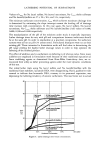
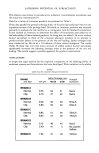
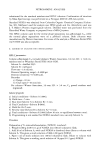
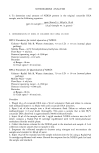
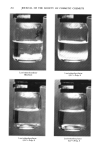
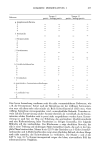
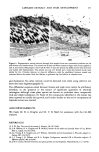
SAPINDUS EXTRACT AND HAIR DEVELOPMENT 271 :" ': •'" t '"'•'• , ' ',•* •' • ..... "W•:'•-'-• • • •5 • • '• .Z .. .• , •- •- •- . • - • •....... -.•- (•) (B) Figure 1: Representative vertical se•ions through skin samples from two symmetrical poskions on the mid-dorsum of a female mouse. The animal was 26 days old when treatment began wkh extract applied to side A, and solvent (7• propan-2-ol) to side B. After 31 days the animal was killed and the skin sectioned and stained wkh haematoxylin. This animal was one of 4 female and 4 male sibs treated results were s•ilar for the 4 females whereas no clear-cut difference could be established between treated and untreated sides • the males. Scale bar-2• •m e-epidermis hg-ha• follicle at-adipose tissue. and cholesterol. No other steroids could be detected even when using selective ion detection mass fragmentography (3). The differential response noted between female and male mice cannot be attributed, therefore, to the presence in the extract of significant quantities of steroidal oestrogens, although some plant species are known to synthesise these compounds (3,4) and related substances (5). None of the compounds identified in the extract has been reported to modify hair growth, and further studies on the active components of Sapindus extract are merited. ACKNOWLEDGEMENTS We thank Dr. B. A. Knights and Dr. V. B. Math for assistance with the GC-MS analyses. REFERENCES (1) F. W. Dry, The coat of the mouse,J. Genetics, 16, 287 (1926). (2) J. R. Hillman, B. A. Knights and R. McKail, SteroIs of the adult and juvenile forms of ivy, Hedera helix L., Lipids, 10, 542 (1975). (3) J.J. Young, B. A. Knights and J. R. Hillman, Oestradiol and its biosynthesis in Phasedus vulgaris L., Nature, 267, 429 (1977). (4) I. J. Young, j. R. Hillman and B. A. Knights, Endogenous estradiol-17/• in Phasedus vulgaris, Z. Pflanzen-physiol., 90, 45 (1978). (5) J. M. C. Guens, Steroid hormones and plant growth and development. Phytochemistry, 17, ! (1978).

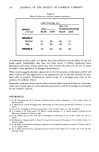
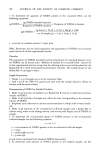
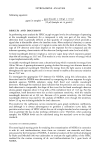
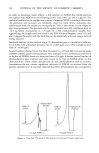
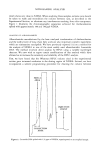
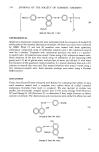
j. Soc. Cosmet. Chem., 31,273-278 (September/October 1980) A replacement for Rubine dye for detecting cationics on keratin RICHARD J. CRAWFORD and CLARENCE R. ROBBINS, Colgate Palmolive Research Center, Piscataway, NJ 08854. Received February 12, 1980. Synopsis Four dyes have been examined as possible substitutes for RUBINE DYE to test for the presence of CATIONIC SURFACTANTS and POLYMERS on hair and wool. The four dyes tested were Red 80 (Sirius Red), Red 84 (Pyrazol Fast Red), Orange II and Orange G. Red 80 proved to be an excellent substitute for Rubine. INTRODUCTION Rubine dye (1) (Structure I) has been used as a stain for detecting cationic surfactants and polymers on keratin substrates (2), however it is no longer being manufactured. Therefore, we elected to search for a suitable stain to replace it. A few dyes similar in structure to Rubine were located in the Color Index (3), from which we selected Red 80 (4) (Structure, IX) and Red 84 (5) (Structure Ill) to examine experimentally. These two dyes are related structurally to Rubine, all three being high molecular weight, polyaromatic, symmetrically disubstituted ureas, containing four to six sulfonate groups and four azo linkages. -- -- 803Na • OH NaOaS N - I H 2 Rubine Dye (Mol. Wt. 1472) SOaNa -o- -c5- NaOaS N•N N=N NaOaS.-'-'-•'•. N / I H -- Red 80 (Mol. Wt. 1372) /c=o 273
Purchased for the exclusive use of nofirst nolast (unknown)
From: SCC Media Library & Resource Center (library.scconline.org)