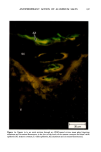
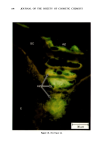
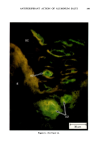
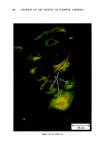
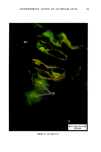
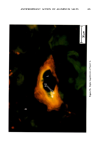
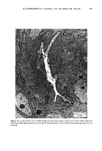
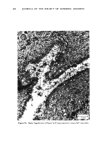
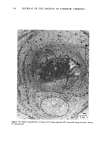
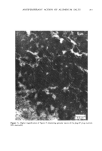
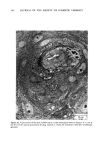
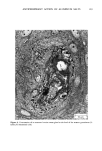
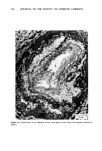
212 JOURNAL OF THE SOCIETY OF COSMETIC CHEMISTS superficial location of the aluminum and zirconium. It is also likely that some of the plug material was lost not only during its sectioning but also during the fixation procedures. Figures 6b and 6c are higher magnifications of the AZAP plug material. The appearance and characteristics of this material were remarkably similar to those of the previously described ACH plug (2). Figures 7a-7c are a view of a different AZAP-treated sweat gland, again sectioned parallel to the skin surface. Figure 7a is a representation of the gland at a level just above the epidermal-dermal junction. The lumen of the duct was filled with AZAP plug material in apparent quantity and density ample enough to cause inhibition of sweating. Although the finding of the plug in this sweat gland (as well as in one other) was rather deep from an anatomical standpoint, it was in fact only ca. 100/am from the skin surface. The electron-dense character was evident in a small portion of the plug, but the density for the most part was less pronounced and more granular, as represented in Figures 7b and 7c, than had been previously observed. This sweat gland is an example of one of those whose function was not restored by Scotch tape stripping away the stratum corneum layer. Figures 8a-8c are a view of the same gland at the level of the stratum granulosum. Only faint traces of the plug material remained. In following this sweat duct to the skin surface, essentially the same characteristics as described above for the first duct were evident. That is, as sectioning progressed toward the skin surface, small amounts of plug material were found within the lumen. At the point of just reaching the skin surface, AZAP plug material scattered throughout the ostium was evident. Figures 9 and 10 are examples of untreated sweat glands at the levels of the stratum granulosum and stratum corneum respectively. No material was ever observed in these control glands. IV. DISCUSSION Various forms of aluminum-zirconium are becoming increasingly widely used as the active ingredient in today's antiperspirant products. Despite the steady gains in their use, little information exists relative to the mechanism by which these complexes are capable of inhibiting perspiration. To date, the sole contribution to that understanding is the study of Relier and Luedders who presented some histological evidence that an AI-Zr antiperspirant solution, when applied to human eccrine sweat glands, appeared to form a mass in the sweat duct. They further stated that this mass was relatively superficial compared to the site of inhibition caused by aluminum chloride (3). Our cellophane tape stripping studies had previously demonstrated that inhibition of sweat gland activity on the human forearm was readily reversed in most cases when the stratum comeurn layer of skin was removed (1). We have now shown that human eccrine sweat glands, when prevented from functioning because of application of AZAP, exhibit the presence of substantial amounts of aluminum and zirconium- derived fluorescence predominantly in the sweat duct at the level of the stratum comeurn, and in some instances in the intraepidermal duct region. These fluorescent masses were present in quantities su•cient enough to make readily plausible the conclusion that they were capable of blocking the escape of sweat to the skin surface. TEM studies further showed that these masses were located occasionally as deep as the

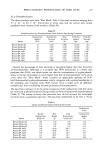
ANTIPERSPIRANT ACTION OF ALUMINUM SALTS 213 Figure 7a. Cross-section of an AZAP-treated eccrine sweat gland just above the dermal-epidermal junction. Plug material is nearly completely filling the duct's lumen (P: plug material W: sweat duct wall C: dermal collagen).
Purchased for the exclusive use of nofirst nolast (unknown)
From: SCC Media Library & Resource Center (library.scconline.org)