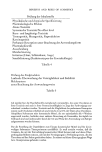
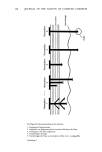
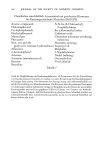
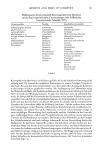
228 JOURNAL OF THE SOCIETY OF COSMETIC CHEMISTS PPD in man (10) and 61% for DAAin guinea pigs (11). These corrections would raise, somewhat, the excretional values reported. 2. SEMI-PERMANENT COLOR--HC BLUE //1 The radioactivity excretion data listed in Table VI indicate that the absorbtion values are of the same order of magnitude as those observed with p-phenylenediamine. This is in spite of substantial differences in the nature of the dye base, in the chemical structure of the dyes, and in the reaction pathways responsible for the color formation. Table VI Scalp Penetration of HC Blue #1 Under Practical Hair Dyeing Conditions. Species Radioactivity Radioactivity Dose Total Dye Total Dye Applied Excreted Excretion Applied Excreted (tzCi) (tzCi) (%) (tzg) (tzg) Rhesus Monkey if6 24 0.036 0.150 74,000 111.0 Rhesus Monkey #7 24 0.022 0.092 74,000 68.1 Rhesus Monkey #8 24 0.029 0.120 74,000 88.8 Human (frO, Male) 336 0.137 0.041 1,268,000 520 Human (#10, Male) 366 0.578 0.166 1,217,470 2,021 Human (#11, Male) 356 0.201 0.056 1,278,570 716 Similarity in the skin absorption pattern between permanent and semi-permanent dyes does not extend, however, to the deposition of these dyes in hair. With HC Blue #1, at least, the color yield in hair is much less than that obtained with either diaminoanisole or p-phenylenediamine (Table VII). Table VII Uptake of HC Blue #1 by Hair. Species Radioactivity in hair Specific Hair Total Radioactivity Radioactivity Weight Radioactivity applied /•Ci/g hair (g) in hair (vCi) (%) Human (frO, male) 0.56 32.02 17.92 5.3 Human (#10, male) 0.62 34.54 21.42 5.8 Human (#11, male) 0.63 37.40 23.56 6.6 DISCUSSION Two major points emerge from the results of our investigation. First, there is a striking equivalence in cutaneous absorption between Rhesus monkey and man. This parallels earlier findings by Wester, et al. (9) who noted a similar pattern with absorbtion of benzoic acid, testosterone and hydrocortisone. Secondly, less than 0.2% of applied dyes

PERCUTANEOUS PENETRATION OF HAIR DYES 229 penetrate through the scalp. The regional variation in percutaneous penetration in man has been well established the scalp is often a preferred site of penetration for several materials (12,13). The low levels of absorption observed here are in contrast to the much higher penetration values (0.7-2.5% of the applied dose) obtained recently (14) for one of the hair dye components (2,4-diaminoanisole) applied to the forearm. A closer look at the hair dyeing process suggests an explanation for the observed differences. Hair coloring relies on the deposition of the dye moiety within the hair structure. This can be accomplished only by diffusion of the dye into the hair. Assuming a uniform distribution of the dye mixture (a justifiable assumption in view of satisfactory performance of hair coloring products), the latter is spread on the hair and the scalp in the form of a thin film. The ratio of the surface area of hair to scalp can be thus viewed as a partition coefficient, governing the distribution of the dye mixture. In the case of Rhesus monkey, we determined this ratio as close to 100 (average hair surface area of monkeys in this study was 3100 cm 2 and that of the scalp was 32 cm2), and it is of the same order of magnitude (between 75-100) for humans. With uniform distribution of the coloring mixture, one can expect that only a small fraction (•1%) of the applied dose will be in contact with the skin of the scalp. If this area correction factor is taken into account, a close correlation becomes apparent between results of this study and the data generated earlier (14). REFERENCES (1) E. P. Frenkel and F. Brody, Percutaneous absorbtion and elimination of an aromatic hair dye, Arch. Envir. Health, 27,401-404 (1973). (2) E. Hruby, The absorbtion p-toluenediamine by the skin of rats and dogs, Cosmet. ToxicoL, 15, 595-599 (1977). (3) M. Nakao and Y. Takeda, Body distribution, excretion and metabolism of p-phenylenediamine in rats, J. Pharmaceut. Soc. Japan, 99:1149-1153 (1979). (4) E. Hruby, et al., Cutaneous resorption of 2,4-diaminoanisole in the rat and dog, SGAE Report//A0037, March 1979. (5) M. Kiese and E. Rauscher, The absorption of p-toluenediamine through human skin in hair dyeing, Toxicol. Appl. PharmacoL, 13, 325-331 (1%8). (6) H. I. Maibach, M. S. Leaffer, and W. A. Skinner, Percutaneous penetration following use of hair dyes, Arch. DermatoL, 111, 1444-1445 (1975). (7) R. S. Yare and M. Garcia, percutaneous penetration following use of hair dyes, Arch. Dermatol., 113, 161 (1977). (8) R.J. Feldman and H. I. Maibach, Percutaneous penetration of steroids in man, J. Invest. Derm., 52, 89-94 (1%9). (9) R. C. Wester, P. Noonan, and H. I. Maibach, Recent advances in percutaneous absorbtion using the rhesus monkey model,J. Soc. Cosmet. Chem., 30, 297-307 (1979). (10) R.J. Feldman and H. I. Maibach, Absorption of some organic compounds through the skin of man, J. Invest. Dermatol., 54, 399-404 (1970). (11) H. I. Maibach. Unpublished data. (12) R.J. Feldman and H. I. Maibach, Regional variation in percutaneous penetration of •4C cortisol in man,J. Invest. Dermatol., 48, 181-183 (1%7). (13) H. I. Maibach, R.J. Feldman, T. Milby, and U. Serat, Regional variation in percutaneous penetration in man, Arch. Envir. Health, 23,208-211 (1971). (14) H. I. Maibach, Percutaneous Penetration of Hair Dyes. Investigation sponsored by the FDA at the Medical School, UCSF, August, 1977.
Purchased for the exclusive use of nofirst nolast (unknown)
From: SCC Media Library & Resource Center (library.scconline.org)