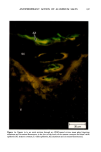
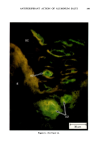
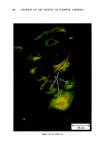
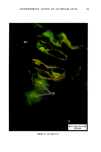
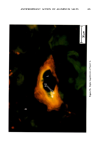
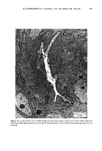
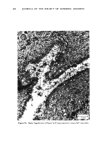
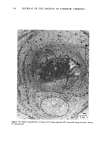
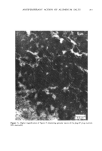
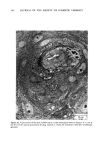
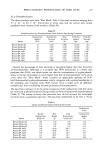
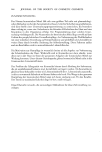
220 JOURNAL OF THE SOCIETY OF COSMETIC CHEMISTS Figure 10. Cross-section of an untreated eccrine sweat gland at the level of the stratum comeum (L: lumen).

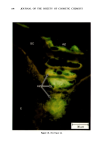
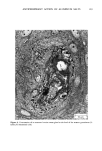
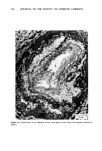
ANTIPERSPIRANT ACTION OF ALUMINUM SALTS 221 viable epidermis but were commonly found only at a very superficial level, in the sweat gland ostium. Histologically, from the standpoint of fluorescence microscopy studies, and particularly from those of TEM, these occlusive masses strongly resembled those which had been seen when the perspiration-inhibiting agent was ACH. However, the ultrastructure studies did not show occlusive masses as extensive as those which were demonstrated for ACH-inhibited glands, suggesting that the plug was very superficial. (An alternative is that the physical structure of an AZAP plug is more readily destroyed by the procedures used to prepare the tissue for TEM sectioning). From these observations, it is concluded that the mechanism of action by which AZAP inhibits eccrine sweat gland function is quite similar to that which has been described for ACH, namely that the antiperspirant forms a plug within the sweat duct that blocks the flow of sweat. Both tape-stripping studies and ultrastructure microscopy have suggested that the location of this plug is relatively more superficial in the duct than is that of ACH, but that it can be as deep as 80-100/.tm in some instances. The mechanism of poral occlusion, perhaps by formation of a hydroxide gel as suggested by others (3), is now established for AZAP. However, these studies have not lent additional insight into one apparent paradox. TEM studies have shown the AZAP plug's presence to be very near the skin surface. However, it has been shown that AZAP's duration of antiperspirant activity is at least as long as four weeks (3), and our own studies (unpublished observations) indicate that ACH's activity disappears after about two weeks. If these observations are correct, then they would suggest that the structural integrity of the AZAP plug is greater than that of ACH. V. CONCLUSIONS Morin-fluorescence microscopy of AZAP-inhibited eccrine sweat glands demon- strated the presence of aluminum and zirconium in the duct in quantities sufficient enough to occlude the flow of sweat. The metals were found mainly in the intracorneal duct but frequently in the intraepidermal duct as well. Transmission electron microscopy showed occlusive masses at similar locations within the duct. AZAP's mechanism of action is similar to ACH's in that it forms a plug but the location of the AZAP plug is probably more superficial. VI. ACKNOWLEDGEMENT We are indebted to Morris Shelanski, M.D. of Products Investigations, Inc., Consho- hocken, Pa. for performing the biopsy procedures. REFERENCES (1) R. P. Quatrale, A. H. Waldman, J. G. Rogers and C. B. Felger, The mechanism of antiperspirant action by aluminum salts. I. The effect of cellophane tape stripping on aluminum salt-inhibited eccrine sweat glands,J. Soc. Cosmet. Chem., 32, 67-73 (1981). (2) R. P. Quatrale, D. W. Coble, K. L. Stoner and C. B. Felger, The mechanism of antiperspirant action by aluminum salts. II. Histological observations of human eccrine sweat glands inhibited by aluminum chlorohydrate,J. Soc. Cosmet. Chem., 32, 107-136 (1981).
Purchased for the exclusive use of nofirst nolast (unknown)
From: SCC Media Library & Resource Center (library.scconline.org)