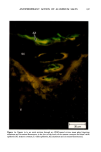
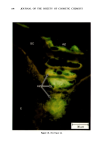
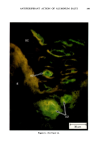
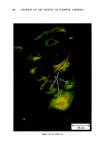
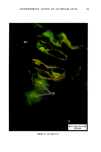
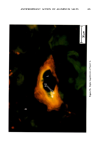
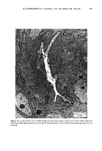
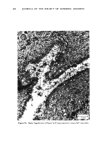
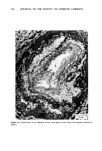
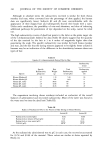
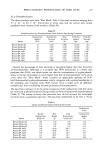
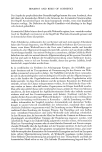
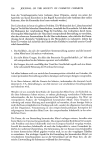
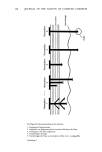
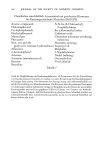
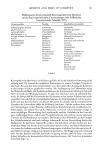
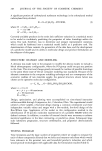
COMPUTERIZED DESIGN OF SURFACTANTS 251 These graphics are, of course, pictorial representations of the mathematical data within the computer model. Appropriate manipulations of these data produce maximum and minimum value structures for the full field of properties measured within the above given structural constraints. The prime value of these data is the enormous aid in molecular design leading to the synthesis of a surfactant of desirable properties for the formulator. Planar (or n-dimensional) interactions are readily available within the computer to generate the formula or formulae for any degree of performance of measured properties, including maxima and minima, with the only constraint being priority of parameters. IMPLEMENTATION--PROPERTIES BY DESIGN The utility of this new tool is best shown by the two examples which follow. In both cases, the eight measured properties are assembled into a hierarchy of most important property to least important, and importance is quantified by weighting factors. Various other desired qualities, such as ranges of property values acceptable, degree of value of one property versus the others, etc., are also considered. The data is processed, and results in the generation of a molecule which will theoretically have properties of desired values for the use intended. As one example, consider the search for a mild surfactant to serve as a fragrance solubilizing agent in a skin or hair care preparation. If we know the HLB of the fragrance, and if we assume the order of importance for such a surfactant to be: 1. HLB 2. Solubility 3. Wetting 4. Surface Activity 5. Foam 6. Cationic Interference 7. LSD (Hard Water Tolerance) 8. Detergency, by prioritizing characteristics as above, a computer-generated structure representing the optimization of these properties is obtained: Cz0H2zO(EO)0.483 (PO)0.348 (EO)0.369 CH2COOH. (IV) (77% carboxymethylation) Another example might be the design of a surfactant to be formulated in a soap/detergent bar. Here the order of importance of properties is assumed to be: 1. LSD 2. Foam 3. Solubility 4. Wetting 5. Surface Activity 6. Detergency 7. HLB 8. Cationic Interference, resulting in a structure such as:

252 JOURNAL OF THE SOCIETY OF COSMETIC CHEMISTS C•6 H,, O(PO)2.4 (EO)0.6 CH=COOH. (v) (83% carboxymethylation) Hence, permutations of these properties can lead to an almost infinite variety of molecules for specific and general end uses, literally at the push of a button. This rapid and effective response can serve a multitude of needs in various industries. SUMMARY A large scale, computer-generated statistical experimental design has been successfully applied to create a predictive tool for an homologous series of alkyl alkoxy methylcarboxylates. The rapid response time provided by this technique now affords the cosmetic/toiletries and household product industries with a source of surfactants of specific properties for their unique end uses. ACKNOWLEDGEMENT Greatly appreciated is the application data generation work by Barbara Shucoski, Chris Jaeger, and Octavia Renold the organic synthesis' efforts of Jack Braun and Toshie Shintani the computer data interpretation and modeling by Dr. Bob Casciani the graphics by Frank Hallett and Barbara Rizzo the initial concept development by Eric Buser and the overall support and leadership of Dr.J.W. Luthy and Chris Schouten.
Purchased for the exclusive use of nofirst nolast (unknown)
From: SCC Media Library & Resource Center (library.scconline.org)