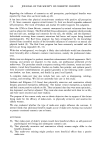
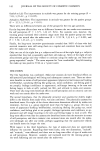
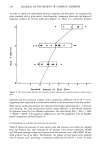
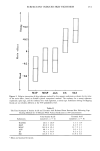
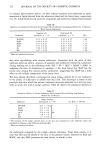
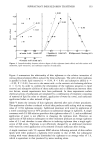
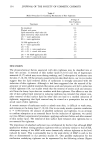
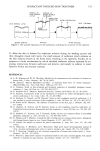
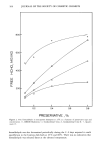
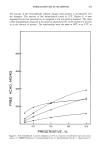
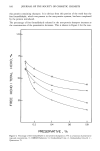
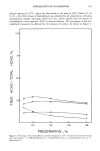
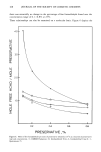
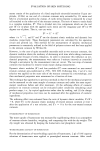
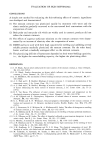
SURFACTANT INDUCED SKIN TIGHTNESS 15 5 REMOVAL OF REMOVAL OF SKIN SURFACE WATER SOLUBLE LIPIDS MATERIALS • I • SURFACTANT SKIN •DSORPTION WATER EVAPORATION SURFACE IIPID ! / • SKIN TIGH • I PERMEATION I I [ BEFORE WASHING WASHING AFTER WASHING Figure 5. One possible explanation •r the mechanism underlying the occurrence of skin tightness. 5): After the skin is defatted by surfactant solution during the washing process and then throughly rinsed with water, the small amount of surfactant which remains on the skin induces tension in the horny layer, resulting in the tightness. Studies are in progress to clarify mechanisms by which adsorbed surfactant induces tightness by an- alyzing interactions between surfactant and keratin, particularly in relation to water behavior within the stratum corneum. REFERENCES (1) A.M. Kligman and W. M. Woocling, Method for the measurement and evaluation of irritants on human skin, J. Invest. Dermatol., 49, 78-94 (1967). (2) W. Kaestner, "Mucous Membranes and Skin," in Surfactant Science Series 10: Anionic Surfactants. (Marcel Dekker, Inc., New York, Basel, 1980), pp 139-307. (3) G. Imokawa, Study on skin-irritating and biological properties of monoalkyl phosphate anionic surfactant, J. Amer. Oil Chem. Soc., 55, 839-843 (1977). (4) G. Imokawa and T. Takeuchi, Surfactants and skin, Cosmetics and Toiletries, 91, 32-46 (1976). (5) G. Imokawa, Comparative study on the mechanism of irritation by sulfate and phosphate type of anionic surfactants, J. Soc. Cosmet. Chem., 31, 45-66 (1980). (6) G. Imokawa, K. Sumura, and M. Katsumi, Study on skin roughness caused by surfactants. I. A new method in vivo for evaluation of skin roughness, J. Amer. Oil Chem. Soc., 52, 479-483 (1975). (7) M. Kawai and K. Okamoto, The influence of surfactants on the skin, Jap. J. Dermatol., 92, 465- 471 (1982). (8) G. Imokawa, K. Sumura, and M. Kastumi, Study on skin roughness caused by surfactants. II. Correlation between protein denaturation and skin roughness, J. Amer. Oil Chem. Soc., 52, 490-493 (1975). (9) G. Imokawa, H. Tsutsumi, and T. Kurosaki, Surface activity and cutaneous effects of monoalkyl phosphate surfactants, J. Amer. Oil Chem. Soc., 55, 839-843 (1977). (10) G. Imokawa and Y. Mishima, Cumulative effect of surfactants on cutaneous horny layers. Adsorption onto human keratin layers in vivo, Contact Dermatitis, 5, 357-366 (1979). (11) H. Scheff6, An analysis of variance for paired comparisons, J. Amer. Stat. Assoc., 47, 381-400 (1952). (12) K. Nakamura, Y. Morikawa, and I. Matsumoto, High speed liquid chromatographic analysis of citric, urocanic and pyroglutamic acids in cosmetic products, Jap. Analyst, 29, 314-318 (1980). (13) D. T. Downing, Variability in the chemical composition of human skin surface lipids, J. Invest. Dermatol., 53, 322-327 (1970). (14) E. Nieminen, Quantitative analysis of epidermal lipids by thin layer chromatography with special reference to seasonal and age variation, Acta Dermato. Venereol., 47, 327-338 (1967).

156 JOURNAL OF THE SOCIETY OF COSMETIC CHEMISTS (15) T. Abe, Studies of the relationship between skin surface lipids and transepidermal water loss, Jap. J. Dermatol., 86, 815-823 (1976). (16) J. F. Kirk, Effect of hand washing on skin lipid removal, Acta Dermato-venereologica, 57, 24-68 (1966). (17) G. Smeenk, The influence of detergents on the skin, Arch. Klin. Exp. Dermatol., 235, 180-191 (1969). (18) G. Imokawa, K. Sumura, and M. Katsumi, A correlation between adsorption of surfactant onto callus and skin-roughness caused by the surfactant, J. Jap. Oil Chem. Soc., 23, 17-23 (1974). (19) G. Imokawa, Monoalkyl phosphate, a new type of artionic surfactant--its detergency and cutaneous properties, Fragrance Journal, 9, 57-65 (1981).
Purchased for the exclusive use of nofirst nolast (unknown)
From: SCC Media Library & Resource Center (library.scconline.org)