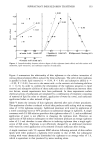
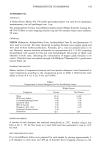
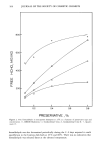
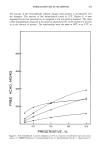
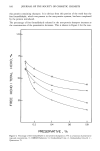
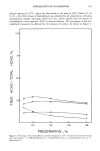
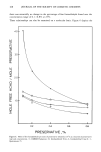
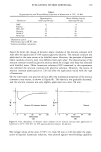
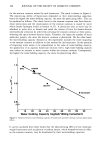
FORMALDEHYDE IN SHAMPOOS 169 moles of free formaldehyde released per mole of preservative at 23øC as a function of preservative concentration and type in the shampoo. DMDM Hydantoin and Imid- azolidinyl Urea each contain two methylol groups while Imidazolidinyl Urea II has four. The molar percentage of free formaldehyde found for these three materials is about the same over the concentration range studied. An average of 1.3 moles of free formaldehyde per mole of preservative was found at 0.1%. This represents 65% of the formaldehyde in DMDM Hydantoin and Imidazolidinyl Urea, but only 33% for Imidazolidinyl Urea II. The fact that only 33% of the bound formaldehyde present in Imidazolidinyl Urea II was found as free formaldehyde is based on the observation that only two of the four methylol groups are formaldehyde donors under the conditions of the Hantzsch reaction employed. The relationship of free molecular formaldehyde versus concentration for Quaternium 15 is analogous to DMDM Hydantoin and Imidazolidinyl Urea, even though Quater- nium 15 has six bound formaldehyde moities. At 0.1% concentration, four of the six formaldehyde moities are released, which is 66% of the total available. CONCLUSIONS The microdiffusion technique has been shown to be a reliable method for determining free formaldehyde in anionic shampoos containing formaldehyde-derived preservatives. The order of formaldehyde release is the same at 23øC and 60øC for the four preservatives studied: Imidazolidinyl Urea DMDM Hydantoin Imidazolidinyl Urea II Qua- ternium 15. The amount of free formaldehyde found in the presence of protein is reduced substantially, indicating a complexation between the protein and formalde- hyde. ACKNOWLEDGEMENT The authors wish to thank T. A. Girard, Vice President, Glyco Inc., for his assistance and guidance in this study. REFERENCES (1) C. H. Wilson, Fluorometric determination of formaldehyde in cosmetic products, J. Soc. Cosmet. Chem., 25, 67-71 (February 1974). (2) E. P. Sheppard and C. H. Wilson, Fluorometric determination of formaldehyde-releasing cosmetic preservatives,J. Soc. Cosmet. Chem., 25, 655-666 (December 1974). (3) D. H. Liem, Analysis of antimicrobial compounds in cosmetics, Cosmetics and Toiletries, 92, 59-72 (March 1977). (4) Identification and determination of free formaldehyde, Official Journal of the European Communities, L 185/18 (June 6, 1982). (5) M. I. Feldman, Determination of free formaldehyde in the presence of its compounds with amino acids and proteins, Biochemistry, 23, 867-872 (1958). (6) M. Tanenbaum and C. E. Bricker, Microdetermination of free formaldehyde, Analytical Chemistry, 23, 354-357 (February 1951).

j. Soc. Cosmet. Chem., 35, 171-181 (May/June 1984) A new method to evaluate the softening effect of cosmetic ingredients on the skin MOTOJI TAKAHASHI, MASAMI YAMADA, YASUHIKO MACHIDA, Shiseido Laboratories, 1050 Nippa-cho, Kohoku-ku, Yokohama, Japan 223, and YUKIO TSUDA, Department of Legal Medicine, Yokohama City University School of Medicine, Yokohama, Japan 232. Received August 11, 1983. Synopsis An apparatus was developed for measuring the changes of rheological properties of the stratum corneum with time when cosmetic ingredients were applied. By using this instrument, skin softening effects were evaluated from the ratio of dynamic elastic moduli before and after treatment. The extent of plasticization of the stratum corneum by aqueous humectant solutions varied depending on their water-holding capacities. It was determined that the higher the water-holding capacity, the more the plasticizing effect. Furthermore, the effects of water, liquid oil, surfactants, and protein denaturing agents on stratum corneum softening were examined. Although the stratum corneum was immediately softened by the application of water, the elastic modulus gradually recovered to the non-treated level as water evaporated. On the other hand, the mechanical properties were not affected at all by the application of polar or non-polar oils which are widely used in cosmetic products. It was also found that dimethyl sulfoxide (DMSO) and lactic acid markedly plasticized the stratum corneum and that the effect of surfactant solution was characterized by an increase of elasticity even after water evaporated. INTRODUCTION The mechanical properties of the stratum corneum and their relationship to water con- tent have been extensively investigated, and it is well known that the flexibility of the stratum corneum depends on its content of water and hygroscopic substances (1-6). However, most of the previous studies have been concerned with an extension method which has some shortcomings in evaluating softening effects of topical moisturizer on stratum corneum. First, it must be considered that in these experiments the mechanical properties could not be measured on the same stratum corneum before and after treatment. The results from the one sample of stratum corneum may not be compared directly with the results from another since no two stratum corneum samples have the same cross-sectional area. Secondly, this method has the disadvantage that the change of mechanical properties with time could not be examined sequentially after the application of cosmetic ingre- dients to the stratum corneum. Lastly, these experiments have the disadvantage that the test samples of stratum corneum must be soaked in a solution to examine the effects 171
Purchased for the exclusive use of nofirst nolast (unknown)
From: SCC Media Library & Resource Center (library.scconline.org)