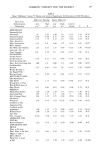
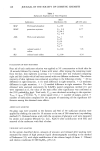
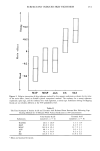
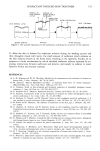
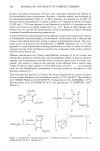
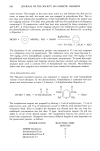
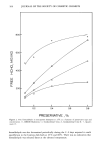
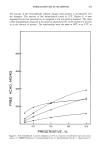
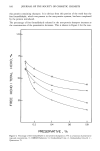
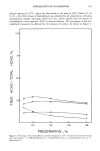
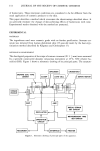
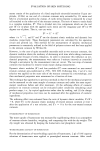
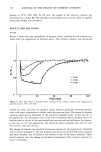
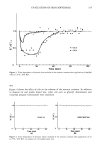
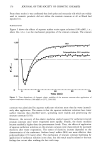
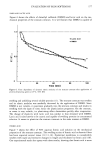
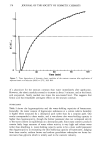
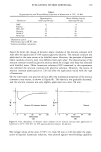
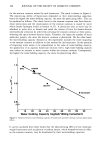
172 JOURNAL OF THE SOCIETY OF COSMETIC CHEMISTS of humectants. These treatment conditions are considered to be far different from the usual application of cosmetic products to the skin. This paper describes a method which overcomes the shortcomings described above. It can precisely estimate the change of skin-softening effects of humectants with time. Experimental results obtained with the method are presented. EXPERIMENTAL MATERIALS The ingredients used were cosmetic grade with no further purification. Stratum cor- neum was removed from human abdominal skin (35-year-old male) by the heat-tryp- sinization method described by Kligman and Christophers (7). MECHANICAL MEASUREMENT The rheological properties of the strips of stratum corneum (20 X 3 mm) were measured by a specially constructed dynamic measuring instrument at 25øC, 50% relative hu- midity (RH). Figure 1 shows a schematic drawing of its principal parts. The measure- MOVING COIL TYPE SPECIMEN I CROSSHEMOTORSERVO 1 - \ RECORDER INITIAL STRAIN SET CIRCUIT OPERATION CIRCUIT MEASUREMTIMECIRCUITSET PRINTER Figure 1. Schematic drawing of principal parts of the apparatus.

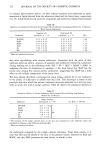
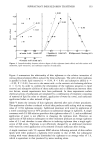
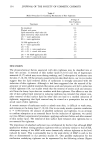
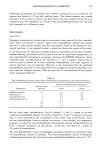
EVALUATION OF SKIN SOFTENING 173 ments consist of the application of a fixed amplitude sinusoidal extension (5 I•m am- plitude, 30 Hz) on one end of a stratum corneum strip extended by 1% strain and held in a horizontal position by clamps. A cyclic stress response is measured by a load cell attached to the other end of the stratum corneum. The ratio of stress to strain leads to a complex modulus, E*. This is divided into two components which are the real part (E') or in-phase with the applied cyclic strain and the imaginary part (E") or 90 degrees out-of phase. That is, one can write E* = E' + iE" where i is X/-1, and E' and E" are the dynamic elastic modulus and dynamic loss modulus, respectively. These rheological parameters are calculated by the operation circuit and printed out. This method for the measurement of dynamic mechanical parameters is extensively utilized in the field of polymer science and has been applied to the stratum corneum by Wilkes (8). However, in the case of quite extensible materials such as wet stratum corneum, the dynamic modulus shows the tendency of decreasing with time while taking continuous measurement because of stress relaxation. In order to minimize this influence on me- chanical properties, the measurements were taken at 3-minute intervals as controlled through a servomotor by the measurement time set circuit. The test strip of stratum corneum was slackened to remove strain except during measurement. Dynamic elastic modulus (E') and loss modulus (E") were measured on non-treated stratum corneum pre-conditioned at 25øC, 50% RH. Following this, 2 I•1 of a test solution was applied on the outer side of the stratum corneum by a microsyringe, and then mechanical properties were remeasured as a function of time. This technique has superiority to previous methods in that (1) the mechanical properties can be measured on the same sample of stratum corneum and under the same experi- mental conditions before and after treatment, (2) the softening effects of cosmetic products on stratum corneum can be evaluated under conditions simulating usual product usage, i.e., by topical application rather than by soaking, and (3) the change of mechanical properties over time can be examined after the application of cosmetic ingredients. The softening effect was evaluated from the ratio of dynamic elastic modulus, E't/E't =0, where E't is the dynamic elastic modulus of treated stratum corneum at time t after the application of a test solution, and E't = 0 is for the non-treated stratum corneum. HYGROSCOPICITY OF HUMECTANTS The water uptake of humectants was measured by equilibrating them in an atmosphere of constant relative humidity, weighing, and comparing this with the dry weight. The dry weight was obtained by keeping the humectants over phosphoric oxide. WATER-HOLDING CAPACITY OF HUMECTANTS For the determination of water-holding capacities of humectants, 2 I•1 of 10% aqueous solutions of humectants were applied to preweighed stratum corneum. After condi-
Purchased for the exclusive use of nofirst nolast (unknown)
From: SCC Media Library & Resource Center (library.scconline.org)