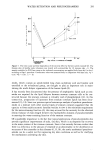
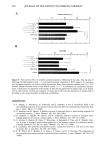
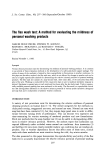
J. Soc. Cosmet. Chem., 40, 297-306 (September/October 1989) The flex wash test: A method for evaluating the mildness of personal washing products DARCEE DUKE STRUBE, STEPHEN W. KOONTZ, RICHARD I. MURAHATA, and RICHARD F. THEILER, Unilever Research United States, Inc., 45 River Road, Edgewater, NJ 07020. Received November 1, 1988. Synopsis Various clinical procedures exist for determining the mildness of personal washing products. It is common to use several of these evaluation methods in the development of a safety-and-claim support package. The utility of many of the methods is limited by their susceptibility to fluctuations in weather conditions. In this paper we describe a method, the flex wash test, which is not affected by changes in weather and can be used as a highly reproducible method for determining the relative irritancy potential of personal washing products. The flex wash test consists of a sixty-second wash, three times daily, of the antecubital fossa (flex area) of the arm. Washing is conducted for five consecutive days or until a moderate erythemic response is elicited. Erythema is assessed prior to each wash and four hours after the last daily wash. Twelve commer- cially available personal washing bars were evaluated in this study. The flex wash is a reproducible clinical test that distinguishes differences in the relative irritancy potential of various syndet (synthetic detergent) and soap bars and is independent of ambient weather conditions. INTRODUCTION A variety of test procedures exist for determining the relative mildness of personal cleansing products on human skin (1-4). The overall categories for the methods in- clude patch testing, exaggerated use tests, and normal use tests. Normal use tests with soap bars have been conducted (1), but they require large panel sizes in order to differ- entiate between varying levels of performance. This can become very expensive and time-consuming for routine screening of marketed products and new formulations. Patch test methods like the soap chamber test (2) can be useful in distinguishing differ- ences in relative irritancy potential. However, the authors report that surfactants can respond differently under occluded versus normal use conditions. Arm immersion (3) and half-face (4) tests more closely resemble realistic use conditions but are weather-de- pendent. Due to weather dependency factors that affect most of these tests, clinical trials with these methods are most sensitive during the cold, dry winter months. The data presented in this paper demonstrate the reproducibility and utility of the flex wash test to accurately discriminate the relative irritancy potential of personal washing 297

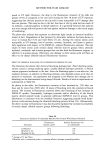
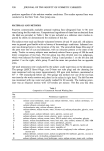
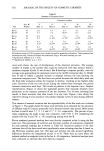
298 JOURNAL OF THE SOCIETY OF COSMETIC CHEMISTS products regardless of the ambient weather conditions. The studies reported here were conducted in the New York-New Jersey area. MATERIALS AND METHODS Fourteen commercially available personal washing bars (designated bars A-N) were tested using the flex wash test. Compositional ingredients of these bars as obtained from the label are provided in Table I. Bar A was included as a reference since studies re- ported by others (2) demonstrated the mildness of this bar. The subjects were male and female volunteers between 20 and 55 years old. All subjects were in general good health with no history of dermatologic conditions. Informed con- sent was obtained prior to the initiation of the test. The antecubital fossae (flex area) of the arms were free of cuts and abrasions, with no irritation present at the onset of the study. Twelve to twenty subjects were randomly selected from a group of 200 for each direct comparison of two bars. The test group was then divided into two subgroups, which were balanced for hand dominance. Group I used product 1 on the left arm and product 2 on the right, while group II used the same two products but on opposite arms. All wash treatments were conducted by the subject under supervision in the laboratory. The sponge (JAECE Identi-Plugs, size D foam test tube plug) and the cleansing bar were moistened with tap water (approximately 100 ppm total hardness, maintained at 92 ø ___ 4øF) immediately before use. The sponge was stroked over one of the test bars ten times by the study monitor and placed in the subject's right hand. The left flex area was moistened with tap water and gently washed for 60 seconds. The washing proce- dure was an elliptical motion with 120 strokes per minute. The flex area was then Table I Composition of Commercial Personal Washing Bars Bar code Predominant ingredients E F G H I J K L M N sodium cocoyl isethionate, stearic acid, sodium tallowate, water, sodium isethionate, co- conut acid, sodium stearate sodium tallowate, potassium soap, water triethanolamine soap, sodium tallowate, glycerin sodium talowate, sodium cocoate, water, coconut acid, sodium polyacrylate, glycerin, cocoa butter sodium cocoate, sodium tallowate, water, glycerin, coconut acid sodium tallowate, sodium cocoate, glycerin, water, coconut acid sodium tallowate, sodium cocoate, water, PEG-6 methyl ether, triclocarban, glycerin dextrin, sodium laurylsulfoacetate, water, boric acid, urea, sorbitol, mineral oil, PEG-14M sodium tallowate, sodium cocoate, water, petrolatum, glycerin sodium tallowate, sodium cocoate, water, mineral oil, PEG-75, glycerin, lanolin oil sodium tallowate, sodium cocoate, water, vegetable oil sodium tallowate, sodium cocoate, water, sodium cocoglyceryl ether sulfonate, glycerin, coconut acid sodium tallowate, sodium cocoate, sodium cocoglyceryl ether sulfonate, glycerin, coconut or palm kernal acid, triclocarbon, polyquaternium-7 sodium tallowate, sodium cocoyl isethionate, water, sodium cocoate, stearic acid, triclosan
Purchased for the exclusive use of nofirst nolast (unknown)
From: SCC Media Library & Resource Center (library.scconline.org)