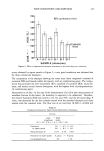
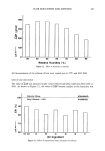
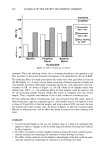
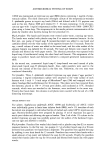
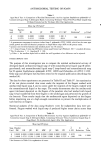
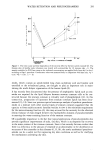
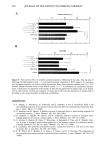
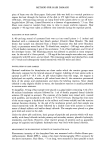
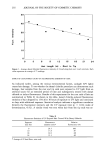
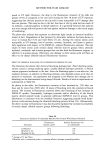
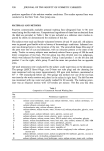
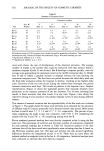
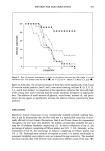
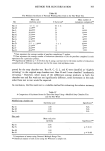
METHOD FOR SKIN IRRITATION 305 Table III The Mildness Attributes of Personal Washing Bars Used in the Flex Wash Test Mean total Mean number of Bar erythema score % Survivors* evaluations completed** BarA 5.7 -+ 1.2 93 -+ 6 19 Bar H 11.0'** 83 18 Bar L 18.4'** 31 14'** Bar C 20.4*** 26 14'** Bar K 25.4*** 15 7*** Bar E 24.4*** 12 12'** Bar G 27.8*** 12 8*** Bar J 26.1'** 7 9*** Bar B 27.7 + 2.0*** 5 -+ 3 10'** Bar I 27.6*** 0 9*** Bar F 28.6*** 0 8*** Bar D 29.4*** 0 7*** * Data represents the average number of panelists completing 15 washes. ** Data represents the average number of evaluations (maximum of 20) the panelists completed in each experiment for a particular product. *** Significantly different (p 0.05) from bar A using a survival test for the mean number of evaluations completed and a Wilcoxon matched pair test for the mean total erythema scores. ported for the soap chamber test. Bars B, C, G, J, and K were classified as "slightly irritating" in the original soap chamber test. Bars H and I were classified "moderately irritating." However, while many of the differences among products in both the chamber test and flex wash are not significantly different, some movement in the rank order from test to test would be expected. In conclusion, the flex wash test is a reliable method for evaluating the relative irritancy Table IV A Comparison of Erythema Scores for Three Bar Soaps Using a Modified Soap Chamber Test and the Flex Wash Modified soap chamber test Erythema score Significance* Bar G 1.09 N.S. Bar M 1.09 N.S. Bar N 0.94 N.S. Flex wash Mean end point erythema Significance** Bar G Bar N Bar M Bar N 5.83 2.2O p • 0.01 1.69 1.18 p • 0.08 * Comparisons of means using Duncan's Multiple Range Test. ** Statistical analysis of rank scores using the Wilcoxon 2 sample test.

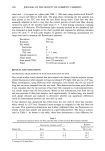
306 JOURNAL OF THE SOCIETY OF COSMETIC CHEMISTS potential of personal washing products. The test is reproducible across a range of local seasonal variations. Product testing, as performed in the flex wash test, allows natural lather development from the bar and closely mimics product concentrations during home usage. Subject compliance is excellent since use of the flex area allows the panelist to follow a normal cosmetic and skin care regimen on the face and hands. The method is useful as a screening test when evaluating mild surfactants and other mildness agents, with directionality evident by the third day of the test. While the test has been de- signed to discriminate small differences in irritation potential, it lacks the ability to separate products based upon dryness. ACKNOWLEDGMENTS The authors wish to thank Ms Joan Barrows and Ms Dolores Borowski for their tech- nical expertise, and Dr. Gary Grove for his consultation in the statistical analysis of the data. REFERENCES (1) S. H. Peck, J. Morse, T. Cornbleet, E. Mandel, and I. Kantor, Soap--Neutral vs alkaline, Skin, 1, 261 (1962). (2) P. Frosch and A.M. Kligman, The soap chamber test--A new method for assessing the irritancy of soaps,J. Am. Acad. Dermatol., 1, 35-41 (1979). (3) J. D. Justice, J. J. Travers, and L. J. Vinson, Testing detergent mildness, Soap Chem. Specialties, 37(8), 53-56 (1961). (4) P. J. Frosch, "Irritancy of Soaps and Detergent Bars," in Principles of Cosmetics for the Dermatologist, P. Frosch and S. N. Horwitz, Eds. (C. V. Mosby Co., St. Louis, 1982), pp. 5-12. (5) M. F. Lukacovic, F. E. Dunlap, S. E. Michaels, M. O. Visscher, and D. D. Watson, Forearm wash test to evaluate the clinical mildness of cleansing products, J. Soc. Cosmet. Chem., 39, 355-366 (1988). (6) S. W. Babulak, L. D. Rhein, D. D. Scala, F. A. Simion, and G. L. Grove, Quantitation of ery- thema in a soap chamber test using the Minolta Chroma (Reflectance) Meter: Comparison of instru- mental results with visual assessments, J. Soc. Cosmet. Chem., 37, 475-479 (1986). (7) G. L. Grove, personal communication.
Purchased for the exclusive use of nofirst nolast (unknown)
From: SCC Media Library & Resource Center (library.scconline.org)