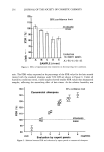
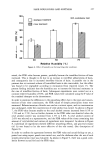
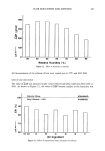
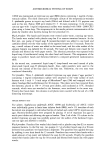
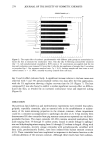
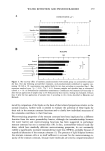
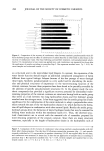
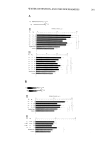
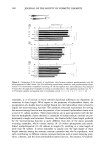
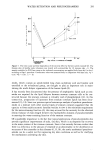
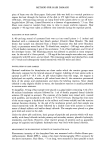
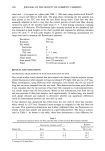
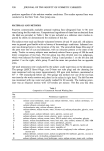
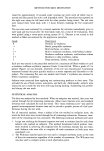
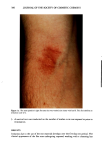
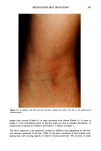
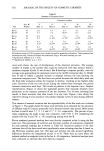
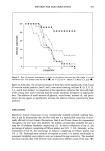
METHOD FOR SKIN IRRITATION 303 80, 100 20- 0 0 • 10 EVALUATION 15 20 Figure 2. Rate of irritation development is shown as the percent survivors (less than Grade 2) at each evaluation time. The product codes are bar H (I) bar C (A) bar B--March ((2)) March (C)), July (O). Based on these data, the irritancy potential of these bars varied significantly: bars A and H were the milder products bars C and L were more irritating and bars B, D, E, F, G, I, J, and K were harsher. A comparison of the ingredients indicates that bars with high levels of soap were more irritating than the syndet (synthetic detergent) or soap/syndet bars. The addition of small amounts of glycerin, cocoa butter, mineral oil, and petro- latum did not appear to significantly decrease the relative irritancy potential for these products. DISCUSSION Repetitive clinical evaluations of two commercially available personal washing bars, bars A and B, demonstrate that the flex wash test is a reproducible assay that is mini- mally affected by local climatic fluctuations. Bars A and B were chosen for comparisons throughout the year since they represent the mildest commercially available bar and a soap bar of moderate harshness, respectively (2). In eleven evaluations of bar A, the percentage of subjects completing all fifteen washes was 93% -+ 6%. Similarly, in five evaluations of bar B, the percentage of subjects completing all fifteen washes was 5% -+ 3%. Although some variation of response occurred, it is mainly attributable to interpanel variability since subjects were not screened for soap sensitivity. The standard deviation was less than 10% between tests conducted at different times of the year. We

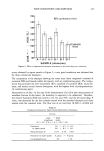
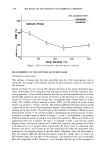
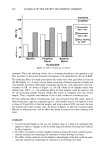
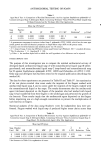
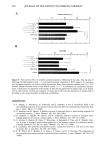
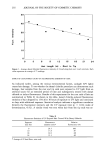
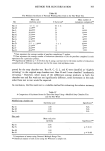
304 JOURNAL OF THE SOCIETY OF COSMETIC CHEMISTS 32•, JAN MAR APR JUN JUL AUG OCT NOV mONTHS Figure 3. Seasonal comparisons of mean total irritation scores during various months are shown for bar A (solid) and bar B (crosshatch). believe the test method reduces the influences of stratum corneum hydration and turn- over due to the sponge application procedure and therefore makes the test less weather- dependent. We have found that the flex wash is capable of significantly discriminating between milder cleansing systems than is typically achievable with a chamber test. This result is illustrated in Table IV, which compares the relative differences observed for the flex wash and a modified soap chamber test (6) for three soap bars. Using the flex wash one observes statistically significant differences that are not seen using a modified soap chamber test. Furthermore, the modified soap chamber test is reported to be as sensitive as the test previously designed by Frosch and Kligman (7). Current trends to develop milder active systems for personal cleansing and the ability to more easily discriminate between these formulations is an important aspect of any clin- ical testing regime. We find that the flex wash is capable of discriminating smaller differences in irritation potential, while good correlation to the soap chamber test can be found when the differences in irritation potential for two products are large (e.g., soap versus syndet bars). As an example, in these studies we chose bar A as a reference standard since Frosch and Kligman demonstrated that this product was the mildest of 18 bars tested in the soap chamber test (2). Utilizing the flex wash, bar A was also found to be superior in mild- ness to the eleven bars tested, which in overall terms correlates well with results re-
Purchased for the exclusive use of nofirst nolast (unknown)
From: SCC Media Library & Resource Center (library.scconline.org)