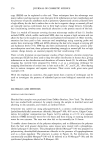
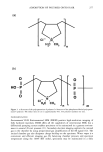
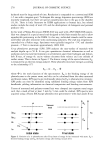
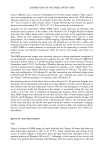
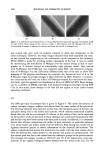
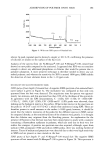
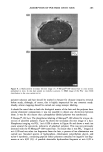
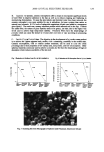
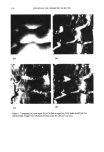
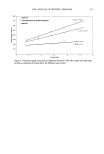
ADSORPTION OF POLYMER ONTO HAIR 285 (a) (b) 60.0, PO 2- ainu = Figure 8. a: Backscattered secondary electron image of a P-Merquat©-100-treated hair in cross section embedded in resin. In this hair sample no medulla is present. b: SIMS image of the PO 2- (m/z 63D) distribution in the cross section in (a). polymer solution and hair should be washed in hexane for siloxane impurity removal before study, although, of course, this is highly impractical for any cosmetic study. Ideally, silicon mapping should be carried out using isotopic labeling. It should be noted that as both the biological matrix of the hair and the polymer have similar elemental compositions it was not possible to obtain any distinction between them. It was for this reason that a phosphorus-labeled polymer was synthesized. P-Merquat©-100 hair. The phosphorus labeling of Merquat©-100 allows for unique de- tection of adsorbed polymer. Figure 8a shows the secondary electron image of a hair. Phosphorus imaging via PO 2- (m/z 63D) is shown in Figure 8b and shows a weak ion count around the epicuticle, indicative of adsorbed polymer. This was not previously detected with the N-Merquat©-100-coated hair. To ensure that it was PO 2- imaged at m/z 63D and not other ion fragments from the hair, a process of ion elimination was carried out. Standard spectra of hydrocarbon, chlorinated, polyethylene glycol, and nylon-6 (synthetic, containing peptide links) polymers contained no negative ion frag- ments at m/z 63D (23). A possible detectable hydrocarbon fragment at m/z 63D is

286 JOURNAL OF COSMETIC SCIENCE C5H3-, but due to the high bond order, this is unlikely. Indeed, an image taken at m/z 65D to map for the similar CsH 5- ion showed virtually zero ion count over the resin and hair. It can therefore be concluded that SIMS has the ability to detect adsorbed mac- romolecules on the surface of hair. CONCLUSIONS Results have shown how these three techniques can be combined to give significant information on the adsorption of polymer onto hair indeed this can be extended to the adsorption of most other adsorbates onto biological materials such as hair, nails, tissue, teeth, or skin. SIMS allowed direct surface analysis and was capable of detecting adsorbed polymers on the hair's surface. Although direct detection could only be obtained using SIMS, XPS has the ability to define the chemical environment or oxidation state of the elements at the surface of the hair. These surface elements may be part of the hair's biological matrix, surface contaminants, or adsorbate molecules at a particularly high concentration. The recent advancement of ESEM has allowed biological materials such as hair to be studied without the prerequisite of high vacuum, and therefore the behavior of hair can be observed under ambient and hydrated environments. ACKNOWLEDGMENTS The authors would like to thank Jeremy Hooper, Dave Greenhill, and Martin Taylor of Imerys for useful discussions and assistance with experimental work and sample prepa- ration. REFERENCES (7) (8) (9) (10) (1) C. R. Robbins, Chemical and Physical Behaviour of Human Hair, 3rd ed. (Springer-Verlag, New York, Berlin, Heidelberg, 1994). (2) R. E. Cameron, Environmental scanning electron microscopy in polymer science, TRIP, 2, 116-120 (1994). (3) J. R. Smith, Use of atomic force microscopy for high resolution non-invasive structural studies of human hair, J. Soc Cosmet. Chem., 48, 199-208 (1977). (4) J. R. Smith, A quantitative method for analysing AFM images of the outer surfaces of human hair, J. Microscopy, 191, 223-228 (1998). (5) P. HSssel, D. I. R. Sander, and W. Schrepp, Scanning force microscopy: Researchers describe how they use this technology to examine hair treated with cationic polymers, Cosmet. Toilerr., 111, 57-65 (1996). (6) S. D. O'Connor, K. L. Komisarek, and J. D. Baldeschwieler, Atomic force microscopy of human hair cuticles: A microscopic study of environmental effects on hair morphology, J. Invest. DermatoL 105, 96-99 (1995). R.L. Schmitt and E.D. Goddard, Investigation into the adsorption of cationic polymers, Cosmet. Toilerr., 109, 83-93 (1994). E.D. Goddard and R.L. Schmitt, Atomic force microscopy investigation into the adsorption of cationic polymers, Cosmet. Toilerr., 109, 55-61 (1994). P. Hallegot and P. Corcuff, High spatial resolution maps of sulphur from human hair sections: An EELS study, J. Microscopy, 172, 131-136 (1993). G. Gillen, S. Roberson, C. Ng, and M. Stranick, Elemental and molecular imaging of human hair using secondary ion mass spectrometry, Scanning, 21, 173-181 (1999).
Purchased for the exclusive use of nofirst nolast (unknown)
From: SCC Media Library & Resource Center (library.scconline.org)