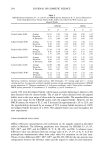
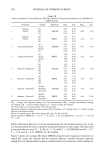
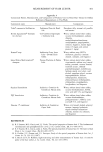
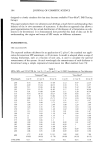
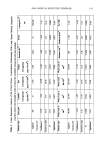
290 JOURNAL OF COSMETIC SCIENCE (DE) were used in order to characterize the hair color/luster alterations after cosmetic and other treatments. EXPERIMENTAL MATERIALS Hair samples. Several tresses of virgin dark-brown and black hair were obtained from Ind. Com. de Cosm6ticos Natura Ltda, Itapecerica da Serra/SP, Brazil. Hair samples were cleaned by 8 h extraction in ethyl ether in a soxhlet and rinsed in distilled water prior to use. The tresses were oriented from root to tip end, and tied near the root end, combed, and stored in a desiccator. The tresses were kept in the instrument room 24 h before the measurements in order to attain humidity equilibrium. Table I shows some features of the tresses used. Cosmetic products and formulations. The following commercial products and formulations were used in this work: Rexona © soap, Tabu © commercial brilliantine, Revlon Aqua- marine © shampoo for dry hair, Neutrox © conditioner, L6real Els•ve Multivitaminas © shampoo, and standard and PQ7 formulations. The manufacturers and composition of these products are shown in Appendix A. Instrument. The diffuse reflectance measurements were made using a diffuse reflectance spectrophotometer, Macbeth Color-Eye 2020. The diffuse reflectance spectrophotometer viewing conditions involve an integrating sphere, a hollow metal sphere inches in diameter and painted white inside. An integrating sphere collects all light reflected from the surface of a sample placed against an opening in its side. Provision is usually made for including and excluding that part of the light reflected in a specular direction from a sample. The measurements were done while keeping the same tress region and turning the hair tress sample in the instrument sample holder. The instrument operation con- ditions were (a) configuration CRIIS (C: ceramic calibration, R: reflectance, I: ultraviolet waves, I: specular component, S: short viewing aperture) and (b) D65 illuminant. Spectra rendered values of L* (lightness of the color), a* (redness if positive coordinate or greenness if negative coordinate), b* (yellowness if positive coordinate or blueness if negative coordinate) from the CIELAB system and X (coordinate x), Y (coordinate y), Z (coordinate z) from the FMCII system. From these, the calculated parameters were DL*, DL (lightness difference), DC*, DC (chromaticity difference), and DE*, DE (color difference), for the CIELAB and FMCII systems of equations, respectively. Table I Virgin Hair Sample Characteristics as Visually Observed/Tress Sample Denomination and Correlated Experiment Hair characteristics Tress sample Experiment Less damaged dark-brown hair (25 cm) More damaged dark-brown hair (20 cm) Less damaged black hair (15 cm) D-B1, D-B2, D-B3 DD-B1, DD-B2, DD-B3 B1, B2, B3, B4, B5 Experimental optimization, color-parameters evaluation Cumulative treatments: standard and PQ7 formulations Internal and external references, statistical analyses

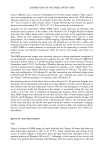
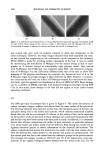
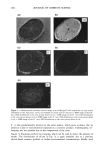
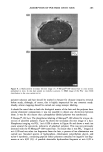
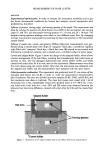
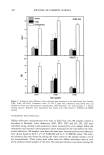
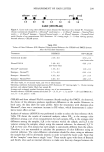
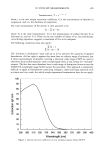
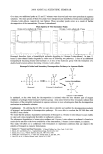
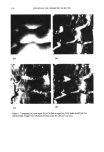
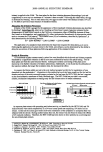
MEASUREMENT OF HAIR LUSTER 291 METHODS Experimental optimization. In order to evaluate the instrument sensibility and to get the better instrumental conditions for human hair samples, several equipments were performed as described. Influence of position, viewing angle, and viewing aperture of the sample. This experiment was done by varying the position of a dark-brown tress (D-B) in the instrument, the viewing angle (2 ø and 10ø), and the sample-viewing aperture (5 x 10 mm and 20 x 10 mm). The sample-viewing aperture readings were taken in two different ways: first, by changing the hair tress position, and second, by retaining the hair tress position in the instrument sample holder. Influence of sample color, texture, and geometry. Diffuse-reflectance measurements were per- formed using a smooth plate with drops of "nanquim" black dye, a cylindrical capillary tube filled with "nanquim" black dye, a black hair tress (B) treated or not treated with brilliantine (cylindrical surfaces), and a smooth and a wrinkled surface of green paper. Current and adapted holder. Figure 1 shows the design of the adapted holder, which allows a better arrangement of the hair fibers, avoiding hair entanglement that could cause an increase in error. The less damaged dark-brown hair tresses (D-B1, D-B2, and D-B3 cleaned with ethyl ether for 8 h) were used in this experiment. Measurements were done first with tresses using the current holder. After that, the instrument was calibrated with the adapted hair holder and the measurements were repeated with the same tresses. Color parameter evaluation. This experiment was performed with 25-cm tresses of less damaged dark-brown hair (D-B), in order to verify the measurement reproducibility after treatments. The tress was divided into three samples (D-B1, D-B2, and D-B3), and the treatments were done in triplicate. The clean hair tresses were rinsed with 1 ml of the product for 2 min, immediately rinsed with distilled water at 35ø-40øC for 1 min, and dried with a hair drier for 1 min. DE* and DE values were obtained between the reference hair tress (zero difference, cleaned with ethyl ether for 8 h) and the treated hair tress. Adapted holder _•.,•. ' . _ • ' ' : •: .... -- •. ,d•.d. -' '.• • • • ':•.• :• • ': .•'• •'•' '• ,' • •- '•:-0:• -•:• ::'•'•: ß ' C•ent hold• Figure 1. Illustration of the adapted holder used in the diffuse-reflectance measurements aperture
Purchased for the exclusive use of nofirst nolast (unknown)
From: SCC Media Library & Resource Center (library.scconline.org)