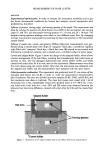
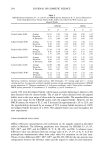
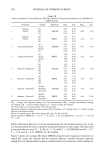
292 JOURNAL OF COSMETIC SCIENCE Cumulative treatments. In this experiment a more damaged dark-brown (DD-B) hair tress was treated with two different formulations obtained from Ind. Corn. Cosm•ticos Natura Ltda., Itapecerica da Serra/SP, Brazil. The tress was divided into three samples (DD-B1, DD-B2, and DD-B3) and rinsed with 1 ml of the formulation for 2 min, washed with water at 40øC for 1 min, combed, and left to dry at room temperature for 3 h before the measurements. This procedure was repeated four times every two days. After thirty days the fifth washing and measurements were done. Treated hair was stored in a desiccator during the intervals. Influence of reference (zero difference) and statistical analyses. The aim of this ex- periment was to evaluate the use of an external or an internal reference (zero difference) to calculate the color difference parameters. A less damaged black hair (B) tress was cleaned by extraction in ethyl alcohol for 8 h (external reference), divided into five samples of 2 g (B1, B2, B3, B4, and B5), and extracted again in commercial ethanol for 8 h. Table II shows the treatments that were done on the samples. RESULTS AND DISCUSSION EXPERIMENTAL OPTIMIZATION Position, viewing angle, and viewing area of the sample. These measurements were done to find the better instrumental operating conditions for human hair samples. Table III shows the average results of L*, a*, and b* parameters obtained with different instru- mental configurations. As observed in Table III, there is no significant difference among the average color values for sample position, viewing angle, and viewing aperture. Based on these results, the following instrumental conditions were chosen for the next experi- ments: horizontal position, a viewing angle of 10 ø, and a viewing aperture of 5 x 10 mm. Influence of sample color, texture, and geometry. The next step was to evaluate the instru- mental sensitivity for samples of different color, texture, and geometry, including or excluding the specular component, as shown in Table IV. As expected, the exclusion of Table II Treatments in Less Damaged Black Hair (B) Samples Samples Treatments B1 B2 B3 B4 B5 Ethanol PA/8 h, ethanol commercial/8 h, and Neutrox © conditioner Ethanol PA/8 h, ethanol commercial/8 h (a), ethanol PA/8 h, and ethanol commercial/8 h (b) Ethanol PA/8 h, Neutrox © conditioner, ethanol commercial/40 min, shampoo + Neutrox © 1 ø (first wash), shampoo + Neutrox © 2 ø (second wash), and shampoo + Neutrox © 3 ø (third wash) Ethanol PA/8 h + Neutrox © conditioner Ethanol PA/8 h + Neutrox © conditioner Operating conditions: D65 illuminant, 10 ø viewing angle, 5 x 10 mm viewing aperture, and adapted holder were used. Sets of ten diffuse reflectance measurements were done. Internal reference was chosen among a set of ten readings, taking the closet L*, a*, b* (CIELAB) and X, Y, Z (FMCII) values to the average value in each treatment.

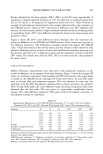
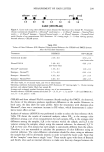
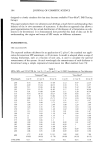
MEASUREMENT OF HAIR LUSTER 293 Table III Color Values as a Function of Position, Viewing Angle, and Viewing Aperture of the Sample L8 a a •: b •: Sample position Sample viewing angie Reading reproducibility • Sample viewing aperture 2 Vertical 23.04 _+ 0.68 4.04 _+ 0.28 4.72 + 0.16 Horizontal 22.48 _+ 0.62 4.10 _+ 0.16 5.13 -+ 0.21 2 ø 23.75 _+ 1.19 3.82 -+ 0.33 4.95 + 0.44 10 ø 23.59 -+ 1.19 3.87 -+ 0.33 4.76 _+ 0.42 5 x 10 mm 22.72 _+ 0.02 3.35 -+ 0.03 3.85 + 0.03 20 x 10 mm 21.68 _+ 0.02 4.28 _+ 0.03 5.41 + 0.03 5 x 10 mm 23.59 -+ 1.19 3.87 -+ 0.33 4.73 ñ 0.42 20 x 10 mm 21.85 _+ 0.31 4.07 _+ 0.17 5.09 -+ 0.38 Operation conditions not specified by second column were: horizontal sample position, D65 illuminant, 10 ø viewing angle and 5 x 10-ram viewing aperture. Averages and estimated standard deviation among a set of ten measurements. Dark brown hair (D-B). • Hair tress remained in the same position during the readings. 2 Hair tress position was changed during the readings. Table IV Color Values as a Function of Color, Texture, and Geometry of the Sample, Including and Excluding the Specular Component Sample Specular component L* a* b* Smooth surface: a slide with black "nanquim" dye Cylindrical surface: capillary tube filled with "nanquim" Cylindrical surface: black hair Cylindrical surface: black hair treated with brilliantine Smooth surface: smooth green paper Irregular surface: wrinkled green paper Included 25.95 -0.05 0.24 Excluded 1.12 0.10 -0.96 Included 19.89 - 0.08 - 0.62 Excluded 19.06 - 0.08 - 0.76 Included 18.37 -0.05 -0.84 Excluded 18.00 0.02 - 0.91 Included 20.67 -0.04 -0.96 Excluded 20.17 0.02 - 0.99 Included 46.75 - 52.38 13.15 Excluded 42.75 - 65.83 17.51 Included 46.28 - 50.84 12.59 Excluded 45.28 - 52.80 13.28 Operating conditions: horizontal sample position, D65 illuminant, 10 ø viewing angle, and 5 x 10-mm viewing aperture. Quintuplicate measurements. the specular component had a significant influence on the color parameters when the surface was smooth. However, for cylindrical samples, this difference was in the experi- mental error range. This means that for hair samples, the specular component does not correlate with luster. Current and adapted holder. As described above, an adapted holder was built in order to improve alignment and to avoid entanglement among hair fibers during the measure- ments, since a reduction in luster occurs when fibers are not sufficiently aligned (7). Table V shows the parameters of average values obtained with the current holder and the adapted holder for the CIELAB and FMCII systems. The L* value decreased by approxi-
Purchased for the exclusive use of nofirst nolast (unknown)
From: SCC Media Library & Resource Center (library.scconline.org)