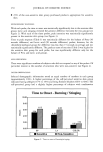
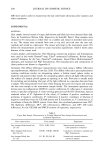
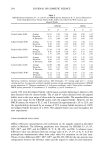
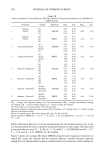
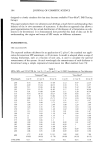
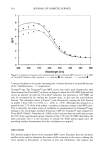
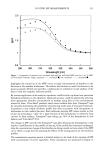
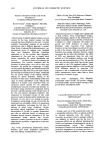
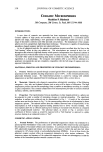
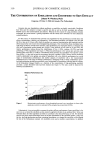
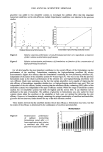
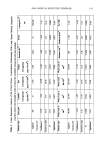
298 JOURNAL OF COSMETIC SCIENCE Table VII Statistical Analysis of Color Difference (DE) Data Obtained Using External Reference for CIELAB and FMCII Systems Treatment Sample Equations DE m S2R DE•4 S2T Ethanol B1 0.65 0.09 PA/8 h B2 CIELAB 1.31 0.32 0.89 1.30 B3 0.73 0.03 Ethanol B1 1.76 0.77 PA/8 h B2 FMCII 3.30 0.94 2.30 7.57 B3 1.18 0.40 B1 0.84 0.07 Commercial alcohol B2 (a) CIELAB 0.43 0.03 0.61 0.39 B2 (b) 0.46 0.04 B3 0.70 0.08 B1 2.98 O.43 Commercial alcohol B2 (a) FMCII 1.12 0.68 2.14 9.52 B2 (b) 1.89 0.44 B3 3.10 0.82 5 Neutrox © conditioner 6 Neutrox © conditioner B1 B2 B3 B4 B5 B1 B2 B4 B5 B3-fw? 7 shampoo + Neutrox © B3-sw?? B3-tw??? B3-fw? 8 shampoo + Neutrox © B3-sw?? B3-tw??? 1.95 0.27 2.94 O.25 CIELAB 0.75 0.05 1.58 8.29 1.53 0.09 1.78 0.16 4.21 1.23 FMCII 6.11 1.04 3.40 33.8 3.21 0.61 1.59 0.79 1.01 0.23 CIELAB 2.32 0.16 1.92 6.34 2.45 0.23 3.13 0.81 FMCII 5.01 0.82 4.44 13.09 5.20 O.99 DE m = average color difference among a set of ten measurements DE N = average color difference among the samples S2R = variance within sample S2T = variance among the samples. ?fw (first wash) ??sw (second wash) •'??tw (third wash). Operating conditions: horizontal sample position, D65 illuminant, 10 ø viewing angle, 5 x 10-mm viewing aperture, and adapted holder. Sets of ten measurements. Black hair samples (B1, B2, B3, B4, and B5). External reference: FMCII (X = 3.27, Y = 3.32, and Z = 3.23) and CIELAB (L* = 21.04, a* = 1.76, and b* = 1.58). diffuse reflectance data of a set of ten measurements for the alcohol-treated tress, as the one that presented the lower estimated standard deviation in color values. The data used as external reference were L* = 21.04, a* = 1.76, and b* = 1.58 (CIELAB) and X = 3.27, Y = 3.32, and Z = 3.23 (FMCII), for all samples. Figure 4 shows the average DE values (FMCII) obtained after sequential treatments in sample B3, using the external and the internal reference. Internal reference data for sample B3 were obtained from ethanol commercial/40-min treatment (sixth reading) for

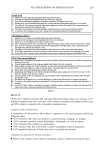
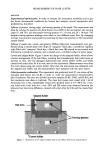
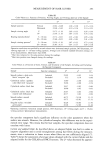
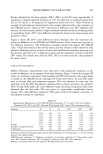
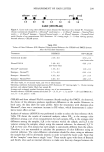
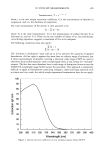
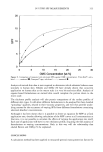
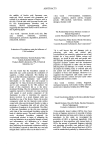
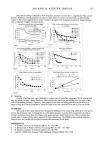
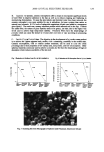
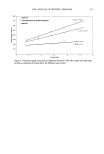
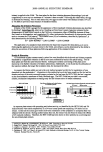
MEASUREMENT OF HAIR LUSTER 299 ethcom s+nl n s+n2 s+n3 ' I ' I ' I ' I ' I ' I ' I ' 0,0 D• ,• ! ,1• ! ,15 • .0 2 .{• :• .D• Lllstr (DE/CIELAIS) Figure 5. Luster scale using color-difference values obtained for black hair tress. Sample B3. Treatments: ethcom (commercial ethanol/8 h), n (Neutrox © conditioner), s + nl (l•lseve © shampoo + Neutrox©/first wash), s + n2 (15,1seve © shampoo + Neutrox©/second wash), s + n3 (15-1seve © shampoo + Neutrox©/third wash). Results of ten measurements. D65 illuminant. 10 ø viewing angle. 5 x 10-mm viewing aperture. Internal reference. CIELAB system. Table VIII Values of Color Difference (DE) Obtained Using Internal Reference for CIELAB and FMCII Systems After the Described Treatments Treatments DE/FMCII DE*/CIELAB Commercial alcohol 2.49 + 0.8 0.50 + 0.3 zero-luster value Ethanol PA/8 h 1.48 + 0.9 0.81 _+ 0.4 zero-luster value Neutrox © conditioner 1.29 + 0.3 1.18 + 0.3 Shampoo + Neutrox©? 3.71 + 0.9 0.61 + 0.4 Shampoo + Neutrox©?? 4.16 + 0.8 2.77 + 0.4 Shampoo + Neutrox©??? 4.40 + 0.9 2.89 + 0.5 ?fw (first wash), ?? sw (second wash), and ??? tw (third wash). Operating conditions: horizontal sample position, D65 illuminant, 10 ø viewing angle, 5 x 10-mm viewing aperture, and adapted holder. Black hair sample B3. Averages and estimated standard deviation among a set of ten measurements. Internal reference: CIELAB (commercial alcohol: L* = 21.55, a* = 1.73, and b* = 1.67) and FMCII (X = 3.13, Y = 3.19, and Z = 3.08). CIELAB and from ethanol PA/8-h treatment (fourth reading) for FMCII. As observed, the choice of the reference produces significant differences in the results. However, in both cases, the data show the same profile. After the treatments with shampoo plus Neutrox ©, there was a consistent increase in DE values, which demonstrates a cumu- lative luster effect on hair. Analysis of variance (ANOVA) was performed in order to select the best reference (8,9). Table VII shows the results of statistical analysis, where DE,,• is the average color difference among a set of ten measurements for each sample, DE M is the average color difference among the samples, S2R is the variance within the sample, and S2T is the variance among the samples, always using the external reference. As observed, S2T • S2R in every case. This means that each sample is statistically different from the others. Therefore, it is not reasonable to calculate the parameters of color difference using an external reference. The color-difference calculations should be done, using as reference the sample that will be afterwards treated, in order to build the luster scale. Note that all the "samples" come from a single "tress." These results agree with those of Bustard and Smith, who used an internal reference to make sure that any changes between the
Purchased for the exclusive use of nofirst nolast (unknown)
From: SCC Media Library & Resource Center (library.scconline.org)