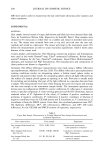
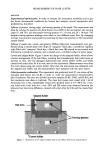
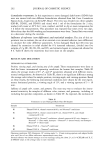
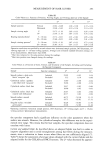
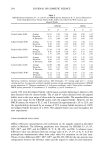
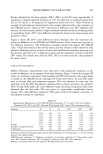
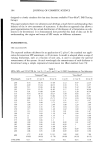
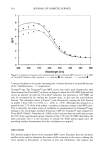
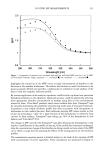
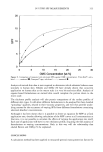
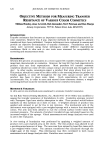
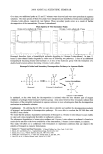
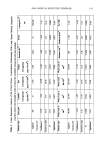
304 JOURNAL OF COSMETIC SCIENCE designed to closely simulate skin has since become available (Vitro-Skin ©, IMS Testing Group). This paper analyzes these two substrates and develops a much better understanding than hitherto of the in vitro assessment of sunscreens. It describes an approach that allows a good approximation for the actual distribution of thicknesses of a formulation on sub- strates to be determined. It is demonstrated how powerful this kind of data can be for understanding the origins and errors of SPF results on different substrates. EXPERIMENTAL THE CALCULATION The expected uniform thickness for an application of 2 t•l/cm 2, the standard test appli- cation for sunscreen SPF assessment, is 20 microns. A model is adopted where a range of varying thicknesses, each at a fraction of unit area, is used to calculate the spectral transmittance of the system. At each wavelength the transmittance of each thickness is determined using a simple exponential transmission law [Beer-Lambert Law (7)]: Table I MPFs, SPFs, and UVA/UVB for 1 wt %, 2.5 wt %, and 10 wt % OMC Formulations on Two Substrates Transpore © tape Vitro-Skin © Wavelength 1 wt % 2.5 wt % 10 wt % 1 wt % 2.5 wt % 10 wt % 290 4.76 10.78 37.69 2.12 4.97 12.25 295 4.99 11.64 40.22 2.16 5.31 14.57 300 5.11 12.06 41.04 2.18 5.42 15.81 305 5.16 12.25 41.82 2.17 5.43 16.44 310 5.01 11.88 42.04 2.11 5.28 16.58 315 4.54 10.43 39.27 1.99 4.83 15.7 320 3.79 8.12 33.84 1.79 4.06 13.93 325 2.88 5.34 23.71 1.54 3.04 10.64 330 2.11 3.21 12.35 1.31 2.13 6.47 335 1.64 2.08 5.73 1.16 1.57 3.49 340 1.38 1.55 2.99 1.08 1.29 2.04 345 1.24 1.31 1.93 1.04 1.16 1.44 350 1.17 1.18 1.49 1.02 1.09 1.18 355 1.13 1.12 1.29 1.01 1.06 1.07 360 1.11 1.09 1.19 1.01 1.04 1.02 365 1.1 1.08 1.14 1 1.02 0.99 370 1.1 1.07 1.11 1 1.02 0.98 375 1.09 1.06 1.1 1 1.01 0.97 380 1.09 1.06 1.09 0.99 1.01 0.97 385 1.09 1.06 1.09 0.99 1 0.97 390 1.09 1.06 1.08 0.99 1 0.97 395 1.08 1.05 1.08 0.99 0.99 0.96 400 1.08 1.05 1.08 0.99 0.99 0.96 SPF 3.72 6.38 12.41 1.89 3.82 7.86 (0.89) (0.83) (1.78) (0.09) (0.22) (0.12) UVA/UVB 0.17 0.16 0.21 0.11 0.14 0.18

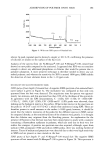
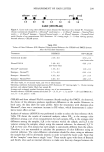
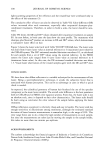
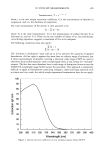
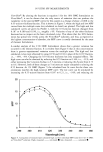
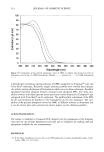
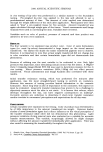
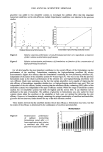
IN VITRO SPF MEASUREMENTS 305 Transmittance, T = e -c ' E ß x where c is the unit weight extinction coefficient, E is the concentration of absorber in suspension, and x is the thickness of suspension. The total transmittance of the system is then assumed to be Ts = Y•fn-Tn where Ts is the total transmittance, Tn is the transmittance of surface fraction fn at thickness xn, and xn -- 0. There can be any number of values of xn, but preliminary curve-fitting experience suggests a maximum of five to be adequate. The following conditions must also apply: Y., fn = 1 Y• fn ß xn = 20 The "fractions x thicknesses" must add up to 20 to preserve the quantity of applied formulation. At first sight it appears this must have an infinite range of solutions, but if three concentrations of absorber covering a relatively wide range of SPF are used in otherwise identical formulations, there is surprisingly little, if any, leeway for "multiple" answers. The fact that most absorbers have a wide range of absorption factors across the UVB/UVA wavelength range further assists the procedure. This approach is immensely difficult to apply to formulations containing inorganic, light-scattering materials such as titania and zinc oxide, for which simple exponential transmission laws do not apply. lOO E 90 80 70 60 50 40 30 20 10 0 I I I I 290 300 310 320 330 340 350 360 370 380 390 Wavelength [nm] Figure 1. Spectral extinction coefficients of octyl methoxycinnamate (Parsol MCX©). 400
Purchased for the exclusive use of nofirst nolast (unknown)
From: SCC Media Library & Resource Center (library.scconline.org)