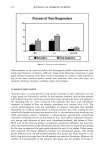
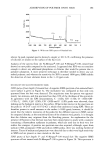
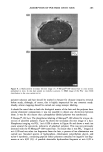
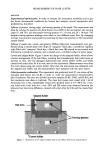
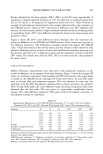
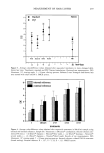
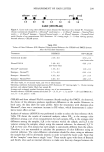
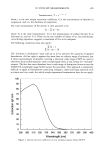
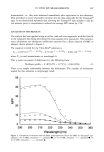
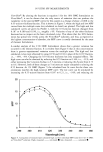
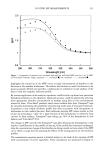
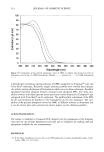
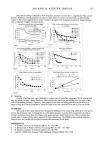
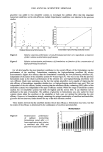
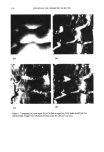
310 JOURNAL OF COSMETIC SCIENCE 290 300 310 320 330 340 350 360 Wavelength [nm] Figure 6. Comparison of measured and calculated high and low individual MPF scans for 2.5 wt % OMC on Vitro-Skin © substrate. High, measured --, calculated m low, measured ....... , calculated O. 5-micron thickness to 4 microns. Increasing the 5-micron fraction is not possible because of the "Sum(Fractions) -- 1" requirement. Transpore © tape. The Transpore © tape MPF curves vary much more dramatically than those obtained on Vitro-Skin ©, as shown in Figure 8, where the 10% OMC high and low curves are plotted. As with the Vitro-Skin © substrate, the variations at 10% OMC can only be accounted for by varying the thinnest areas, in this case the zero-thickness fraction. The calculated curves in Figure 5 were obtained by varying the 0.02 fraction in profile 2 from 0.012 to 0.039, i.e., -40%, to +95%. Although this amounts to a spread of only 2.7% of the total surface, it produces a dramatic change in the MPF curve. This is obviously the major source of variability in measurements on Transpore © tape, leading to the much larger standard deviations in SPF for Transpore © tape compared to Vitro-Skin © (Table I). Variations of + 100% in the 2-microns fraction could only account for 25 % of the experimental spread. Analysis of the 2.5 % and 1% OMC data follow the same procedure, but it is not necessary to include the whole process again since the preceding analysis demonstrates how the calculations are applied. DISCUSSION The detailed analysis above of the measured MPF curves illustrates how the thickness profiles can be used to determine the source of the variations in the curves, relating the curve spreads to fluctuations in fractions of area and thicknesses. The analysis also

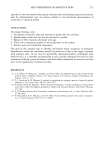
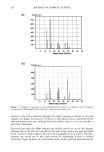
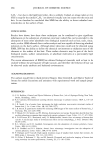
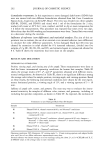
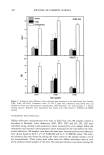
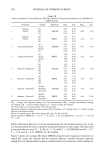
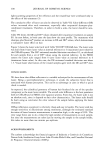
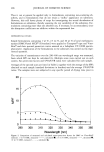
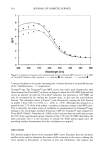
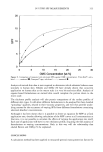
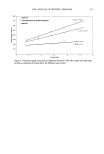
IN VITRO SPF MEASUREMENTS 311 2.5 n 1.5 0.5 I I I I I I 290 300 310 320 330 340 350 360 Wavelength [nm] Figure 7. Comparison of measured and calculated high and low individual MPF scans for 1 wt % OMC on Vitro-Skin © substrate. High, measured --, calculated I low, measured ....... , calculated O. highlights the sensitivity of the MPF curves at high concentrations of absorber to the fractions at the smallest thicknesses. This allows the fractions at small thicknesses to be quite accurately defined and provides a useful point to commence initial analysis of the data to find the complete thickness profile. By routine application of the analysis, experience could be built up about how particular formulations behave on the substrates. Improved accuracy could be achieved by selecting more appropriate absorber concentrations or perhaps using four or five concentrations instead of three. Vitro-Skin © produces much more uniform data than Transpore © tape by virtually eliminating the possibility of producing small areas of uncovered substrate. It produces a very simple thickness profile that does not permit wide fluctuations in thicknesses or their surface fractions. Both substrates develop SPF values similar to that of skin by providing a "sink" for a large fraction of the formulation in relatively deep crevices in their surfaces, Transpore © tape taking up 56% of the formulation in this fashion and Vitro-Skin © 81%. The change in SPF noted for the Transpore © tape after allowing the formulations to dry implies a modification of the profiles on drying. If the profile had remained unchanged, then the concentration change of the absorber on drying would not have altered the MPF curve. There is scope here for assessing the effects of the drying process on the thickness profiles. The transmission equations permit a detailed analysis to be made of the variation of SPF with concentration of active ingredient. These calculations are presented in Figure 9,
Purchased for the exclusive use of nofirst nolast (unknown)
From: SCC Media Library & Resource Center (library.scconline.org)