ABSTRACTS 3 21 The Relationship between Moisture Content of Human Fingernails and the Mechanical Properties of the Fingernail(Part2)* Tooru Sugawara, Mizue Kawai, Toshiyuki .Suzuki., Cosmetic Research Laboratories, Kao Corporation []It is well known that nail damages such as yellowing, split nails and peeled nails (onychoschisis) are caused by continuous use of nail enamel for a long period. Within serious nail damages, we aimed at split nails and peeled nails and basically investigated the relationship between fingernail moisture content and the mechanical properties and the structure of tingemails to make clear the factors affecting those nail damages. As a result, fingernail moisture content was lower than plantar horny layer one. The change in tingemail volume due to moisture absorption was much more considerable in thickness than in length and width. It is suggested that the state of tingemail is changed by moisture absorption from the result of E'and tan 8 of the tingemail dipped in[]water. Moreover we propose the mechanism that cause split nails and peeled nails. []Key words : moisture content, tingemail, mechanical property, nail enamel, trouble, split nail, peeled nail, þstructure, bending test, SEM image Time Frequency Analysis of the Brain Waves Variation by Cyclic Odor Stimulus* Makoto Fujii, Koichi Shimmoto Fundamental Research Laboratory, KOSE Corporation ** []Objective evaluation of psychophysiological effects is needed to develop the cosmetics with relaxation effectiveness. Recently, analyzing brain waves is used for evaluating these effects. For example, these effects are evaluated qualitatively by comparing power spectra of brain waves with and without stimulus. However quantifying variation in power spectra by stimulus is not easy, because the variation is affected by environment such as emotion, situation, etc. This paper proposed the new method for extracting the variation quantitatively. In this method, giving cyclic stimulus to human, the variation, which arises along the cycle, can be extracted by STFT (Short Time Fourier Transform) and FFT Moreover, experimental system was constructed based on our theories. Odor stimulus as peppermint and spearmint were tested, and the variations being able to extract quantitatively was shown. In case of peppermint, components of power spectra were increased in area of 4-6 Hz, and in spearmint, the components were also increased in 9-11 Hz. From these results, it was suggested that the proposed method was useful for objective evaluation of psychophysiological effects. •3Key words: STFT, time frequency analysis, FFT, power spectra, frequency analysis, cyclic stimulus, brain wave, odor, peppermint, speannint Properties of the Perfluoroalkylethyl Acrylate (FA) Copolymers and Their Applications for Cosmetics* Masamichi Morita" ,Tatsuhiko Watanabe", Motonobu Kubo**, Kazuo Shimamoto***, Yasuo Sugawara*** R&D Department No.2, Chemical Division, Daikin Industries, Ltd. **, Yao R&D Laboratories, Nihon Kolmar Co. Ltd. *** Properties of the perfluoroalkylethyl acrylate (FA) copolymers and their applications for cosmetics were studied. The main conclusions from this study were summarized as follows : firstly, the FA copolymers which include hydrophobic comonomers made it possible to mix fluorinated compounds with non-fluorinated materials easily. This comes from the ability of FA copolymer to decrease the interfacial tension at fluorinated compound / non-fluorinated solvent. This technique can be applied to prepare the non-aqueous emulsion (perfluoropoly ether/non-fluorinated solvent type) and the foundations which contain a large quantity of fluorinated powders. Secondly, the FA copolymers which include hydrophiliccomonomers made it possible to repel oil both in air and in water. Its behavior was demonstrated by the surface chemistry-based measurement used with flat substrate (PET film) and with powder substrate (talc). This technique may be applied to prepare the cosmetics which are durable against sebum in all environments. þKey words : perfluoroalkylethyl acrylate copolymers, butylacrylate, silicone methacrylate, silicone mercaptane, polyethyleneglycol methacrylate, water and oil repellency, hybrid polymer, non-aqueous emulsion, sebum release polymer, contact angle, interfacial tension

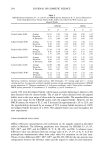
322 JOURNAL OF COSMETIC SCIENCE Effect of Thermal Environmental Changes on the Physical Characteristics of Human Hair* Hiromi Kono*, Kaoru Suganuma **, Toshimasa Furukawa*** Cosmetics/Environmental Research Laboratory, FCG Research Institute, Inc.* C.T.C Japan Ltd.*** [2Changes in the physical characteristics (surface friction and bending characteristics) and perceptual qualities of human hair during temperature and humidity change were evaluated using KES and a sensory evaluation method. The standard setting for the temperature and the humidity was 20D, 65% RH, while low and dry was 15D, 30% RH and high and humid was 30•, 80% RH. Ten strands of hair were taken from the head of Japanese woman in her 20s who had never had her hair chemically treated. The process of perming, brushing, bleaching and more brushing was repeated 4 times on 5 of the 10 healthy strands to create a damaged condition. EThe healthy and damaged strands were then treated with typical cationic cellulose and silicone oil. We obtained the following results. 1) There was a correlation between the physical characteristics and sensory evaluation. 2) Both the healthy and damaged hair became smooth due to the reduced friction factor at high temperature and humidity. 3) Both the healthy and damaged hair became soft due to the reduced bending rigidity at high temperature and humidity. 4) It is easy to compare and examine the subtle differences due to various treatmentsUwhen the physical characteristics and sensory evaluation are performed under the standard conditions or low temperature and humidity conditions. •Key words : environment, humidity, hair, silicones, cationic cellulose, bending, friction, KES, surface, MIU
Purchased for the exclusive use of nofirst nolast (unknown)
From: SCC Media Library & Resource Center (library.scconline.org)