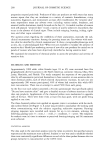
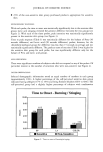
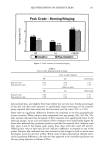
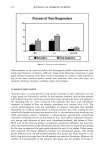
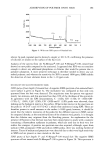
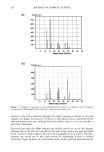
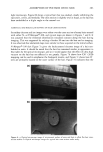
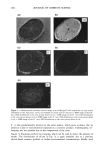
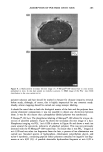
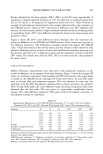
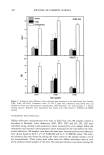
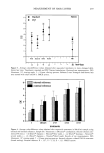
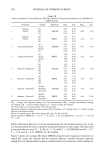
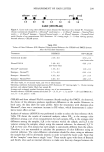
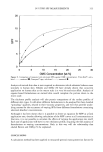
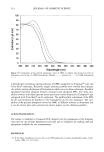
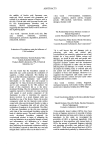
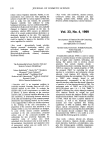
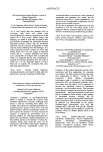
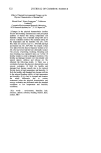
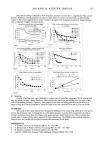
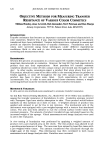
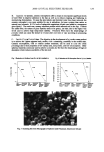
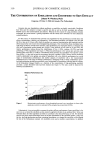
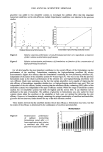
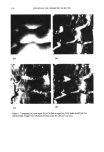
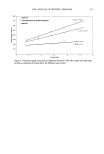
2000 ANNUAL SCIENTIFIC SEMINAR 335 obtained in both scan directions providing ns with two complementary images illustrating the torsional bending experienced by the cantilever in the leR-to-right and right-to-leR scan directions. Combing measurements of hair tresses were performed using a Miniature Tensile Tester (Dia-Stron Ltd.) operated by M'YFVqI• 4. la soRware. Oriental human hair (International Hair Importers & Products, Inc.) was used for all investigations due to its high radius of cu.,'vature as compared to other hair types, which are more elliptical in shape. Virgin hair, as supplied by the distributor, was compared with hair that was extracted with a series of solvents. The effect of solvent extraction on hair was investigated first by extraction with t-butanol and n-hexane, each for 4 hours, then with a mixture of chloroform/methanol (70:30 v/v) for 6 hours. For each extraction procedure, 3 g of hair was extracted with 250 mL of solvent. Additionally, we examined the effect of bleaching hair by using a commercial bleaching system consisting of Clairol Professional BW 2 bleaching powder and Emiliani Professional 20 Volume clear developer. In an attempt to correlate data obtained from a miniature tensile tester with AFM/LFM data, we will present the combing analysis of untreated hair and hair that has undergone the treatment protocols described above. We will also discuss the image analysis of data obtained from AFM/LFM. For demonstration, topographic, error signal, LFM (left-to-right), and LFM (right-to-left) images have been included in Figures 1-4, respectively. These images were obtained simultaneously for a 20 •m 2 scan area on untreated hair. The scale in Figure 1 correlates darkly colored areas with lower topography and lightly colored areas with regions of higher topography. The error sign,-fi does not provide us with useful topographic information, however it does offer informative boundary data, which can be used to determine the size of features in the xy plane. The LFM data, included in Figures 3 and 4, demona'tmte the torsional bending of the cantilever as it rasters across the sample in both directions. It is important to note that what appears dark in Figure 3, transpires as light in Figure 4 and vice-versa. In Figure 3 (left-to-right) dark represents areas that are higher in friction whereas light is indicative of lower frictional regions. The opposite is true for Figure 4 (right-to-left), in which light corresponds to high friction and dark represents low friction. By talcing the difference between Figures 3 and 4, one can obtain relative frictional information about a particular material. However, the images must be collected at various normal forces in order to obtain a plot of torsional cantilever deflection as a function of the set point. In this study we compare virgin with solvent-ex-tracted and bleached hair. Figure 5 provides preliminary data for each of these hair types in which the difference in the left-to-right and right-to-left LFM signals are plotted as a function of the normal force applied by the probe. The slope for each hair type, which is related to the frictional coefficient between the probe and a given hair surface, is reported in the Figure and demonstrates a larger slope for bleached and solvent extracted hair thaa for virgin hair. For bleachd hair, such a result is in agreement with evaluation of mechanical combing forces which suggest higher dry combing works as compared to virgin hair. (1) Phillips, T. L. Horr, T. J. Huson, M. G. Turner, P.S. Text/'/e Res. J. 1995, 65, 445-453. (2) Smith, J. R. J. Microscopy 1998, 191, 223-228. (3) Smith, J. R. J. Soc. Cosmet. Chern. 1997, 48, 199-208. (4) O'Connor, S. D. Komisarek, K. L. Baldeschwieler, J. D. J. /nves& Oerrnato/. 1995, 105, 96-99. (5) You, H. Yu, L. Scanning 1997, 19, 431-437. (6) Goddard, E. D. Schmitt, R. L. Cosmet. & Toil 1994, •09, 55-61. (7) Schmitt, R. L. Goddard, E. D. Cosine& & Toil 1994, 109, 83-93. (8) H•ssel, P. Sander, R. Schrepp, W. Cosmet. & Toil. 1996, I I 1, 57-65. (9) Pfau, A. H6ssel, P. Vogt, S. Sander, R. Schrepp, W. Macrorno/. Syrnp. 1997, •26, 241-252. (1 O) Parbhu, A. N. Bryson, W. G. Lal, R. Biochemistry 1999, 38, 11755-11761.

336 JOURNAL OF COSMETIC SCIENCE (a) (b) (c) -. (d) Figure 1. Topography (a), error signal (b), LFM [left-to-right] (c), LFM [right-to-left] (d) for untreated hair. Images were obtained simultaneously for a 20 pm a s• us• area.
Purchased for the exclusive use of nofirst nolast (unknown)
From: SCC Media Library & Resource Center (library.scconline.org)