Cosmet. Sci., 52, 211-224 (July/August 2001) Differential scannino calorimetry studies of sebum models MONICA R. MOTWANI, LINDA D. RHEIN, and JOEL L. ZATZ, Rutgers-The State University of New Jersey, College of Pharmacy, 160 Frelinghuysen Road, Piscataway, NJ 08854 (M.R.M., J.L.Z.), and SmithKline Beecham Consumer Healthcare, 1500 Littleton Road, Parsippany, NJ 07054 (L.D.R.), Accepted for publication April 15, 2001. Synopsis Human sebum is a mixture of triglycerides, fatty acids, wax esters, squalene, cholesterol, and cholesterol esters. P. acnes, a bacterium that is normally found on the skin, hydrolyzes certain triglycerides to fatty acids, thereby changing the sebum composition. The objective of this study was to examine the physical state of a model sebum and the effect of variations in its composition on its physical properties including (a) the carbon chain length of the components, (b) the ratio of unsaturated to saturated components, and (c) the ratio of triglycerides to fatty acids. A model sebum mixture was prepared based on a composition reported in the literature and evaluated by differential scanning calorimetry (DSC). Since cholesterol and cholesterol esters contribute insignificantly to sebum composition, they were not included. Squalene was kept constant (13%), while the concentration of the rest of the components was varied. Variations of sebum were prepared by dissolving all components in a 3:1 chloroform-methanol mixture for uniformity. Subsequently the solvent was evaporated at room temperature. The samples were then analyzed using DSC. Four distinct endotherms (namely, Mp-1, Mp-2, Mp-3, and Mp-4) were observed between -50øC and 100øC. Mp-1 and Mp-2 occurred below 0øC and were contributed by unsaturated components. Mp-3 and Mp-4, which represent the saturated components, occurred above 30øC. Thus, at normal skin temperature (skin surface temperature is 32øC), sebum contains both a solid and a liquid phase. All the transition temperatures increased with an increase in carbon chain length for the same ratio of unsaturation to saturation. A replacement of unsaturated components with corresponding saturated components led to a decrease in the transition temperatures for the former (Mp-1 and Mp-2) and an increase in the transition temperatures for the latter (Mp-3 and Mp-4). Replacement of triglycerides with corresponding fatty acids (mimicking the action of anaerobic bacteria) caused an increase in Mp-2 and a decrease in Mp-4. In all cases, the final melting temperature (Mp-4) was greater than the temperature of the human skin surface (32øC) thus components contributing to these endotherms are still solids at skin temperature. All variations in the sebum model led to mixtures of solids and liquids at skin temperature. Considering a reduction in Mp-3 and/or Mp-4 to represent sebum "fluidization," it was achieved by a decrease in carbon chain length, an increase in unsaturation, or a substitution of triglycerides by corresponding fatty acids. Preferential enrich- ment with the saturated species will lead to enrichment of solids versus liquids in the sebum, presumably making it difficult for the liquid phase to dissolve the solids. It seems plausible that perturbation of the balance of solid and liquid components of sebum, such as by P. aches action, may lead to blockage of the follicle. Future research will investigate strategies to dissolve and/or liquify the solid phase of sebum. INTRODUCTION Sebaceous glands produce an oily secretion, sebum, composed of non-polar lipids. These 211

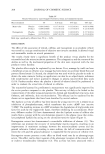
212 JOURNAL OF COSMETIC SCIENCE glands are holocrine (self-destructing), and the secreted sebum forms when the fully mature, lipid-rich cells die and disintegrate, discharging their contents to the skin surface via the follicular canal (1). Sebum is often thought to play a role in the patho- genesis of acne. This role has, however, not been clearly established (2). Some authors have suggested that the physical properties of sebum may be important in the patho- genesis of acne (3). However, studies done on the physical properties of sebum have been scarce and incon- clusive. Butcher and Coonin (4) studied some of the physical properties of sebum acquired from the forehead of a large number of subjects (presumably normal), and Burton (5) studied the properties of sebum obtained from the scalp of ten acne patients and seven normal patients. These properties have been summarized in Table I. Another study that investigated forehead sebum ascribed a melting point at 33ø-35øC (6). These studies suggest that sebum collected from different sources or body sites have different viscosities and melting points. One of the reasons for these differences could be that scalp sebum is not involved in acne whereas forehead sebum is. The physical properties of sebum, its melting point and viscosities in particular, are important, as they would mediate the blockage of the sebaceous follicle. To evaluate this theory, we have examined the physical properties of the sebum components and their mixtures using differential scanning calorimetry (DSC). There are, however, physical limitations to collecting large amounts of sample from the skin surface, and it is not easy to get "pure" sebum since it is contaminated with varying amounts of skin surface lipids. Furthermore, sebum varies quantitatively from person to person, contributing to the variability of the data. Hence we decided to carry out our experiments on a model sebum based on a composition given in the literature. We have evaluated a different sebum model and the effect of its components on its melting temperatures. SEBUM COMPOSITION The lipids from the skin surface are derived mainly from two sources, the sebaceous glands and the epidermis (7). The surface lipid from the gland-rich areas naturally contain a higher proportion of sebaceous lipid, whereas from gland-deficient areas such as arms and legs there is a greater proportion of epidermally derived lipid. Skin lipids from the face are derived in large part from sebum. The main components of sebum are triglycerides, wax esters, squalene, cholesterol esters, and cholesterol (7). The composi- Table I Physical Properties of Sebum Property Forehead sebum (ref. 4) Scalp sebum (ref. 5) Specific gravity Surface tension Viscosity Freezing point 0.91 g/cm 3 24.9 dyne/cm from 26.5 to 31øC 0.55 poise at 38øC 1.00 poise at 26.5øC Viscosity discontinuous at 30øC due to the separation of a precipitate in the sebum Sample started to freeze at 30øC and then solidified at 15ø-17øC 0.90 g/cm 3 for three normal samples 22.9 dyne/cm for six normal samples at 30øC 0.32 poise at 35øC 0.82 poise at 25øC 15o_17oc
Purchased for the exclusive use of nofirst nolast (unknown)
From: SCC Media Library & Resource Center (library.scconline.org)