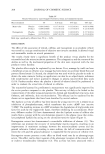
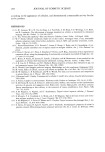
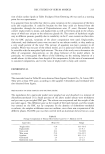
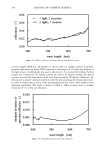
DSC STUDIES OF SEBUM MODELS 219 shown in Figure 5. The transition temperatures are plotted versus the percent saturated in Figure 6. As the saturation increases (or unsaturation decreases), the temperatures of the unsaturated components (Mp-1 and Mp-2) decrease with a concurrent increase in the Mp-3 and Mp-4. Since the slope of Mp-3 is significantly higher than that of Mp-4, it would seem that the unsaturation seems to affect the wax ester portion of the model sebum more than the triglyceride and fatty acid portion of the mixture. It appears that Mp-1 and Mp-2 are affected to a lesser extent in terms of their melting point than both Mp-3 and Mp-4 (from slopes). As mentioned earlier, the presence of other substances decreases the melting point of the pure compounds. When there is more unsaturation than saturation, by the time the temperature is reached for the melting of the saturated compounds, some of the saturated portion dissolves in the already-melted unsaturated portion and their melting point decreases. The more the unsaturation, the more the dissolving and hence the higher decreases in the melting point. In these cases, the unsaturated portion acts as the solvent. When the percent of saturated fraction is greater, -eo -30 a Mp-1 20 40 60 80 % Saturated (w/w) 100 • 60 o • 55 • 50 o 45 = 35 '-' 30 ,• 25 20 Mp-4 • Mp-3 • 0 20 40 60 80 100 % Saturated (w/w) Figure 6. Effect of percent saturated on transition temperatures (a) Mp-1 and Mp-2 and (b) Mp-3 and Mp-4 for C-16. Error bars indicate the standard error of the mean of three replicates.

220 JOURNAL OF COSMETIC SCIENCE it dissolves partially in the diminished percent of the unsaturated portion. This is probably the reason that Mp-1 and Mp-2 are not affected as much as Mp-3 and Mp-4 by the increase in the percent saturated. The decrease in Mp-3 more than in Mp-4 means that the unsaturated portion is a "better" solvent for the wax ester than for the triglyc- erides and fatty acids. We are not sure as to why there is preferential dissolution of the wax ester fraction as compared to the combined fatty acid and triglyceride fraction. Similar results were also obtained for carbon chain lengths 14 and 18. EFFECT OF CHANGE IN TRIGLYCERIDE AND FATTY ACID RATIOS P. aches hydrolyzes triglycerides to fatty acids in the skin. It was hence necessary to examine the transition temperature of the model sebum when it contained different percentages of triglycerides and fatty acids. In these experiments the ratio of the unsat- urated to the saturated portion was 1:2 and the carbon chain length was 16. The wax ester fraction used in these experiments was palmityl myristate, and there was no unsaturated wax ester added. This wax ester was selected because, according to Nord- storm et al. (11), this was the fraction that occurred most frequently. In Figure 7, Mp-4 is ascribed to a mixture of palmitic acid (m.p = 63øC) and tripalmitin (m.p = 68øC). Figure 8 shows the effect of decreasing the relative amount of triglycerides and increas- ing the fatty acids. MP-4 decreases from 59øC to 48øC as the percentage of triglycerides decreases, as shown in Figure 8b. Mp-3 can be assigned to the wax ester palmityl myristate (m.p = 49.4øC) and decreases from 44øC to 39øC (Figure 8b) as the percentage of triglycerides decreases (fatty acid increases). Mp-3 is not affected as much as Mp-4 by the altered triglyceride to fatty acid fractions because it is a wax ester peak. From Figure 8, it can be concluded that as the percentage of triglycerides increases, Mp-4 increases, whereas Mp-3 is affected to a lesser degree. 5.0 4.0 3.5 3.13 2.5 2.0 1.5 -4 4 I I --t -50 -25 0 25 50 75 O% 10% 2O % 30% 5O% 6O % 100 Telnperature (øC) Figure 7. Representative thermogram showing the effect of percentage of triglycerides in the model sebum. Numbers on the side of thermograms indicate the percent of triglycerides.
Purchased for the exclusive use of nofirst nolast (unknown)
From: SCC Media Library & Resource Center (library.scconline.org)