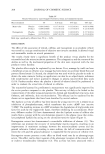
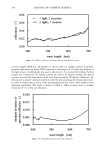
DEVICE TO MEASURE HAIR LUSTER 247 Figure 15. Photograph of the measuring device. COMPARISON OF DEVICE MEASUREMENT AND SENSORY EVALUATION BY EXPERT ASSESSOR Examples of measurement results are shown in Figure 17. Part (a) depicts permed hair parts (b), (c), and (d) illustrate straight hair samples parts (e) and (f) depict dyed or bleached hair samples and parts (g) and (h) show hair from male subjects. Our theory predicted that measurement using this device would not be affected by hair color. Validation was performed by the comparison of two groups categorized by hair colors, with results shown in Figure 18. The measurements and the sensory score for each group were found to be congruous, showing that measurement by the device is not affected by hair color. Moreover, results categorized by hairstyles are shown in Figure 19. light source receiver Figure 16. Structure of the measurement part of the device

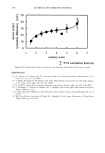
248 JOURNAL OF COSMETIC SCIENCE Table I Precision of the Device Output by Repeated Measurement on Three Subjects Device output (average) Standard deviation [mV] [-] Subject A (n = 20) 29.48 1.510 Subject B (n = 20) 17.53 1.045 Subject C (n = 20) 21.80 0.796 Although a difference is seen in the high scores of a few samples, measurements by the device and the sensory score for each group are also congruous. The correlation of the measurements obtained by the device and the sensory score supplied by the expert assessor is shown in Figure 20 for all subjects. Since the evaluation scores are saturated near both ends of the scoring range (1 and 7), it becomes such a curve. Both results were seen to be highly correlative, demonstrating that measurement by this device is useful in human hair luster evaluation. CONCLUSION A new and unique device, which can measure human hair luster easily and accurately, was developed. The sensory score obtained by the expert assessor and the measurements by this device were highly correlated. A more precise evaluation of hair luster is made possible by this device, which also offers the following advantages: ß It enables direct measuremen,t without cutting the subject's hair. ß It is not influenced by the subject's hairstyle and/or hair color. sensory score : 2 sensory score : 3 device output : 17.5 device output : 21.0 (a) permed (b) straight (short) v. sensory score : 4 sensory score : 6 device output : 29.5 device output : 42.3 (c) straight (medium) (d) straight (long) sensory score : 2.5 device output : 22.5 (e)colored sensory score : 3 sensory score : 3 device output : 28.0 device output : 24.3 (f) bleached (g) male Figure 17. Examples of the measurements. sensory score : 5 device output : 41.5 (h) male
Purchased for the exclusive use of nofirst nolast (unknown)
From: SCC Media Library & Resource Center (library.scconline.org)