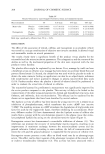
DEVICE TO MEASURE HAIR LUSTER 249 5O 4O 30 20 10 0 . $ dyed or bleached hair ¸ not dyed hair - ¸ I I I I I 1 2 3 4 5 6 7 sensory score I' 95% confidence intervals Figure 18. Validation of the measurements by this device unaffected by hair colors. It requires only about 0.2 seconds to register measurement, is quick, and is less burdensome to the subject. It is a small and simple device. Therefore, measuring by this device will be useful not only for research, such as vali- dation studies on hair care products, but also for sales promotion at cosmetics shops. •' 50 40 • 30 • 20 o.,,• • lO • 0 $ penned hair . O short hair ß medium length hair . Along hair - O I i I I I 1 2 3 4 5 6 7 sensory score I' 95% confidence intervals Figure 19. Validation of the measurements by this device unaffected by hairstyles.

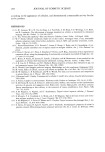
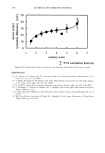
250 JOURNAL OF COSMETIC SCIENCE •, 50 40 • • 30 ß • • 20 = 10 o •'• 0 I I I I I 1 2 3 4 5 6 7 sensory score I' 95% confidence intervals Figure 20. Relationship between the sensory score of human hair luster and the device output. REFERENCES (1) A. Guiolet, J. C. Garson, and J. L. Levecque, Study of the optical properties of human hair, Int. J. Co.•met. Sci., 9, 111-124 (1987). (2) T. Maeda, M. Okada, H. Watanabe, and T. Hara, Measurements of hair luster by color image analysis, J. Sot'. Cosmet. Chem. Japan, 25,215-222 (1992). (3) S. A. Shafer, Using color to separate reflection components, Color Res. Appl., 10, 210-218 (1985). (4) Y. Watanabe, T. Tamura, H. Harada, and Y. Yagihara, Hair Science (Japan Hair Research Institute, Tokyo, 1986), pp. 3-15. (5) S. Tominaga and S. Ohhashi, A color reflection model for object surfaces, Trans. IPSJapan, 33, 37•45 (1992). (6) The Color Science Association of Japan, Ed., Handbook of Color Science, (University of Tokyo Press, Tokyo, 1980), pp. 625-644.
Purchased for the exclusive use of nofirst nolast (unknown)
From: SCC Media Library & Resource Center (library.scconline.org)