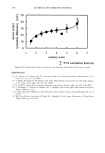
DSC STUDIES OF SEBUM MODELS 221 -5 -20 -25 -3O a • Mp-2 nMp-1 i t i i 0 10 20 30 40 50 60 % Triglyceride (w/w) 7O 6O •45 • 40 E 35 30 25 2O r• • Mp-4 • Mp-3 0 10 20 30 40 50 60 70 h % Triglyceride (w/w) Figure 8. Effect of percentage of triglycerides on the transition temperatures (a) Mp-1 and Mp-2 and (b) Mp-3 and Mp-4 for C-16 (ratio of unsaturation to saturation = 1:2). Error bars indicate the standard error of the mean of three replicates. Mp-2 decreases with the increase in percentage of triglycerides (Figure 8a). It was mentioned earlier that the Mp-2 peak is the mixture of the unsaturated wax ester and the unsaturated fatty-acid ot form of palmitoleic acid. In these experiments, we did not use an unsaturated wax ester, and so Mp-2 is not a combination peak but just a peak of the unsaturated fatty acid. Mp-2 does not appear until the 30% triglyceride level, and is not seen in compositions of 50% and 60% triglycerides. The peak decreases in area as the percent of triglycerides increases and as its percentage in the lipid mixture decreases. Mp-1 appears more or less constant (Figure 8a). Due to the fact that Mp-1 is a corn-

222 JOURNAL OF COSMETIC SCIENCE bination peak of the unsaturated fatty acid and the unsaturated triglyceride, this result is difficult to resolve. CONCLUSIONS We conclude that under the experimental conditions explained earlier, the unsaturated lipids help dissolve the saturated lipids. As the proportion of the saturated, solid com- ponents (associated with the Mp-3 and Mp-4 peak) increase, it is more unlikely that the liquid components will be able to dissolve the solid under natural conditions of skin. Hence if P. a•cnes preferentially changes the relative percent of the longer chain, more saturated constituents, producing more solids, these will not be dissolved by the skin's natural liquid oils and may plug the pilosebaceous ducts. Some evidence suggests that comedonal material is relatively more saturated while sebum collected from the skin surface is more unsaturated (10). Additionally, it is well published that there is a deficiency in polyunsaturated fatty acids such as linoleic and sebaleic acids in acne (14). Converting triglycerides to free fatty acids by P, a•cnes may not have the largest conse- quences as far as the physical properties of sebum are concerned, since the saturated forms of both are still solids above skin temperature and the unsaturated species of both are still liquids below skin temperature. However if relatively more of the saturated fatty acid species are produced by bacterial hydrolysis, the balance between the liquid and solid phase will be altered. Actual sebum may lie somewhere in between all the model sebum that we have inves- tigated, and a portion of it may be solid at 32øC. Furthermore, the presence of the solid portion depends in a large part of the presence of the unsaturated or liquid portion of the sebum. The fact that sebum may exist in different phases has also been suggested by Burton (5). Butcher and Coonin (4) showed that while some components of forehead sebum started to solidify at 30øC, it completely solidified at 15ø-17øC. These studies are in agreement with our observations that sebum does not exist as one phase, but rather as a mixture of a solid and a liquid at skin temperature. DSC of scalp sebum has been performed by Bore and Goetz (15). Their results also confirm the presence of multiple phases in sebum. Their samples were also mixtures of solids and liquids at body tem- perature. They showed that as the percentage of the unsaturated portion increased, the viscosity of the sample decreased. We showed that as the unsaturated portion increased, the saturated portion's melting temperature decreased, which in turn may contribute to the decreased viscosity. SUMMARY The present research showed that: 1. Sebum is not one phase but may exist in multiple phases at skin temperature (32øC). 2. Two transitions are at very low temperatures, Mp-1 and Mp-2. These are attributed to the unsaturated portion of sebum, generally, Mp- 1 to the unsaturated triglycerides and fatty acids and Mp-2 to the unsaturated wax ester. At skin temperature, these compounds are liquid. 3. Two transitions occur at higher temperatures, Mp-3 due to saturated wax esters and
Purchased for the exclusive use of nofirst nolast (unknown)
From: SCC Media Library & Resource Center (library.scconline.org)