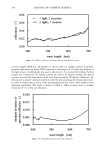
246 JOURNAL OF COSMETIC SCIENCE 0.08 0.06 0.04 0.02 0.00 -- - 1 light, 2 receivers - 2 lights, 1 receiver I I 400 500 600 700 wave length [nm] Figure 13. Diffuse reflection of human hair for each optical system. a power supply (006P dry cell battery), it can be used in a cordless system. A general- purpose light-emitting diode (LED) emitting a wavelength of 570 mm was adopted as the light source. A photodiode was used as the receiver. A structure for holding the hair sample was constructed 90 degrees toward the device (0 degrees toward the optical system), to avoid the orientation of the hair from becoming 90 degrees. Moreover, the influence of a subject's hairstyle can be avoided by miniaturizing the measurement part. In order to explain the accuracy of the measurements by this device, three subjects were measured repeatedly. The result is shown in Table I. High accuracy with a standard deviation of 1.5 or less was obtained. 0.020 0.015 0.010 0.005 0.000 400 500 600 700 wave length [nm] Figure 14. Standard deviation of specular reflection.

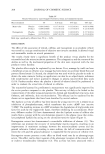
DEVICE TO MEASURE HAIR LUSTER 247 Figure 15. Photograph of the measuring device. COMPARISON OF DEVICE MEASUREMENT AND SENSORY EVALUATION BY EXPERT ASSESSOR Examples of measurement results are shown in Figure 17. Part (a) depicts permed hair parts (b), (c), and (d) illustrate straight hair samples parts (e) and (f) depict dyed or bleached hair samples and parts (g) and (h) show hair from male subjects. Our theory predicted that measurement using this device would not be affected by hair color. Validation was performed by the comparison of two groups categorized by hair colors, with results shown in Figure 18. The measurements and the sensory score for each group were found to be congruous, showing that measurement by the device is not affected by hair color. Moreover, results categorized by hairstyles are shown in Figure 19. light source receiver Figure 16. Structure of the measurement part of the device
Purchased for the exclusive use of nofirst nolast (unknown)
From: SCC Media Library & Resource Center (library.scconline.org)