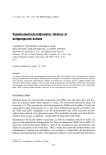
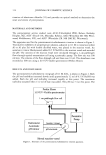
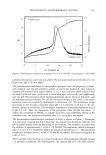
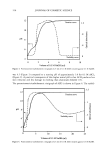
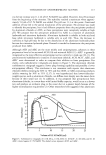
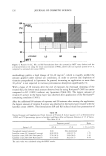
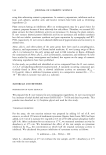
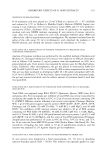
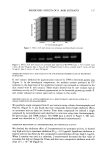
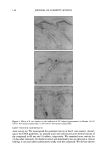
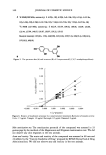
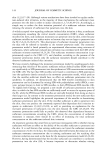
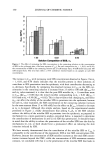
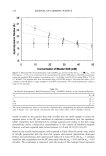
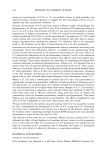
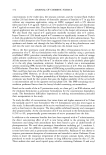
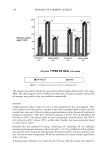
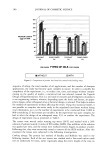
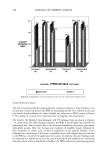
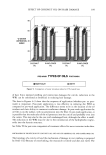
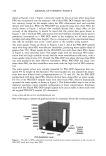
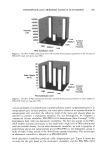
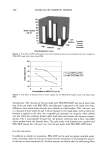
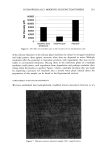
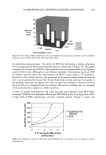
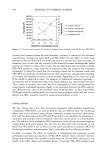
204 JOURNAL OF COSMETIC SCIENCE 450,000 - 45 400,000 •. 40 350,000 -. 35 300,000 ' 30 • i 250,000 25 .• 200,000 20 • 150,000 15 • 100,000 10 50,000 • 5 o • , T Io 2.5 3.0 3.5 4.0 4.5 Viscosity - with DCP Viscosity - with PEG-DCP Syneresis with PEG-DCP Syneresis with DCP Elastomer Concentration (wt %) Figure 11. Viscosity and syneresis for anhydrous antiperspirants thickened with DCP versus PEG-DCP. viscosity and syneresis values for these formulas. Syneresis is reduced as the elastomer concentration increases for both DCP and PEG-DCP, but the effect is much more pronounced for the PEG-DCP. For DCP, the viscosity increase with each increment of elastomer level is such that the viscosity of the formula becomes unmanageable before syneresis is reduced to values close to zero. On the other hand, each increment of added PEG-DCP produced a large reduction in syneresis, while the viscosity was essentially unchanged. It should be noted that the viscosities shown for the formulas made with PEG-DCP are somewhat misleading because these systems are strongly shear thinning. As a result, the measured viscosity is quite variable, depending on the shear rate used. If the sample is subjected to shear--for example, by shaking the container vigorously-- the viscosity will be much lower than it was before shaking, but will increase over time. This increase in viscosity over time may be a consequence of chain entanglement be- tween loosely crosslinked elastomer chains, or an association between the PEG substitu- ents. Whatever the cause of the reversible shear thinning effect, we have found PEG- DCP quite useful for making stable low-viscosity antiperspirants such as roll-ons, and we believe this effect would be useful for aerosol antiperspirants as well. CONCLUSIONS We have shown that a new class of silicone elastomers, PEG-modified dimethicone crosspolymer (PEG-DCP), can provide benefits that are different from the thickening effects that can be achieved using silicone elastomers without functional substituents. Our work has demonstrated that PEG-DCP has utility as an emulsifier for preparing w/s emulsions and multiple (w/s/w) emulsions where the silicone phase is cyclopentasilox- ane. The addition of the hydrophilic PEG substituents to the silicone elastomer improves compatibility with polar organic oils, and this was illustrated with tocopherol. It was found that PEG-DCP is not as effective as the non-functionalized elastomer (DCP) for thickening anhydrous antiperspirants, but is more effective for reducing syneresis. In order to evaluate the effects of variations in composition and processing on the performance and physical properties of PEG-DCP, samples from a two-level factorial design were evaluated. The variables studied were the level of PEG substitution, the length of the PEG chains, and crosslink density. In general, PEG-DCP samples made

HYDROPHILICALLY MODIFIED SILICONE ELASTOMERS 205 with longer PEG substituents were more effective emulsifiers, as measured by a water uptake test, and could accommodate more tocopherol. Emulsification effectiveness and compatibility with tocopherol also increased as the level of PEG substitution increased. The crosslink density of the PEG-DCP had the largest effect on the viscosity elastomer dispersion, with lower crosslink density giving the highest viscosities. These findings suggest that PEG-DCP can be tailored for specific applications by selecting the appro- priate combination of composition and process. REFERENCES (1) W.J. Schulz, Jr. and S. Zhang, U.S. Patent 5,654,362 (August 5, 1997). (2) W.J. Schulz, Jr. and S. Zhang, U.S. Patent 5,811,487 (September 22, 1998). (3) Z. Lin, W.J. Schulz, Jr., and S. Zhang, U.S Patent 5,948,855 (September 9, 1999). (4) Z. Lin, W.J. Schulz, Jr., and J. M. Smith, U.S. Patent 6,080,394 (June 27, 2000). (5) N. E. Prieto and A.J. O'Lenick, J. Cosmet. Sci., 51, 91-101 (2000).
Purchased for the exclusive use of nofirst nolast (unknown)
From: SCC Media Library & Resource Center (library.scconline.org)