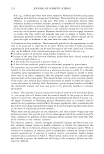
218 JOURNAL OF COSMETIC SCIENCE • A requirement for risk-benefit considerations with adequate animal experimentation to underpin the human studies • A need for informed consent from the subject or legal guardian • Provision of special consideration for vulnerable groups such as children and those with social hardship • Creation of special cases when using live micro-organisms • The responsibility of the unit director should be highlighted • A requirement for the work to be written up in a report and documentation of the consideration given to ethical justification of the study • The need for work to be published while maintaining the dignity of the subject (the first allusion to the confidentiality of the subject) • Additional constraints for non-therapeutic research: (a) Prohibition where consent was not obtained (b) Primacy and preference for laboratory and animal studies to generate data to either negate the need for human experiments or to ensure the validity of the human study (c) Prohibition of studies on minors if there is any risk to the child (d) Prohibition of tests on the dying • Provision of an ethical imperative to carry out research where current known methods are likely to fail • Academic training for physicians carrying out research, in the ethical and scientific aspects of their studies and in their publication Fewer cases of unethical experiments on humans have aroused so much widespread public condemnation than the Nazi atrocities during the Second World War (36). Twenty-three physicians stood trial for war crimes and crimes against humanity. Ex periments had ranged from determining for military purposes the survival period at sub-zero temperatures or low atmospheric pressure, to the assessment of the efficacy of antibiotics and immunization therapies. Malaria experiments resulted in 30 deaths from malaria and a further 300-400 from complications. Female prisoners were given simu lated battle wounds and deliberately infected with gangrene to determine the efficacy of sulphanilamide many died and others were left permanently disabled. Vast collections of human skeletons and organs were amassed to perform anthropological measurements and to study racial specificity. Programs included forced sterilization of Jews, Gypsies, and Poles of child-bearing age using drugs and concealed X-ray units. Less macabre experiments had been conducted elsewhere, including 15,000 criminals and mentally-ill subjects forcibly rendered sterile in the USA (36). Indeed, the French Nobel Laureate Alexis Carrel suggested (36) that criminals and the mentally ill should be "humanely and economically disposed of in small euthanasia institutions supplied with the proper gases." Studies to determine the effect of withdrawing various quantities of blood from subjects were conducted in the US (8) and Germany. In the UK, experi ments into the spread and treatment of scabies were performed on volunteers drawn from conscientious objectors to the war (9). Despite the availability of guidance material, unethical studies were still being conducted, e.g., Children with learning disabilities at Willowbrook School were deliberately infected with hepatitis in order to follow its natural history. It was claimed that the parents of the children consented. However, the information provided to them was deliberately deceptive as it made the inoculations appear to be part of a vaccination programme (10).

ETHICS OF HUMAN TESTING: BACKGROUND 219 In the Tuskegee syphilis experiment 400 poor, black syphilis-positive subjects were studied without treatment even though cheap effective therapy became available. They were not informed about the study but told that they had "bad blood." Their participation was secured by promises of free transport and lunch on "study days" and free medical care and burial after autopsy. This led to guidelines for Institutional Review Boards on the peer review of protocols and the ethical principles which should underpin their decisions (11). Cancer cells were injected into elderly debilitated patients in a New York hospital. The work was funded by the US National Institutes of Health and the case was the subject of an enquiry (10). Parents of premature babies reported that their infants had been included in a research study of a ventilator without their knowledge or consent (12). At one hospital over 2000 organs were removed from 800 children purportedly for research purposes without their parents' knowledge (13). As a result of such events, including the Thalidomide tragedy, a raft of codes appeared,· including the Nuremburg Code (1947), the World Medical Organization's Declaration of Helsinki (1964 and subsequent amendments), the US National Research Act (1974), and the Belmont Report (1979). The Nuremburg Code championed informed consent. It has been argued that this code is based on experiments conducted during wartime and that the experiments were neither ethical nor intended so to be (c.f. with Operation Desert Storm when US military were exempted from the need to gain informed consent when administering a range of therapies to soldiers). The US National Research Act stipulates that all federally funded research must first receive ethical review by Institutional Review Boards (IRBs). The scope and responsi bilities of IRBs are given in Title 21 of the Code of Federal Regulations, Parts 50 and 56, and in Title 45 of the Code of Federal Regulations, Part 46. There is a requirement to follow the Declaration of Helsinki or the Belmont report. The Belmont report (14) • differentiated between research and accepted therapy • addressed basic ethical principles (respect for persons, beneficence, and justice) • reviewed application of general ethical principles (informed consent, risk/benefit assessment, and subject selection) The Declaration of Helsinki is also a set of principles, which include the following dicta: • Biomedical research on humans must conform to accepted scientific principles and be based on data from animal experiments and the literature. • The proposals should be in clearly written clinical protocols for review by ethics committees independent of the sponsor and investigator. The protocol should contain a statement of the ethical considerations involved and confirm compliance with the Declaration. • Trials should be conducted and supervised only by suitably scientifically/medically qualified staff: responsibility for the subjects rests with a medically qualified person and not the subjects themselves. • The importance of the objective must be in proportion to the inherent risk to the subject. Assessment of predictable risk should be considered against foreseeable ben efits to subjects or to others. The interest of the subject must prevail over the interest of science or society.
Purchased for the exclusive use of nofirst nolast (unknown)
From: SCC Media Library & Resource Center (library.scconline.org)