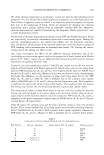
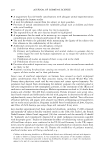
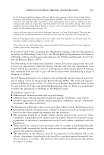
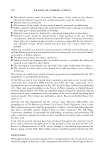
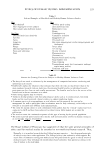
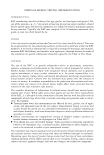
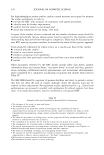
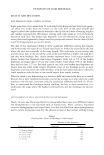
ETHICS OF HUMAN TESTING: IMPLEMENTATION Table I Selected Examples of Non-Medicinal Healthy Human Volunteer Studies Hair Anti-dandruff Hair clipping for in vitro analysis Hair volume salon half-head studies Oral Care Dentinal hard-tissue abrasivicy Calculus Caries Skin 48/96-hr patch testing Arm immersion tests Ballistomecer tests Biopsy Comedogenici ty Cumulative irritation Exaggerated use Flex-wash tests 225 Gingivitis Hoc-room antiperspirant studies (antiperspirants and Malodor Plaque Dentinal hypersensitivity Stains and whitening Taste deodorants) In-use safety Itch testing Occular irritation Photosensitivity Phototoxicicy Repeated-insult patch testing Soap-chamber tests Tape-stripping Transepidermal water loss (corneometer readings evaporimeter studies) Underarm sniff tests Table II Reasons for Growing Concern for Subjects in Healthy Human Volunteer Trials • The duty of care owed to volunteers by the management of companies/institutions conducting and sponsoring such research. • Risk/benefit analysis for volunteers that indicates chat while the risks are much lower than in the more-regulated research trials on medicines, the potential health benefits to individual research participants are less clear-cut, and usually non-existent. The benefits tend to be to the success of the business and to future consumers as a whole. • Some testing regimes may be invasive. • Trends to develop products with more physiological claims such as in cosmeceuticals, functional foods, and the need to provide clinical evidence to support marketing claims. • A common practice of using employees as trial subjects and the potential for coercion by management for staff to participate (their involvement must be truly voluntary), or for subjects to be overused or recruited onto different trials simultaneously. • The trend for journal editors to seek confirmation from authors chat the "clinical" studies have been conducted to GCP and have been subjected to ethical review before papers are accepted for publication. • The need to ensure the continued acceptance of this type of testing by the general population. • The need to provide protection for the scientific staff and institutions involved in human testing in an increasingly litigious environment. The Royal College of Physicians has suggested (2) that the same general principles of ethics used for medical studies be extended to non-medicinal human research. Thus, Naturally, it is in medical research chat this College has most expertise ... but the general principles of ethical review have wider application. The College believes that authorities which appoint Re search Ethics Committees serving non-medical areas will profit from this guide to ethical review of medical research. They will adapt the membership of any Committee they appoint according to the class of studies to be undertaken.

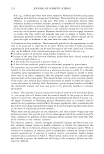
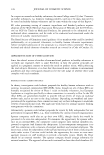
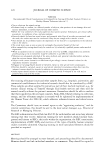
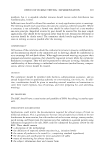
226 JOURNAL OF COSMETIC SCIENCE In a report on research on healthy volunteers, the same College stated (3) that "Cosmetic and other substances, e.g. domestic washing powders, used on or by man, may need to be tested on healthy human volunteers and so come within the scope of this Report." EU rules governing testing of cosmetic ingredients and finished products requires adoption of the World Medical Association Declaration of Helsinki and the EU Direc tive on GCP for Trials on Medicinal Products, for protocols to be submitted to an authorized ethics committee, and for trials to be conducted and monitored under the direction of suitably trained personnel. The Royal Society of Chemistry issued guidance (4) to members who could be involved professionally, or as potential volunteers, in healthy human volunteer experiments. Advice included submission of test proposals to a research ethics committee. The pro fessional and ethical elements of market research are covered in a Code of Conduct (5 ). IMPLEMENTATION OF ETHICAL REVIEW Since the ethical review of studies of non-medicinal products in healthy volunteers is currently not regulated, there is some flexibility in how the general principles are applied in a pragmatic manner to match the needs to product sector, while protecting the trial subjects. However, it is clear that this research must conform to international guidelines and that investigators should not be the sole judge of whether their work complies with such standards. RESEARCH ETHICS COMMITTEES (RECS) In theory, investigators could submit proposals for healthy human volunteer trials to existing, recognized, independent RECs/IRBs. Some, though not all, of these RECs are formally recognized for review of Phase 1 trials on healthy volunteers, but European legislation as it applies specifically to these committees is currently in flux. In the UK these RECs are government-funded to provide ethical review of trials on medicinal products only, and at no cost to the drug industry. Depending on workload and inter pretation of the regulations, these committees may vary in their willingness to undertake reviews of non-medicinal trials. The applicant would need to arrange separate funding arrangements with the committee. Alternatively, sponsors could submit proposals for review by fully independent but not government-recognized RECs, e.g., those established by contract research organizations. Sponsor companies could also set up their own RECs, though clearly this would be perceived to be even less independent. To minimize the opportunity for sponsor influ ence on an internal REC, the committee could comprise only external members em powered to appoint (and dismiss) the chairperson. A less-transparent arrangement is to staff the committee with a mixture of external members and internal employees. The latter must at least be independent of the staff and reporting-line of those conducting the trials under review. Criticism could include the opportunity for covert or overt man agement pressure on staff members to provide a favorable review. Ideally the Chair should be an external member. The sponsor company should arrange indemnity for external members. The approach of one multi-national has been described elsewhere (6).
Purchased for the exclusive use of nofirst nolast (unknown)
From: SCC Media Library & Resource Center (library.scconline.org)