ETHICS OF HUMAN TESTING: IMPLEMENTATION 229 members, but it is arguable whether minutes should receive wider distribution (see Confidentiality, below). Sufficient time should be allowed for members to study applications prior to meetings. The meeting should reach unanimous decisions by consensus wherever possible. Where a consensus is not achievable, a formal vote should be taken based on a one-member one-vote principle. Expedited reviews by post should be reserved for the most simple applications they should be the exception rather than the rule. Reasons for deferment or rejection should be clearly stated. The committee should notify applicants of its deci sions in writing as soon as possible after the meeting. CONFIDENTIALITY All business of the committee should be conducted in private to preserve confidentiality, and documentation related to the committee and its meetings should be confidential so as to encourage full and frank debate. When applicants attend meetings to present their proposals and answer questions, they should be requested to leave while the committee formulates its response. They will not be permitted to take part in voting. Similarly, the confidentiality of data relating to individual trial volunteers (medical history, compen sation, adverse events) should be ensured. FINANCIAL The committee should be provided with facilities, administration assistance, and an annual budget from its appointing authority to cover training, site visits, etc. In addi tion, consideration should be given to awarding external members an honorarium to cover their travel expenses, loss of earnings, and time preparing for, and attending, meetings. REC PROCEDURES The REC should have a constitution and portfolio of SOPs describing its modus oper andi. ETHICS REVIEW DOCUMENTATION Applications could mirror the documentation required for ethical review of trials on medicinal products. This is good practice for true clinical studies but is likely to be over burdensome for more routine, low-risk studies such as hot-room sittings, sensory studies, patch testing, and flavor trials. For routine tests that conform to a general pattern using substances recognized to be safe, SOPs could be submitted for generic review by the REC. These should contain • a description of the methodology • the definition of expected adverse reactions (e.g., irritation levels) • the nature of products to be tested (i.e., comprising standard ingredients) • the decisions and justification for prior assessment of safety • means of monitoring for adverse reactions • the subject information sheet and consent form

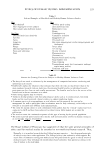
230 JOURNAL OF COSMETIC SCIENCE For high-throughput routine studies, quality control measures are required to monitor the studies periodically in order to • provide the REC with assurance of compliance with agreed procedures, • identify areas for further improvement, • confirm that the system is not abused, and • check that volunteers are not being "over used." A report of the number of tests conducted and the number of adverse events should be reviewed periodically. Serious adverse events must be reported to the chairman within three working days and followed through to completion. These must be discussed at the next REC meeting to permit members to reconsider the status of their generic approval. Trials should be submitted for ethical review on a case-by-case basis if they involve • "proof of principle studies" • novel or non-routine protocols • products containing novel ingredients • products that have previously caused harm and have since been modified • mrnors Other documents reviewed by the REC should include safety data sheets, panelist information sheets and consent forms, "case-report forms" to record trial data, question naires including confidential medical questionnaires, and recruitment advertisements. Issues considered by a committee in preparing its opinion will include those listed in Table IV. The REC/IRB should be cognizant of sponsor deadlines and strive to provide a service that does not delay the start of studies, although clearly the sponsors must also be realistic in their expectations. For regulatory studies, applications for, e.g., clinical trial authorizations can proceed in parallel with application for ethical support, but these trials, if on medicinal products, must be reviewed by a recognized REC. Table IV Examples of Factors Considered by Research Ethics Committees • The relevance of the study, its aims and design. • The benefits versus the risks. • The suitability of the researchers (review of investigator CV) availability of medical support/supervision during the trial and aftercare and the rights to terminate the study scientific responsibilities for preparation, dosage control, and quality assurance of product and analysis of samples. • The safety of the products including purity, and the properties of likely contaminants/additives, and evidence to confirm minimal risk ro subjects. • The suitability of the facilities for the trial (by visiting the test facility if necessary). • The arrangements for recruiting subjects (informed consent, inclusion/exclusion criteria). • The special requirements for recruiting minors, volunteers whose first language is not English, etc. • Medical histories and degree of supervision during, and after, exposure. • The means of identifying, recording, and investigating adverse events. • The amounts of, and the arrangements for, rewards to volunteers and external investigators, and compensation to subjects who are injured (e.g., "No Fault" compensation). • Mechanisms to prevent overuse of individual volunteers. • Documentation (records, reports, security, archiving).
Purchased for the exclusive use of nofirst nolast (unknown)
From: SCC Media Library & Resource Center (library.scconline.org)