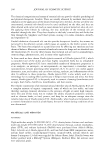
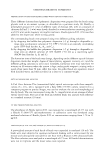
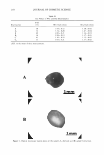
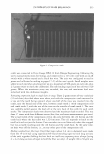
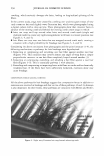
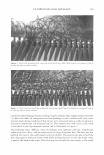
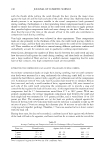
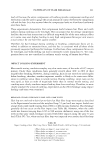
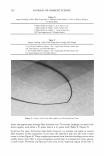
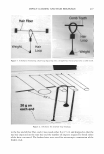
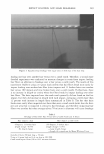
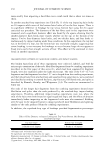
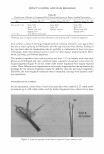
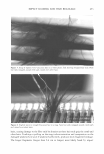
238 JOURNAL OF COSMETIC SCIENCE combing, which seriously damages the hairs, leading to longitudinal splitting of the fibers. In the current study, snags were created by combing one- and two-gram tresses of very curly steam-set hair and slightly wavy Caucasian hair, which were photographed using a digital camera with a close-up lens. These photographs show that crossover hairs in advance of the moving comb and behind the moving comb create snags in which: • hairs can wrap and loop around other hairs and around comb teeth (single and multiple teeth) to create very tight entanglements with hairs in stressed positions (see Figures 3, 4, and 5), • hair fibers can cross over taut hairs that are wrapped around comb teeth, creating a situation with a high probability for breakage (see Figures 3, 4, and 5). Considering the above conclusions from photographs and the prior literature (1-4), the following mechanisms or pathways for hair breakage were hypothesized: 1. Impacting or compressing and extending one hair fiber against another taut hair (Figures 3-5). This condition may involve almost any angle of wrap from a simple perpendicular crossover to one hair fiber completely looped around another (3). 2. Impacting or compressing, extending, and abrading a hair fiber against a taut hair fiber (Figures 3-5). This is essentially pathway 1 with abrasion. 3. Extending and compressing or impacting hairs with flaws or cracks and/or chemically weakened hair. If the fibers have been sufficiently weakened, extension alone may cause breakage. COMPRESSION FORCES DURING COMBING All the above pathways for hair breakage suggest that compression forces in addition to extension are involved in breakage and that in two of these pathways (2 and 3 ), abrasion is also important. In other words, these pathways are consistent with Brown and Swift's Figure 3. Slight wavy Caucasian hair snag beneath advancing comb.

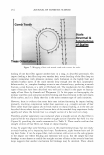
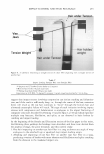
PATHWAYS OF HAIR BREAKAGE 239 Figure 4. Very curly Caucasian hair snag underneath advancing comb. Note looped and crossover hairs at or near the hair-to-comb interface. Figure 5. Very curly Caucasian hair underneath advancing comb. Note the looped and crossover hairs at or near the hair-to-comb interface. conclusion that breakage during combing is more complex than simple tensile extension (3). Since the effect of compression on hair breakage is not a widely held view, com pression loads during combing of hair tresses were measured using a comb containing a miniature compression cell mounted onto it. The compression comb used in this work is described in the Experimental section and is illustrated in Figure 1. The following three different ways of combing were explored with the compression comb using two-, four-, and six-gram tresses of virgin Caucasian hair: The first way was holding the tress in the comb loosely with the thumb. The second way was to hold the hair snug against the back of the comb while pulling the hair so that the major stress is against the back of the comb. The third way was to hold the tress snugly in the comb
Purchased for the exclusive use of nofirst nolast (unknown)
From: SCC Media Library & Resource Center (library.scconline.org)