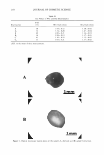
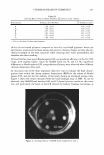
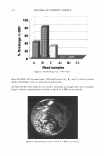
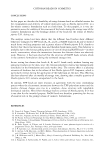
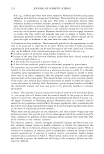
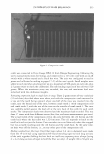
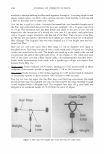
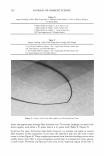
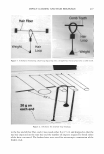
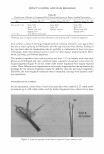
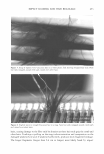
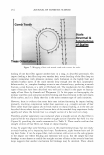
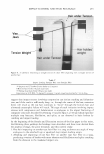
23 JOUR1 1 r\L OF CO MET.IC SClfaTCE attached to the tape holding the fiber ends together, through a 15-cm-long single-strand plastic-coated copper wire (#16) with a circle at one end to ind the fiber to the tape and a hook at the other encl to attach the weight. l-foir loojJ over str,,ight hair i,n t'ICI. A strai �hr horizontal hair was threaded through one of the fiber loops (descri eel above) and the loo was weighted with a 20-gram loa (total wt 21 g). The horizontal hair was held firmly and taped to the jaws of one vise and draped over the bottom jaw of a second vise (vise jaws 4. 5 cm apart), and pulled taut with a 10-gram weight attached to the free end of the fiber. Then the part of the fiber on the vise jaw was taped to the bottom hard-rub er jaw of the second vise to minimize fiber slippage. The weighted loop was then dropped at a 15-cm height onto the hori zontal hair fiber. Hair loop over comb tooth impact. Hair fiber loops 6.4 cm in diameter were made as described above. Each loop was placed over a comb tooth, and a 50 gram or a 30 gram weight was connected to the wire. �rl1e weight was raised up to the comb in the vise and droppe near the ack of the comb tooth (drop ] 5 cm) (:Figure 2). The comb teeth used were of two types cut from a Blue Goody comb, with measurements described below. Comb tooth measurements 'ere made with a spindle-type caliper micrometer from General Tools Mfg. Inc.: Thick tooth: Tooth thickness 0. 70 inches, tapering to 0.056 inches (tooth to about midpoint of micrometer spindle or approximately 1 778 to 1422 microns) . .Fine tooth: Tooth thickness 0.049 inches, tapering to 0.037 inches (tooth to midpoint of micrometer spindle or approximately 1245 microns to 940 microns). Hair loop over hair loop impact. For this fiber loop over fiber loop experiment, the taped end of one hair loop was clamped into one vise with another hair loop threaded through it and weighted wit a 30-gram load. The weighted hair loop (31 g total load) was dropped at an estimated height of 15 cm from the point of impact. Hair Fiber Weight ... ····•.,. ··•. Hair Loop GombT�th Hair Loop ··········Weight Figure 2. Hair loop over straight hair versus hair loop over comb tooth.

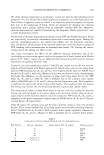
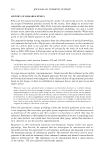
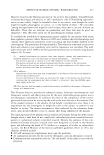
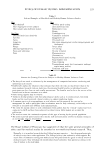
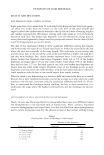
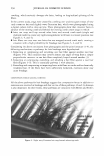
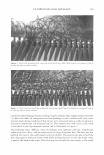
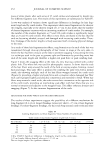
PATHWAYS OF HAIR BREAKAGE 237 RESULTS AND DISCUSSION HAIR BREAKAGE DURING COMBING OF TRESSES Eight-gram hair tresses made from 14-inch dark brown European hair were both square cut about two inches from the bottom (so the ends were of the same length) and angle-cut about two inches from the bottom to the tip (the ends were of varying lengths) and combed vigorously for 100 strokes, starting each comb stroke at 17 .8 cm from the bottom of each tress. The broken hair fragments were all collected on a large piece of white plastic and separated by length into five groups and counted. See the data of Table I and the Experimental section for details. The data of this experiment (Table I) show significant differences among hair lengths and between the two types of cut. Clearly more hairs are broken by crosscutting the hair where the ends are essentially of the same length. This technique of crosscutting hair provides more hairs at the end of the comb stroke and therefore a higher end peak force and thus more breakage. But, clearly another important factor is the larger number of shorter broken hair fragments than longer fragments. Only 3% to 5% of the broken fragments are longer than 17 .8 cm (the comb stroke), while about 70% of the broken hairs are less than 1.27 cm. For both types of cut, only two broken hair fragments are longer than the comb stroke length. Therefore, most of the breakage occurs in short fragments at or near where the comb interfaces with the hair rather than above where the comb interfaces with the hair as one would expect from tensile loading. Thus the comb is not functioning as a device to hold and stretch the hairs as in tensile fracture, but a more complex interaction is occurring at snags at or near where the comb interfaces with the hair, consistent with the conclusion of Brown and Swift (3). There fore, to understand hair breakage during combing, the key to these interactions is to understand the snags where the highest combing forces and hair breakage are encoun tered. ENTANGLEMENTS IN SNAGS AND PATHWAYS FOR HAIR BREAKAGE Nearly 30 years ago, Brown and Swift (3) photographed hair snags in an SEM and related the entanglements to the fractured ends of human hairs. These scientists illustrated crossover entanglements and looped hairs, but also described how these entanglements lead to cuticle disruption caused by the abrasive actions of hair on hair rubbing during Table I Combing Hair Tresses and Breakage by Hair Length Number of hair fragments Broken-hair lengths Cross-cut Angle-cut 17 .8 cm or longer 2 2 12.7 to 17.8 cm 33 16 6.4 to 12.7 cm 63 23 1.27 to 6.4 cm 192 64 d.27 cm 754 238
Purchased for the exclusive use of nofirst nolast (unknown)
From: SCC Media Library & Resource Center (library.scconline.org)