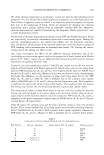
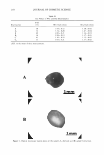
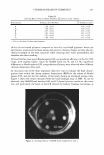
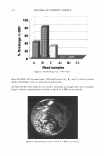
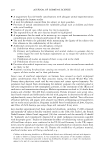
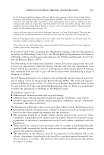
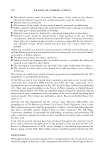
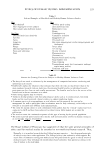
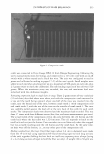
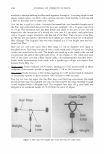
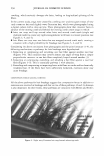
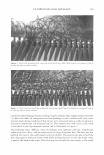
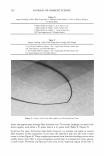
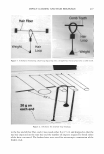
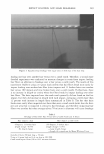
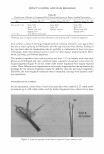
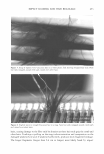
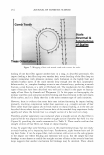
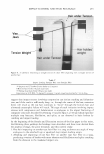
242 JOURNAL OF COSMETIC SCIENCE Table IV Impact Loading a Hair Fiber Loop Over a Thinner-Comb Tooth (-1245 to 940 µ) Using a 5 1-Gram Load 8 Fibers broke on impact 1, 2 at contact site 2 fibers broke on impact 2 near contact site 2 fibers broke on impact 5, 1 near contact site (22 Total impacts and 12 broken hairs) Table V Impact Loading a Hair Fiber Loop Over a Single Hair (Loop) 10 of 10 hairs broke on impact 1 for 51-gm load, all near contact site (10 Total impacts and 10 broken hairs) 12 of 12 hairs broke on impact 1 for 31-gm load, all near contact site (12 Total impacts and 12 broken hairs) Figure 6. Crease in hair loop after impact over horizontal taut hair. where the approximate average fiber thickness was 70 microns, breakage occurred with fewer impacts with either a 51-gram load or a 31-gram load (Table V, Figure 5). In all but five cases, the bottom hair broke however, no attempt was made to control fiber diameter in this experiment. In all cases, the unbroken loop was left with a small crease in it (see Figure 6). These simple experiments show that hair breakage occurs more readily when a hair fiber is impacted against another hair as compared to a hair against a comb tooth. Therefore, the force per unit area in the impacted region of the hair is

PATHWAYS OF HAIR BREAKAGE 243 critical to breakage. So during combing, when a snag is encountered, and a single hair is impacted or pulled/stressed against another object, the smaller that object (hair over hair versus hair over thin or thick comb tooth), the more readily the hair will break. CONCLUSIONS By examining photographs of snags and the resultant hair-on-hair arrangements and interactions, three pathways for hair breakage were described. Compression loads during combing were estimated by combing hair tresses with a comb fitted with a miniature compression cell and by comparing impact loading of a hair fiber over another hair versus over a comb tooth. The results of these experiments show that compression and abrasion are important to breakage during combing and that impact loading of hairs over other hairs during snagging is a likely route for hair breakage. This preliminary conclusion, based on a few impact loading experiments, will be followed up in a subsequent publication focusing more on the impact loading of hair fibers, to try to more fully assess its relevance to hair breakage during combing. REFERENCES (1) Y. K. Karnath and H.-D. Weigmann, Fractography of human hair,]. Appl. Polym. Sci., 27, 3809-3833 (1982). (2) Y. K, Karnath, S. B. Hornby, and H.-D. Weigmann, Mechanical and fractographic behavior of Ne groid hair,]. Soc. Cosmet. Chem., 35, 21-43 (1984). (3) A. C. Brown and J. A. Swift, Hair breakage: The scanning electron microscope as a diagnostic tool,]. Soc. Cosmet. Chem., 26, 289-299 (1975). (4) J. A. Swift, The mechanics of fracture of human hair, Int.]. CoS1net. Sci., 21, 227-239 (1999). (5) C.R. Robbins, Chemical and Physical Behavior of Human Hair, 4th ed. (Springer-Verlag, New York, 2002), pp. 256, 390. (6) W. Hamburger, H. M. Morgan, and M. M. Platt, Some aspects of the mechanical behavior of hair, Proc. Sci. Sect. TGA, 14, 10-16 (1950). (7a) N. P. Khumalo et al., What is normal black African hair? A light and scanning electron-microscopic study,]. Am. Acad. Dermatol., 43, 814 (2000). (76) M. L. Garcia and J. Diaz, Combability measurements on human hair,]. Soc. Cosmet. Chem., 27, 379-398 (1976). (8) G. V. Scott, Colgate Palmolive Internal Report, June 25, 1974. (9) M. L. Tate, Y. K. Karnath, S. B. Ruetsch, and H.-D. Weigmann, Quantification and prevention of hair damage,]. Soc. Cosmet. Chem., 44, 347-373 (1993). (10) P. Alexander et al, Wool: Its Chemistry and Physics, 2nd ed. (Franklin Publishing Company, New Jersey, 1963), pp. 61-65. (11) C.R. Robbins, Chemical and Physical Behavior of Human Hair, 4th ed. (Springer-Verlag, New York, 2002), pp. 168-171. (12) C. R. Robbins, Ibid, pp. 398-399 (2002).
Purchased for the exclusive use of nofirst nolast (unknown)
From: SCC Media Library & Resource Center (library.scconline.org)