]. Cosmet. Sci.) 54, 245-257 (May/June 2006) Hair breakage during combing. II. Impact loading and hair breakage CLARENCE ROBBINS, 12425 Lake Ridge Circle) Clermont) FL 34711. Accepted for publication January 4, 2006. Synopsis During combing of hair, short fiber fragmentation (less than 2. 5 cm) and longer segment breaks occur by different pathways. Longer fiber breaks most likely occur principally by impact loading. Impact loading causes hair breakage at lower loads than tensile loading, with essentially no increase in strain versus normal tensile testing, which produces large strain increases. Strain rates in impact loading are more similar to combing rates than rates of extension in tensile loading, and the looped and crossed hair formations in snags fit impact-load breakage better than simple extension of straight/non-crossed hairs in tensile testing. Extension or impacting hair fibers with flaws or damaged hair sections such as damaged wrapped ends produces short fiber fragmentation, while longer segment breaks may be produced in fibers with natural flaws such as fiber twists, cracks, or badly abraded or chemically weakened hair or even knots. INTRODUCTION The objective of this work was to provide a better understanding of how human hair fibers break during combing or brushing, with the hope of ultimately leading to approaches for assessing the strength of hair fibers under conditions that are relevant to actual hair breakage. In the first paper in this series (1), hair snags were examined to determine the important hair-on-hair versus hair-on-comb arrangements and interac tions that might be involved in breakage. In addition, the inadequacies of tensile testing for explaining hair breakage on live heads were presented, and one impact-loading experiment was reported, suggesting that impact loading may be more relevant to breakage then simple tensile loading, a conclusion consistent with the observation by Brown and Swift about 30 years ago (2) that hair breakage on the head "is more complex than simple tensile fracture of single hairs." The focus of this paper is to explore additional variables via impact-loading experiments with hair fibers and to examine the ends of hairs broken by combing and impact loading to try to determine those condi tions most relevant to breakage during the combing of hair. EXPERIMENTAL The hair used in all of these experiments was purchased as 12-inch dark-brown virgin 245

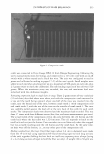
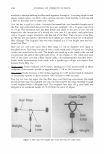
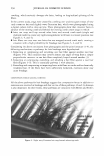
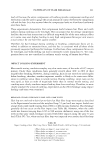
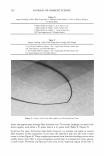
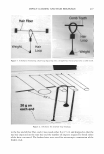
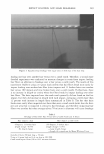
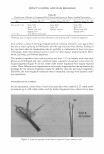
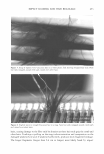
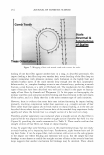
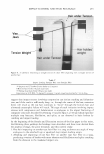
246 JOURNAL OF COSMETIC SCIENCE hair from Caucasians, reported to be undamaged, and purchased from DeMeo Brothers of New York City. This hair actually measured 14 inches. In some experiments, small tresses of highly coiled steam-set hair (12-inch hair), purchased from DeMeo Brothers, was also used. All experiments were conducted at 41 ±2% RH and room temperature. MAKING WEIGHTED HAIR FIBER LOOPS Hair fiber circles/loops (about 6.4 cm in diameter) were made from the 14-inch hair using tape (Scotch® brand mending tape) to bind long sections of the ends together (folding the hair back on itself over separate pieces of tape (using 4 x 4-cm-long sections of tape) to hold the fiber securely). A weight (10-50-gm load) was attached to the tape holding the fiber ends together, through a 15-cm-long wire (single-strand plastic #16 coated copper wire) forming a wire circle at one end to bind the fiber to the tape and a hook at the other end to attach the weight. IMP ACTING HAIR LOOP OVER STRAIGHT HAIR SECTION A straight horizontal hair was threaded through one of the fiber loops (described above) and the loop was weighted with a 20-gram load (total wt 21 g). The horizontal hair was held firmly and taped and clamped to the jaws of one vise and draped over the bottom jaw of a second vise (vise jaws 4.5 cm apart) and pulled taut with a 10-gram weight attached to the free end of the fiber. Then the part of the fiber on the vise jaw was taped to the bottom hard rubber jaw of the second vise to minimize slippage. The weighted loop was then dropped at a 15-cm height onto the horizontal hair fiber. IMPACTING HAIR LOOP OVER COMB TOOTH Hair fiber loops (6.4 cm in diameter) were made as described above. Each loop was placed over a comb tooth and a 50-gram or a 30-gram weight was connected to the wire, providing a total weight of 51 to 31 grams. The weight was raised up to the comb in the vise and dropped near the back of the comb tooth (15 cm) (Figure 1). The comb teeth used were of two types cut from a Blue Goody comb, with the measurements described below. The comb tooth measurements were made with a spindle-type caliper microm eter from General Tools Mfg. Inc.: Thick tooth: Tooth thickness 0.070 inches, tapering to 0.056 inches (tooth to about midpoint of micrometer spindle or approximately 1778 to 1422 microns) Fine tooth: Tooth thickness 0.049 inches, tapering to 0.03 7 inches (tooth to midpoint of micrometer spindle or approximately 1245 microns to 940 microns) ATTACHED-LOOP EXPERIMENTS A 14-inch hair fiber with tape on each end was hung over two adjacent thick teeth of a comb, held in a vise. Twenty-gram weights were attached to each end of that hair via clamps. One end of another 14-inch hair fiber was held firmly by taping it to a marked position on the table top alongside the vise, and the free end was fed between the two comb teeth and over the taut hair (Figure 2). A weight (10 to 30 grams) was attached
Purchased for the exclusive use of nofirst nolast (unknown)
From: SCC Media Library & Resource Center (library.scconline.org)