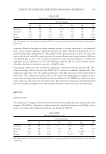
JOURNAL OF COSMETIC SCIENCE 172 left are samples CE1, CE4, and CE6, characterized in terms of “nourishing,” “softening,” “fresh,” “moisturizing,” “delicious smell,” “natural,” “use on body,” and “night time use.” Fragrance E4 was selected for the further development of a cosmetic cream as it had the highest overall liking scores among respondents of the two clusters and was signifi cantly associated with “nourishing,” “moisturizing,” “softening,” “delicious smell,” and “mild smell,” as well as considered a suitable fragrance for face and body creams, and associated with a “natural” image. CONCLUSIONS Use of “CATA” questions allowed the identifi cation of different perceptions of six fra- grances among consumers. The results provided an insight into consumers’ perceptions of different aspects of creams associated with their fragrances, including their possible effects on the skin, affective associations, zone of application, and target market. The selection of a suitable fragrance can contribute to reinforcing product image, and the use of CATA questions enables the rapid identifi cation of associations made by consumers with a cream’s fragrance, as well as providing useful insight on possible marketing and communication strategies. ACKNOWLEDGMENT We thank Lariales S.A. for advice on selecting the fragrant essences used in this study. Figure 2. Correspondence analysis plot for CATA terms associated with the different types of fragrance by Cluster 2 respondents.

SELECTION OF FRAGRANCE FOR COSMETIC CREAM CONTAINING OLIVE OIL 173 REFERENCES (1) A. Abriat, S. Barkat, M. Bensafi , C. Rouby, and V. Guillou, Emotional and psychological effects of fra- grance in men´s skin care, IFSCC Magazine, 8, 255–300 (2005). (2) C. Rouby, S. Pouliot, and M. Bensafi , Odor hedonics and their modulators. Food Qual. Prefer., 20, 545–549 (2009). (3) E. Oelkers. Perfumes y cosmética La infl uencia de las notas de "perfumería fi na" en la perfumación de productos cosméticos. Contac 54, Haarmann & Reimer. 20–26 (1991). (4) R. Dollase, “The motivation for perfume choice: A naive-psychological reinterpretation of fi ndings in odor and perfume,” in The Psychological Basis of Perfumery, 4th Ed., J. S. Jellinek. Ed. (Blackie Academic and Professional, Chapman and Hall, London, 1996), Chapter 24, pp. 218–231. (5) J. S. Jellinek, El perfume y el marketing mix, Dragoco Rep. 3, 103–121 (1992). (6) R. Schueller and P. Romanwsky, The essence of fragrance, Cosmet. Toiletr., 120, 67–71 (2005). (7) P. Jellinek, “Fragrance in cosmetic products,” in The Psychological Basis of Perfumery, 4th Ed., J. S. Jellinek. Ed. (Blackie Academic and Professional, Chapman and Hall, London, 1997), Chapter 16, pp. 131–137. (8) M. E. Parente, A. V. Manzoni, and G. Ares, External preference mapping of commercial antiaging creams based on consumers’ responses to a check-all-that-apply question, J. Sens. Stud., 26, 158–166 (2011). (9) A. Gámbaro, E. Parente, A. Roascio, and L. Boinbaser, Word Association Technique Applied to Cos- metic Products. A case study. J. Sens. Stud., 29, 103–109 (2014). (10) K. A. Rasinski, D. Mingay, and N. M. Bradburn, Do respondents really mark all that apply on self- administered questions? Public Opin. Q., 58, 400–408 (1994). (11) J. D. Smyth, D. A. Dillman, L. M. Christian, and M. J. Stern, Comparing check-all and forced-choice question formats in web surveys, Public Opin. Q., 70, 66–77 (2006). (12) P. Varela and G. Ares, Sensory profi ling, the blurred line between sensory and consumer science. A re- view of novel methods for product characterization, Food Res. Int., 48, 893–908 (2012). (13) L. Dooley, Y. S. Lee, and J.F. Meullenet, The application of check-all-that-apply (CATA) consumer pro- fi ling to preference mapping of vanilla ice cream and its comparison to classical external preference mapping, Food Qual. Prefer., 21, 394–401 (2010). (14) M. E. Parente, G. Ares, and A.V. Manzoni, Application of two consumer profi ling techniques to cos- metic emulsions, J. Sens. Stud., 25, 685–705 (2010). (15) G. Ares, P. Varela, G. Rado, and A. Gimenez, Are consumer profi ling techniques equivalent for some product categories? The case of orange-fl avoured powdered drinks, Int. J. Food Sci. Technol., 46, 1600– 1608 (2011). (16) G. Ares, P. Varela, G. Rado, and A. Giménez, Identifying ideal products using three different consumer profi ling methodologies. Comparison with external preference mapping, Food Qual. Prefer., 22, 581– 591 (2011). (17) M. E. Parente, G. Ares, and A.V. Manzoni, Application of two consumer profi ling techniques to cos- metic emulsions. J. Sens. Stud., 25, 685–705 (2011). (18) M. E. Parente, A. V. Manzoni, and G. Ares, Incidencia de la fragancia en la percepción de cremas humectante por consumidores. (Congreso Latinoamericano e Ibérico de Químicos Cosméticos, Isla Margarita, Venezuela, 2011), Medio de divulgación: CD-Rom. (19) D. Plaehn, CATA penalty/reward, Food Qual. Prefer., 24, 141–152 (2012). (20) J. S. Jellinek, También olemos con la cabeza. Dragoco Rep., 4, 125–131 (1996). (21) IOC, Sensory Analysis of Olive Oil—Method for the Organoleptic Assessment of Virgin Olive Oil, IOC/T.20/Doc. no 15/Rev. 4, (International Olive Council, Madrid, 2011). (22) A. Gámbaro, E. Parente, A. Roascio, and L. Boinbaser, Word association technique applied to cosmetic products: A case study, J. Sens. Stud., 29, 103–109 (2013). (23) M. Greenacre, “Correspondence Analysis,” in International Encyclopedia of Education, 3rd Ed. (New York, 2010), Vol. 8, pp. 103–111. (24) M. A. Muñoz, V. G. Civille, and B. T. Carr, Sensory evaluation in quality control, (Van Mostrand Reinhold, New York, 1992), pp. 240.
Purchased for the exclusive use of nofirst nolast (unknown)
From: SCC Media Library & Resource Center (library.scconline.org)