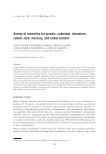
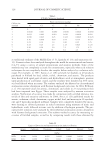
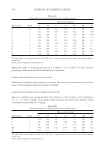
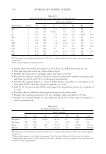
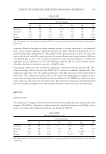
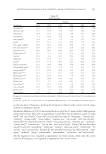
JOURNAL OF COSMETIC SCIENCE 170 Table VI CATA Results for Cluster 2 Attribute Sample CE1 CE2 CE3 CE4 CE5 CE6 Nourishingns 14.6 9.8 7.3 19.5 12.2 12.2 Moisturizingns 24.4 22.0 22.0 36.6 19.5 17.1 Softeningns 19.5 12.2 24.4 26.8 9.8 17.1 Energizingns 4.9 12.2 9.8 2.4 0.0 9.8 Anti-agingns 2.4 0.0 12.2 4.9 12.2 2.4 Anti-wrinklens 0.0 2.4 2.4 4.9 9.8 0.0 Freshns 14.6 14.6 29.3 22.0 7.3 19.5 For young womenns 14.6 9.8 14.6 17.1 2.4 19.5 For older women* 14.6 31.7 31.7 14.6 36.6 17.1 Daytime usens 24.4 31.7 12.2 22.0 12.2 24.4 Night time usens 12.2 4.9 17.1 17.1 14.6 14.6 Naturalns 17.1 4.9 17.1 22.0 9.8 12.2 Artifi cialns 22.0 39.0 29.3 14.6 34.1 39.0 Cheap* 24.4 36.6 22.0 24.4 46.3 46.3 Delicious smell* 19.5 7.3 26.8 31.7 7.3 19.5 Disagreeable smellns 14.6 29.3 17.1 14.6 34.1 26.8 Strong smell*** 17.1 48.8 17.1 12.2 41.5 51.2 Mild smell*** 53.7 9.8 43.9 41.5 14.6 14.6 Popular** 9.8 34.1 14.6 7.3 24.4 17.1 Summer use* 7.3 34.1 12.2 17.1 12.2 24.4 Use on feet* 2.4 19.5 14.6 2.4 17.1 17.1 Use on handsns 31.7 31.7 17.1 22.0 22.0 29.3 Facial use** 4.9 0.0 22.0 17.1 9.8 4.9 Use on bodyns 48.8 22.0 41.5 51.2 46.3 41.5 Frequency of mention by attribute and sample. Only terms used by more than 10% of respondents are shown. *p ≤ 0.05, **p ≤ 0.01, ***p ≤ 0.001, ns: no signifi cant differences (p 0.05) according to Cochran’s Q test. “delicious smell,” “mild smell,” and “for pampering oneself.” Of the creams with the low- est overall liking scores, CE1 had a low frequency of mention among the CATA terms, while sample CE6 was described mainly in terms of “fresh,” “for young women,” “day- time use,” “delicious smell,” and “summer use.” Samples CE4 and CE5 were associated with “older women” by Cluster 1 respondents. Signifi cant differences (p ≤ 0.05) were found for 9 of the 24 CATA terms used by Cluster 2. As for Cluster 1, cream CE4 was described by Cluster 2 in terms of “delicious smell” and “mild smell,” yet its overall liking was rated below the minimum commercial poten- tial threshold. This may support the idea that Cluster 2 respondents did not regard the fragrance of the creams as an important sensory attribute in evaluating their overall liking. Cream CE5, which was assigned the lowest overall liking score by Cluster 2, was de- scribed by this group in terms of “for older women,” “cheap,” and with a “strong smell.” The high odor intensity of this cream, together with its perceived cheapness, may explain the low overall liking scores assigned to CE5.

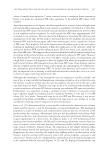
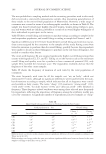
SELECTION OF FRAGRANCE FOR COSMETIC CREAM CONTAINING OLIVE OIL 171 As mentioned above, a correspondence analysis was used to visualize the relationships between products and associations. The resulting perceptual maps are shown for the two clusters in Figures 1 and 2, respectively. The fi rst two dimensions of the correspondence analysis explained 61.2% and 79.2% of the variability of the experimental data for Clus- ters 1 and 2, respectively. Cluster 1 respondents differentiated between three groups of samples (Figure 1). On the right are samples CE3 and CE2, with fruit and lemon fragrances, characterized in terms of “summer use,” “for young women,” “daytime use,” “fresh,” and “energizing.” Below is sample CE4, a complex fragrance with several fl oral constituents, including jasmine and white fl owers, as well as vanilla and sandalwood. CE4 is characterized in terms of “facial use,” “expensive,” “nourishing,” “softening,” and “glamorous,” consis- tent with its high overall liking score. On the left are samples CE1, CE5, and CE6, with fl oral and vanilla fragrances, characterized in terms of “cheap,” “use on hands,” and “night time use.” Figure 2 shows that Cluster 2 respondents differentiated between two groups of samples, with a lesser degree of discrimination than Cluster 1. On the right of the fi gure are samples CE2, CE3, and CE5, characterized in terms of “summer use,” “for older women,” with “disagree- able,” and “strong” smells, “artifi cial,” “cheap,” “for a mass market,” and “use on feet.” On the Figure 1. Correspondence analysis plot for CATA terms associated with the different types of fragrance by Cluster 1 respondents.
Purchased for the exclusive use of nofirst nolast (unknown)
From: SCC Media Library & Resource Center (library.scconline.org)