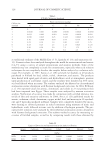
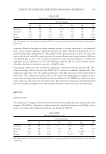
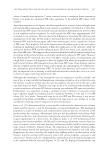
JOURNAL OF COSMETIC SCIENCE 192 range. In acid, a rapid quantitative conversion of the cyanate ion (CNO−) to ammonium ion (NH4+) occurs as shown in equation 1. This reaction is complete at room temperature in suf- fi ciently concentrated acid solution. These fi ndings are in complete agreement with those of Warner (9). The absence of occurrence of reverse reactions in acid media by the rapid hydroly- sis of cyanate promotes the increase in urea degradation rate constant in strong acid condition. l - 2 4 2 3 CNO 2H 2H O NH H CO + + + + + (1) The reversibility is also limited in alkaline solution by the decomposition of cyanate ion in basic environment as depicted in equation 2. This agrees with the increase in urea degradation rate constant in strong basic condition in our experiment. l - - 2 4 3 CNO OH 2H O NH OH CO2- + + + (2) Increase in temperature as well as working out of the range of 4–8 for pH increased the decomposition of urea. The calculated values of the decomposition free energies as a function of pH and tem- perature are shown in Table III and can be used for stability analysis of urea. The higher value of the free energy means the more the stability of urea at a given condition (tem- perature and pH). Therefore, the maximum value of ∆Gi or the maximum stability of urea was obtained at 25°C, the highest initial urea concentration (10%) and pH 6.0 with lactate buffer for the temperature and pH ranges under study. THE KINETICS OF UREA DEGRADATION IN NON-AQUEOUS SOLVENTS A variety of non-aqueous solvents used mainly in pharmaceutical preparations (propylene glycol, glycerol, N-methylpyrrolidone, dimethylisosorbide, ethanol, isopropanol, pentylene Table III The values of the free energies of decomposition, ∆Gi, in kJ/gmol calculated from the experimental data of rate constant with various initial urea concentrations (2.5%, 5%, and 10%) as a function of pH and temperature pH ∆Gi at 25°C (kJ/gmol) ∆Gi at 40°C (kJ/gmol) ∆Gi at 60°C (kJ/gmol) 2.50% 5% 10% 2.50% 5% 10% 2.50% 5% 10% 3.11–3.36 104.16 104.28 104.29 102.67 102.7 102.79 101.59 101.6 101.61 4.08–4.19 104.47 104.49 104.51 102.98 103.02 103.18 101.63 101.67 101.69 6.43–7.36 104.52 104.59 104.63 103.01 103.02 103.2 101.67 101.68 101.72 8.40–8.59 104.46 104.47 104.49 102.96 103.02 103.15 102.39 101.65 101.69 9.40–9.67 103.88 103.92 103.94 102.47 102.6 102.64 101.59 101.6 101.6 6.00 (lactic buffer) 104.59 104.73 104.84 103.04 103.14 103.3 6.00 (phosphate buffer) 104.59 104.69 104.78 103.03 103.1 103.29 6.00 (citric buffer) 104.56 104.6 104.7 102.99 103.05 103.27 4.50 (lactic buffer) 104.5 104.49 104.68 103 103.02 103.22

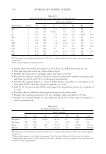
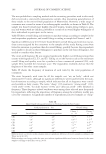
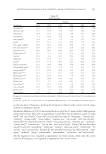
STABILITY OF UREA IN SOLUTION AND PHARMACEUTICAL PREPARATIONS 193 glycol, hexylene glycol, and polyethylene glycol) was intended to evaluate the effect com- paring to aqueous solution on urea degradation rate constant. However, urea did not dis- solve after sonication for 30 min or afterward precipitation in N-methylpyrrolidone, dimethylisosorbide, and hexylene glycol. The urea solutions of concentration 2.5% with residual non-aqueous solvents were prepared and incubated at 25° and 40°C. The linear regression of the decomposition data shows that urea degradation reaction in non-aqueous solvents obeys fi rst-order kinetics at all measured temperature values of the experiments. Table IV demonstrates the values of the rate constant, k, in h-1 calculated from the experimental data of the residual urea concentration as a function of solvent and temperature. Both isopropanol and ethanol show lower degradation rate constants (2.70 × 10⁻⁶ h−1 at 25°C, 3.92 × 10⁻⁵ h−1 at 40°C 2.73 × 10⁻⁶ h−1 at 25°C, 4.02 × 10⁻⁵ h−1 at 40°C, respectively) than that of water (3.03 × 10⁻⁶ h−1 at 25°C, 4.29 × 10⁻⁵ h−1 at 40°C). The calculated values of the decomposition free energies as a function of temperature are also shown in Table IV and can be used for stability analysis of urea in non-aqueous sol- vents. The maximum value of ∆Gi or the maximum stability of urea in non-aqueous solvent was performed by isopropanol used as a solvent for the temperature ranges under study. A work by Alexandrova and Jorgensen (4) also demonstrated that NH3 elimination as- sisted by a water molecule was found to have the lowest activation energy, and the pre- ferred reaction route was initiated via hydrogen transfer between the two amino groups mediated by one water molecule. The forming zwitterionic intermediate, H3NCONH, received substantial stabilization via extended hydrogen bonding to the solvent, and its subsequent decomposition was found to be rate-determining. A computational study of the solution phase decomposition of urea by Estiu and Merz (3) showed that elimination was favored for the solution phase reaction, which proceeded by H-bond coordination of a water molecule to the amine nitrogen atoms. The coordination of one water molecule greatly facilitates the reaction by allowing it to proceed through a cyclic six-member transition state. According to both previous studies, we therefore postulate that water molecule acts as a hydrogen shuffl e for the fi rst step of the elimination reaction. In the elimination step, the hydrogen atom can easily undergo nucleophilic attack by nitrogen atom of one NH2 group followed by concerted H-transfer. Alcohols with various dipole moments in O–H Table IV The values of rate constants, k, in h−1 and the free energies of decomposition, ∆Gi, in kJ/gmol calculated from the experimental data of rate constant as a function of temperature Non-aqueous solvents 25°C 40°C k Value ∆Gi k Value ∆Gi Isopropanol 2.70 × 10⁻⁶ 104.81 3.92 × 10⁻⁵ 103.24 Ethanol 2.73 × 10⁻⁶ 104.78 4.02 × 10⁻⁵ 103.18 Water 3.03 × 10⁻⁶ 104.52 4.29 × 10⁻⁵ 103.01 Pentylene glycol 5.00 × 10⁻⁶ 103.28 6.85 × 10⁻⁵ 101.79 Propylene glycol 5.07 × 10⁻⁶ 103.25 6.85 × 10⁻⁵ 101.79 Glycerol 5.43 × 10⁻⁶ 103.08 6.93 × 10⁻⁵ 101.76 Polyethylene glycol 5.72 × 10⁻⁶ 102.95 6.97 × 10⁻⁵ 101.75
Purchased for the exclusive use of nofirst nolast (unknown)
From: SCC Media Library & Resource Center (library.scconline.org)