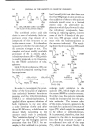
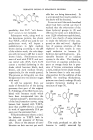
244 JOURNAL OF THE SOCIETY OF COSMETIC CHEMISTS washing whereas that from T.H.T., for example, is very persistent. It was considered to be of decided interest to see the result of applying dihydrolawsone in the presence of ammonium thioglycollate to the skin, since the thioglycollate should produce free SH groups. Caution is necessary in the use of such a mixture since blistering of the skin can and often does occur: the re- sulting reddish-orange stain is, how- ever, much more persistent than that from dihydrolawsone alone, indicating that, as expected, more of the compound (VI) has been pro- duced iron complex formation does not occur under these conditions. It is a well-known fact that juglone [5 (8)-hydroxy- 1,4-naph- thaquinone] which is isomeric with lawsone, will stain skin when ap- plied as its colorless dihydro-deriva- tire. This is attributed to the same series of reactions discussed above for T.H.T. leading ultimately to a structure of type (VII). This mole- cule could clearly form a chelated iron salt through the OH group and the quinone O in the peri position. o (VII) The experimental evidence sup- porting the incorporation of the colorless T.H.T. and, by analogy, the other colorless triphenols, to give dyed materials, and the mode of combination suggested in this lecture, has been submitted for pub- lication in the ]ournal of the Society of Dyers and Colorists. The work appears to have a direct bearing on (a) the coloring (oxidative dyeing) of keratinous proteins (skin, hair, wool), and (b) the production of pigments (which are not melanins) in both the animal and vegetable kingdoms. SWELLING STUDIES OF SINGLE HUMAN HAIR FIBERS* By MILTON G. ECKSTP. OM, Raymond Laboratories, Inc., St. Paul, Minn. Tins p^pEu will be divided into two sections. The first portion will contain a description of the swelling apparatus which has been * Presented at the December 5, 1950, Meeting, New York City. used at Raymond Laboratories. In the second payt, the results of sev- eral actual experiments will be given and discussed, especially in their relation to cold permanent waving. Early work on transverse hair

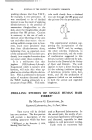
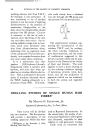
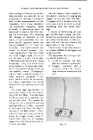
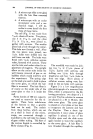
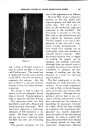
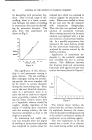
SWELLING STUDIES OF SINGLE HUMAN HAIR FIBERS 245 fiber swelling had shown that several characteristics are desirable in an apparatus for making reproducible and reliable measurements of hair diameters, while those diameters are continually changing. Quite obviously a microscope must be employed to observe the fiber dur- ing the experiment. For recording the changes in diameter in the course of an experiment the two most readily apparent means are photographically or by visual ob- servation. The latter method was chosen for several reasons. Any mounting device for the fiber which we could design would always al- low at least a slight lateral play which had to be corrected by visual inspection. Also, it is often found to be necessary to focus separately on the two edges of fibers which are not perfectly round. Photograph- ing the fiber would of course be a more accurate procedure if the other factors could be controlled, but visual observation has proved sufficient for our purpose up to this time. The most rigid specification for apparatus design is in the mount- ing of the hair fiber. The hair must be firmly anchored at one end, but not at the other. The reason for this is that the longitudinal swelling and deswelling of a fiber anchored at both ends will bow the fiber in and out of the field of view. How- ever, the free end must not be al- lowed to dangle loosely, since it would then drop out of focusing range when the fiber is softened by various solutions. Another feature which should be included is a means of changing the reagent in contact with the fiber. Changing of the solution must be quick and simple in order to avoid interfering with the timed read- ings. A means' of eliminating air and gas bubbles from around the fiber should be incorporated since these can affect the reaction of the solu- tion with the fiber and obscure the observation of the diameter. I believe that these requirements have been fulfilled in the apparatus to be described. The equipment for making swell- ing studies consists of: 1. A cell to contain the hair fiber and the reacting solution. Reagent reservoirs and a manifold system for admit- ting various solutions into the cell. Figure 1.'
Purchased for the exclusive use of nofirst nolast (unknown)
From: SCC Media Library & Resource Center (library.scconline.org)