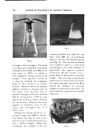
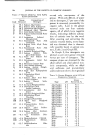
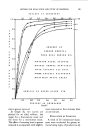
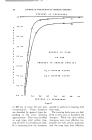
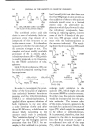
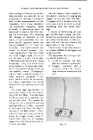
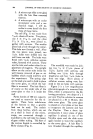
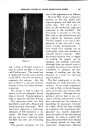
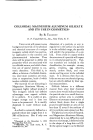
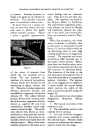
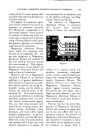
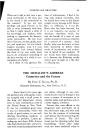
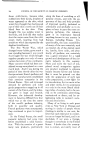
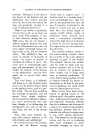
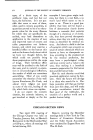
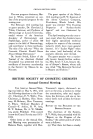
246 JOURNAL OF THE SOCIETY OF COSMETIC CHEMISTS 3. A microscope slide cover glass with the hair fiber mounted thereon. 4. A microscope with an ocular micrometer scale and a me- chanical stage. I will de- scribe in some detail the first three of these items. The cell (Fig. 1)was made from a,/•6-in. sheets of Lucite. Two pieces, one 3 X 11/16 in. and the other 11/2 X 11A• in., were joined to- gether with acetone. The smaller piece had a hole through the center. This hole now formed a well. After the two pieces were joined, two Vs-in. holes were drilled into the well from one side. The holes were fitted with 1/8-in. cellulose acetate tubes, fastened with acetone. These are the inlet and outlet tubes for re- placement of reagents. The upright elbow on the outlet tube inside the well insures removal of gas or air bubbles which would interfere with the experiment. The spring clips on the ends are used to hold in place the cover glass, on which the hair fiber is mounted. The hair fiber is of course on the under side of the cover glass so that it is inside the well Pyrex bottles of 500 ml. capacity are used as reservoirs for the re agents. These have tubulatures at the bottom so that a gravity feed can be used. The outlets from these bottles, which are set on a shelf in front of the micro- scope, are connected through a manifold to the cell inlet by means of gum rubber tubing. The flow of the various liquids is controlled by Mohr clamps (Fig. 2). ' :'•.":'i!½".. 7:-!" ' • : • :•m• 2:• i--' ' ......... • •,•.:'" .... .......... :.•:-:,,,,,...'• :•' ,k: '. • ' .•:•'. :.. _¾ : -'•.5•:• • .:x .... ::.: --. • ...... ........ :: ...... . •'.... ..? . •n•- .... . Figure 2. The manifold was made by join- ing two x/2 X l t/•-in. pieces of a/•o-in. Lucite with acetone, and drilling one l/8-in. hole through lengthwise and four x/8-in. holes in from one edge. Short pieces of cellulose acetate tubing were fast- ened in the six holes with acetone. Figure 3 is a low magnification photomicrograph of a mounted hair fiber, which is prepared by the fol- lowing procedure: two drops of a 5 per cent Vinylite solution in acetone are placed on a 20 X 40-ram. thin slide cover glass. The cover glass is placed on a hot plate at 19w heat to evaporate the acetone and fuse the Vinylite. Then a short (ap- proximately 3 min.) piece of glass capillary is placed on one of the Vinylite spots and the slide cover again heated to bond the capillary to the cover glass. A hair fiber is now threaded through the capillary

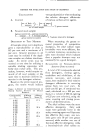
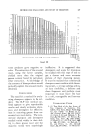
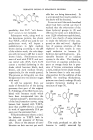
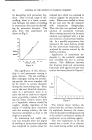
SWELLING STUDIES OF SINGLE HUMAN HAIR FIBERS 247 Figure 3. and a drop of Vinylite solution is used to anchor the fiber to the sec- ond Vinylire spot. The excess hair is clipped off and the mount placed in the 105øC. oven fi•r two hours to evaporate the acetone. Also the hair is dried to a constant moisture content so that the initial diameter is constant. The mount is held in place by means of the two phosphor bronze clips on the cell. Stopcock grease is used to keep the cell from leaking. The apparatus which has been described is used with a Bausch and Lomb binocular microscope. With the 8-min. objective, a total mag- nification of 430 diameters is ob- tained. We found that we could not use the 4-min. objective, since the fiber was then out of focusing range. The general procedure for the use of this apparatus is as follows: The hair fiber mount is placed in position on the cell, sealed with stopcock grease, and held with the spring clips. The cell is put in place on the mechanical stage and connected to the manifold. The microscope is focused on the hair fiber close to the anchored end and the original dry diameter noted. The first reagent to be used is then admitted to the cell and a stop- watch started simultaneously. have found that readings can be comfortably taken and recorded at one-half minute intervals. After the desired reaction time or degree of swelling the reagent can be changed, and readings continued. Although there are several ways of arranging the data, I have found it convenient to calcula_te the per- centage of swelling over the dry diameter as a basis for reporting and correlation. The first experiment to be dis- cussed was not really planned in its entirety. In an earlier experiment we tried to find a relation between stress-strain data and certain swell- ing phenomena. Although this ex- periment did not lead to any c,•n- elusive relation, examination of the data indicated that the amount of deswe!ling by potassium bromate of a fiber which has been swelled by treatment with ammonium thio- glycolate was exactly dependent upon the extent of the thio-induced swelling. In order to confirm this idea, several more fibers were treated for various periods of time with ammonium thioglycolate followed
Purchased for the exclusive use of nofirst nolast (unknown)
From: SCC Media Library & Resource Center (library.scconline.org)