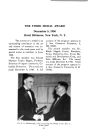
ERIC C. KUNZ--MEDALIST 263 The building of an industry is never the work of one man it is the attainment of his company, which is a team, in conjunction with many competitive firms, all functioning in an industrial milieu in which the raw materials are obtainable and the products find a sale. But I believe that the perfume and cosmetic industries and their suppliers would be unanimous in naming the one man who, more than any other, made the greatest contributions to the growth and development of synthetic aromatics in America. In co-operation with his many colleagues and coworkers in Dela- wanna, and aided by the experience of his colleagues abroad, Dr. Kunz guided the company in the es- tablishment of numerous installa- tions for the manufacture of aro- matics that had never before been made in this country on a plant scale established new processes that made possible greater purity of material, brought prices down- ward in an effort to increase the use, and then with increased use estab- lished larger production in order to bring prices lower again. One need but compare the pro- duction of this industry today with that of a quarter of a century back to see an almost unparalleled and certainly unforeseeable growth compare its prices today with those of former times, and find consistent reductions. It is for these achieve- ments that Dr. Kunz can share in the spotlight of honor. The efforts of Dr. Kunz were twofold--first, to convince the American cosmetics and perfume industries that this country could supply aromatics of as fine a qual- ity, from both cl•mical and olfac- tory point-of-view, as could be ob- tained from Europe and, second, to build up and make available to these industries a line of chemicals of domestic production encompass- ing practically all synthetic perfume materials in daily use. But his achievements were not confined to perfumery. Under his guidance, and largely due to the direct work of Dr. Kunz, the com- pany brought for the first time on the American market a highly puri- fied cetyl alcohol, utilizable by the cosmetic indt•stry. It was Dr. Kunz who did pioneering work as early as 1926 on stabilization of the aldehydes, and particularly phenyl- acetaldehyde, so important in per- fume mixtures for creams. The development of antioxidants, partic- ularly for stearic acid, was a major contribution in the stabilization of white creams and other cosmetics. Dr. Kunz was one of the inventors of a mixture of isopropyl esters of fatty acids, that has come to be known as Deltyl, and that has found wide ap- plication as a substitute for mineral oil, but having the advantage of greater stability and freedom from rancidity. . Always acutely interested in chemical economics, Dr. Kunz has taken a foremost role in the work of the Synthetic Organic Chemical Manufacturers Association, of which he has been a vice-president on the Board of Governors, and has par- ticipated in the formation of its

264 JOURNAL OF THE SOCIETY OF COSMETIC CHEMISTS solid political foundation. He was a founder of the Essential Oil Associa- tion of the United States, and then he proceeded to establish the Scien- tific Section of that Association, of which he has been chairman since it was founded some sixteen-years ago. It was Dr. Kunz personally who first proposed to the Essential' Oil Association the adoption of industry-wide standards for perfume materials, a proposal which was greeted with great skepticism, but which he persistently urged and today the Essential Oil Association has already adopted standards for numerous essential oils and aro- matic chemicals which are followed not only by producers and users in the United States, but throughout the world. Among his many achievements, Dr. Kunz can proudly recall his almost one-man campaign to con- vince the U.S. Pharmacopoeia Re- vision Committee of the desir- ability of accepting racemic men- thol in the U.S.P., thus contributing to making America independent of foreign sources for its menthol, and aiding to avert a critical shortage of this substance during the recent World War. In the field of interna- tional affairs, he made an original contribution in a critique of the multilateral system of trade agree- ments, and, to come to a subject closer to the group gathered here, his critique of the American patent system, coupled with concrete •nd constructive proposals, stands out as another original contribution of a versatile intellect. If one were to name the out- standing achievements of the past decade in the domain of cosmetic chemistry, I dare say that there must come to the minds of many the development of antiseptic and germicidal soaps and cosmetics, ca- pable of being used for everyday pur- poses. The deodorant qualities of these materials, arising out of their bactericidal power, have widened their appeal to the public, and the germicidal qualities have materially increased the functional value of numerous cosmetics and soaps and widened the horizons of the entire cosmetic industry. The study of antisepsis, and the search for non- toxic germicides which would re- tain their bacteria-killing power in the presence of soap, was foremost for many years in the mind of Dr. Kunz, and the historically signifi- cant use patent involving the utilization of G-11 (hexachloro- phene) or related substances in soap bears the name of Dr. Kunz as one of the co-inventors. It was fitting, indeed, that in a career devoted so fully to the per- fection of pleasantly odorous mate- rials, the crowning glory should have been the perfection of odor- inhibiting materials. And thus, one of the most ancient and most exquisite of the purposes of cos- metics--to make more fragrant the human body--was made possible by the work of Dr. Kunz in two different but complementary direc- tions. This is, as I have said, a lifetime of work that can tell its own story.
Purchased for the exclusive use of nofirst nolast (unknown)
From: SCC Media Library & Resource Center (library.scconline.org)