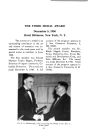
COSMETICS AND What can I add to this save a per- sonal testimonial to the man, just as his record is the testimonial to the scientist? It was my rare privilege and good fortune to be ab•le to work intimately with him, so that I might absorb a little of his knowledge and wisdom, while seeking to appreciate his humani- tarian personality. He was more than visionary, teacher, guide, men- tor, and employer he was friend, inspirer, example and, if I may unashamedly look inward behind the cloak of my own mind, there was in my evaluation something of the hero-worship of a child in con- templation of a father. As I think of this glorious life- THE FUTURE 265 time of achievement, I find it fit- ting and, indeed, inevitable, that we should have come to this dinner tonight to pay homage to Dr. Kunz. But, on reflection, it is not Dr. Kunz who has been honored, but it is our industry, our section of American chemistry, which has had the benefit of a man of such caliber among its foremost scientists for a quarter of a century. And, finally, mine was the honor to have been permitted to deliver these words of introduction and evalua- tion in behalf of our medalist. If my words have been inadequate, it is because the flickering candle cannot pour its light on a life that is a blazing sun. THE MEDALIST'S ADDRESS Cosmetics and the Future By ERic C. KUNZ, PH.D. Givaudan-Delawanna, Int., New York •7, N.Y. SOME THIRTY-FIVE years ago, the perfume and toilet goods count- ers occupied only a small corner in the drug and department stores, even in such cosmopolitan cities of the United States as New York. It was not considered good taste, it was not fashionable, within the circles of good society, to use such alluring beautifying mediums as cosmetics or perfume. Ladies pa- rading up and down Fifth Avenue who had enhanced their attractive- ness with cosmetics and perfume were not ladies, although it was com- monly known that in Europe it was more a matter of economics as to whether ladies used perfume and, to a lesser degree, cosmetics. Creams that were offered in the drugstores were practically all of the cold-cream type, and were used less for the purpose of enhancing one's beauty than for preventing the infection of hands. The cold- cream was for cleansing rather than beautifying. Some older ladies even saw some medicinal value in

COSMETICS AND What can I add to this save a per- sonal testimonial to the man, just as his record is the testimonial to the scientist? It was my rare privilege and good fortune to be ab•le to work intimately with him, so that I might absorb a little of his knowledge and wisdom, while seeking to appreciate his humani- tarian personality. He was more than visionary, teacher, guide, men- tor, and employer he was friend, inspirer, example and, if I may unashamedly look inward behind the cloak of my own mind, there was in my evaluation something of the hero-worship of a child in con- templation of a father. As I think of this glorious life- THE FUTURE 265 time of achievement, I find it fit- ting and, indeed, inevitable, that we should have come to this dinner tonight to pay homage to Dr. Kunz. But, on reflection, it is not Dr. Kunz who has been honored, but it is our industry, our section of American chemistry, which has had the benefit of a man of such caliber among its foremost scientists for a quarter of a century. And, finally, mine was the honor to have been permitted to deliver these words of introduction and evalua- tion in behalf of our medalist. If my words have been inadequate, it is because the flickering candle cannot pour its light on a life that is a blazing sun. THE MEDALIST'S ADDRESS Cosmetics and the Future By ERic C. KUNZ, PH.D. Givaudan-Delawanna, Int., New York •7, N.Y. SOME THIRTY-FIVE years ago, the perfume and toilet goods count- ers occupied only a small corner in the drug and department stores, even in such cosmopolitan cities of the United States as New York. It was not considered good taste, it was not fashionable, within the circles of good society, to use such alluring beautifying mediums as cosmetics or perfume. Ladies pa- rading up and down Fifth Avenue who had enhanced their attractive- ness with cosmetics and perfume were not ladies, although it was com- monly known that in Europe it was more a matter of economics as to whether ladies used perfume and, to a lesser degree, cosmetics. Creams that were offered in the drugstores were practically all of the cold-cream type, and were used less for the purpose of enhancing one's beauty than for preventing the infection of hands. The cold- cream was for cleansing rather than beautifying. Some older ladies even saw some medicinal value in
Purchased for the exclusive use of nofirst nolast (unknown)
From: SCC Media Library & Resource Center (library.scconline.org)