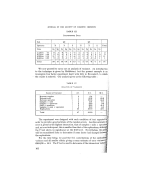
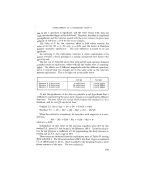
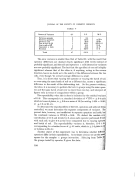
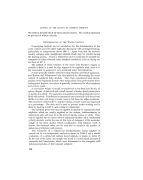
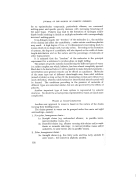
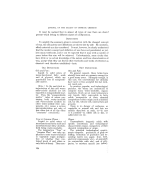
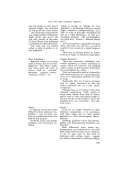
JOURNAL OF THE SOCIETY OF COSMETIC CHEMISTS foam almost disappears and is no longer a continuous layer over the liquid surface. The number of plates washed is recorded. Various methods of determining the end-point can be used, of which the most common is to consider foaming the main criterion of performance and record the number of plates washed until the foam is reduced to a thin surface layer. Different operators will differ in their interpretations of the end-point: for example, one may usually wash one plate more than another in a typical result of, say, 15 to 25 plates. Alternatively, the en&point can be taken when grease is deposited on the side of the basin or when it becomes impossible to clean further plates--one of such methods necessarily being used for those detergents (e.g., certain non-ionics) which do not foam. Nevertheless, a high correlation between results on different end-points is shown and in general the choice of procedure has no effect on the compara- tive results for different detergents. PRECISION OF THE TEST The first stage in evaluating any test procedure is to determine the precision of the test, i.e., the repeatability of the results when as many variables as possible are maintained constant. The repeatability is then re-determined with these variables controlled at different levels--e.g., one variable being the operator, another operator will be studied--and thus the levels at which to control the variables so as to obtain results of high precision is determined. It is necessary to determine the repeatability for different levels of the variable being measured as it frequently is not constant. The first experi- ment was carried out using four different quantities of a detergent, expected to give results of from 4 to 30 plates, which was thought to be the useful range of the test. The simplest method of determining the repeatability would be for one operator to perform about six successive tests with each detergent using the same batch of soil. However, we can here introduce statistical methods into the design of our experiment ß instead of performing the six successive tests with the same batch of soil and operator, we can use different operators and different soils, and thus study the additional factors. To obtain the same reliability of the estimate of precision, we should, with three operators, need 12 tests per sample. This is twice the work, but yields three-fold as much information because the effects of varying the operator and batches soil are assessed as well as the simple repeatability. In fact, the increase information is more than three-fold as we now have the separate estirna tes21•!•' of the abilities of three different operators in place of a repeatability for one operator only. The experiment now has as its objective the investigation of the factors as studied by PughL The methods of performing the test a

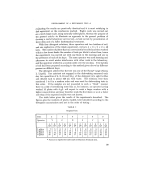
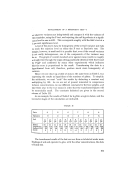
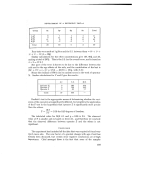
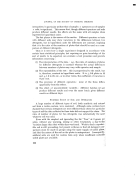
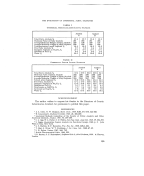
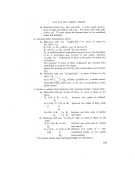
DEVELOPMENT OF A DETERGENT TEST--I evaluating the results are practically identical and it is most satisfying to find agreement on the conclusions reached. Pugh's work was carried out on a much larger scale, using naturally soiled plates, whereas the purpose of the present article--to illustrate an approach to the general problem of devising a useful laboratory service test--is best served by presentation of fewer data and of a fuller mathematical treatment. With four detergent solutions, three operators and two batches of soil, and one replication of the whole experiment, we have 4 x 3 x 2 x 2 = 48 tests. The number of plates that can conveniently be soiled and then washed within a few hours limits the number of tests per block to about four, hence the experiment was carried out with one block in the morning and one in the afternoon of each of six days. The same operator was used morning and afternoon to avoid undue interference with other work in the laboratory, and the operators worked in a random order over the six days. Two batches of soil had been prepared according to the method given above by different persons on different days. The detergent selected for the test was one of the Nansa* range (Nansa L. Liquid). One assistant not engaged in the dishwashing measured each day two quantities of 4, 8, 16 and 24 g. of the detergent into eight bottles and diluted each to about 120 mi. with water. The solutions were then numbered 1 to 8 in a random order and were used for dishwashing tests in this order. If the samples are not presented in such a "blind" manner there is a risk of introducing some bias as, for instance, an operator having washed 15 plates with 4 g/1. will expect to wash a larger number with a higher concentration and may therefore wash the first dozen or so at a faster rate than if the expected results were not known. The table below gives the results of the experiments described. The figures give the numbers of plates washed, here tabulated according to the detergent concentration and not in the order of testing: TABLE I Original Data Date 2 3 6 7 8 I 9 -- __ -- Operator Y Z X Z Y X ,. a p a p a p a p a p a p Q2 Q3 Q3 Q2 Q2 Q3 Q2 Q3 Q3 Q2 Q3 Q2 1 g/litre 7 5 6 6 7 6 5 6 6 5 6 6 2 g/litre 10 9 10 11 10 9 9 10 10 10 10 13 4 g/litre 16 14., 14 14 18 16 13 15 12 12 14 16 6 g/litre 20 16 17 18 20 17 19 18 17 17 18 17 * Nansa is a registered trade mark of Marchon Products Ltd. 99
Purchased for the exclusive use of nofirst nolast (unknown)
From: SCC Media Library & Resource Center (library.scconline.org)