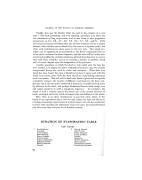
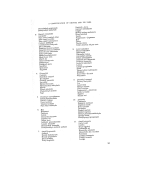
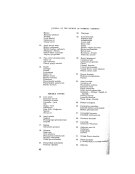
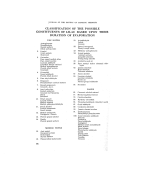
JOURNAL OF' THE SOCIETY OF COSMETIC CHEMISTS one day I gave the coefficient 1, and to the others g to 100. This work went on and on and soon seemed endless, because I had to make repeated tests when the results were doubtful. However, at the end of four years I had finished, and when the substances were grouped under their' respective coefficients, and the groups tabulated progressively from 1 to 100, I had before me a picture that was tantamount to the fractional distillation of any fragrance. But I feel it is necessary to point out at this stage that the application of this Key to the Basis of Perfumery will always depend upon the artistry of the worker in his laboratory, since without imagination it will never produce a masterpiece. A comparison with my other hobby will perhaps more clearly demonstrate my point, as a similar flair is required of the successful landscape photographer. He has travelled to a beautiful part of the country with the sole object of making some pictures of great excellence, and has climbed a low hill to get a glimpse of his subject. But before him spreads an immense panorama, in which are arrayed magnificent mountains, wild canyons, lovely lakes, fine trees and dainty wild-flowers, all crowned by a superb cloud-scape, and he realises at once that a comprehensive shot of this ravishing scene will never make a satisfactory picture, despite its magnetic appeal to the eye. In fact there is enough material here to make a whole series of masterpieces. So he selects one outstanding feature at a time from this medley, and moves about until he discovers a viewpoint from which he can arrange it in a pleasing design ß and only then does he release the shutter of his camera to record a work of art. I am now going to give you a selection from this classification of odours. ? the substances with coefficients from 1 to 14 I will call the Top Notes those from 15 to 60 the Middle Notes and the others from 61 to 100 the( :• ..• Basic Notes or Fixers, because they are fixatives in the usually accepted sense and aromatics which, when skilfully blended, yield the characteristic lastingi!½ note of any fragrance. However, I will return to the problem of fixation!:!! later in this paper. ToP NOTES ' (1) Acetophenone (2) Limes (3) Coriander (4) LavenzS! der' (5) Terpinyl Acetate (6) Bergamot (7) GeranioI (8) Amy!?! Salicylate (9) Peppermint (10) Linalyl Acetate (11) Sweet (12) Methyl Heptine Carbonate (13) Paracresyl Phenylacetate ß and Lemongrass. M•DDLE NOTES: (15) Heliotropin (16) Eugenol (17) Melissa Orris absolute (19) Verbena (20) Clary Sage (21) Anisic Aidehyde the Ionones (22) Orange Flower Water Absolute (23) Broom Absolute?:• (24) Ylang (31) Orange Flower Absolute (34) Celery Root (43) and Rose Absolutes, and (50) Neroly. :!}•zfi• I BASra NOTES ' {65) Cinnamic alcohol (77) Meth 1 Na hthyl Keto

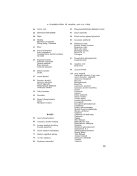
A CLASSIFICATION OF ODOURS AND ITS USES (80) Hydroxy Citronellal (88) Ethyl Methyl Phenyl Glycidate (89) Cyclamen Aidehyde (90) Orris and Opoponax Resins (91) Undecalac- tone (94) Angelica Root and (100) Amyl Cinnamic Aidehyde, Coumarin, Decyl Aidehyde, Isoeugenol, Labdanum Resin, Artificial Musks, Oakmoss Resin, Patchouli, Phenyl Acetic Aidehyde, Santal, Undecyl Aidehyde, Vanillin and Vetivert. My paper contains a complete list, which I will give to your president for publication. A question that arises from this classification is as to whether the con- stituents of one group may function temporarily in another if they are used in a dominating percentage in the finished compound. In this connection it is interesting to. compare the vital constituents of lilac with those of hyacinth, because there is a similarity between them, but with two substitu- tions and one notable omission. The following are common to both in this ratio: 5 times as much benzyl acetate in the hyacinth 6 times as much phenyl ethyl alcohol in the lilac the same percentage of heliotropin and of isoeugenol in each but the hyacinth requires 3 times as much cinnamic alcohol, and 100 times as much phenyl acetic aidehyde. It will be observed that the almost equivalent change-over in the quantity of the two top-note constitutents is required by the difference in bouquet of the flowers, and is further modified of necessity by replacing the terpineol in the lilac with a similar quantity of linalol in the hyacinth the middle note of anisic aidehyde in the former is replaced by ionone in the latter and while hydroxy citronellal is an essential constituent of the lilac, it can be omitted entirely from the hyacinth, which, however, is dominated by the vast increase in the powerful aidehyde. It would seem, therefore, that longer-lasting aromatics might be used in such quantity as to raise them temporarily into a higher grouping, as further instanced by the middle note of ylang in a lilac fantasy, where it might be used in such quantity as to dominate its fragrance or the basic notes of such aliphatic aldehydes as C 10 or 11 or 12 in an intense flowery bouquet, where they might be raised to middle- or even top-notes in accordance with the percentage employed. But in my view this cannot ultimately alter the original coefficients in this classification. On the other hand, it seems certain that the relative quantities of aroma- tics in a complex mixture do in fact influence the duration of evaporation of the whole: first, depending upon the ratio of the combined basic substances to the middle and top note constituents and second, to the changes that may take place on maturing, or even to interactions of an obscure nature between the various constituents. But it is not easy to prove the latter point, and an examination of the former may even lead to speculation. For, if we take a simple compound of two substances, such as bergamot and patchouli, or lavender and coumarin, and mix them in the proportions of 85
Purchased for the exclusive use of nofirst nolast (unknown)
From: SCC Media Library & Resource Center (library.scconline.org)