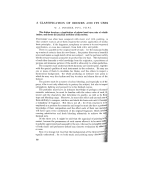
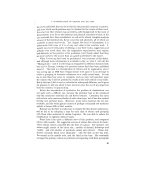
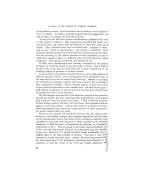
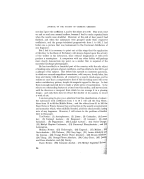
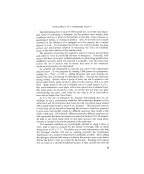
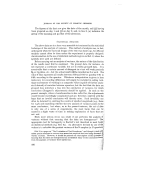
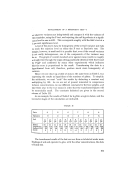
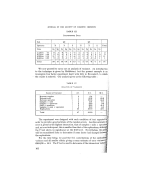
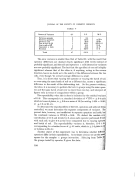
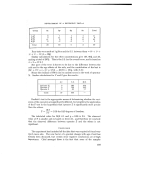
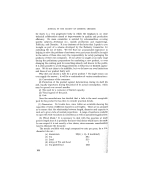
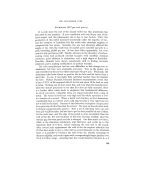
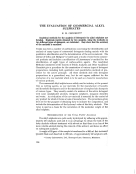
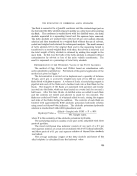
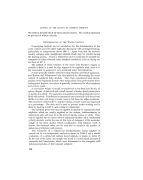
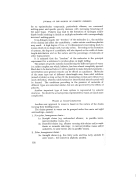
JOURNAL OF THE SOCIETY OF COSMETIC CHEMISTS TABLE V Source of Variance d.f. S.S. M.S. .__ Between samples 3 6.4 -- Between operators 2 129.5 64-8'* Between soils 1 60-8 60.8* Due to age of Q2 1 193.1 193.1'** Due to age of Q3 1 15-5 15.5 Operators x soils 2 82.6 41-3' Residual 37 428.0 11.6 __ Total 47 9! 5.9 -- The error variance is smaller than that of Table III, with the result that operator differences are deemed clearly significant (0-01 level) instead of probably significant, and the soils and operators x soils interaction variances are now probably significant. The fact that the age effect of one soil is highly significant whereas that of the other is, if anything, acting in the reverse direction, leaves no doubt as to the reality of the difference between the two soils, even though 'he overall average difference is small. Thus, it is shown that varying the operator or v'arying the batch of soil, or even using the same batch of soil on a different day, causes a significant,:: difference in the result of the dishwashing test. On the present evidence,i': therefore, it is necessary to perform the tests in groups using the same opera-. tor and the same batch of soil over no more than one day, and interpret all figures only in terms of comparisons within a group. The repeatability when this is done is indicated by the residual variance' •} ' of 11.6. This corresponds to a standard deviation of V'I ].6 = 4- 3.4 unitS::!! which in terms of plates, is 4- 0.8 on a mean of 10 (for antilog. 1.034 ----- or q- 1.6 on 20, etc. To determine the reproducibility of the test, operators and soils not being? controlled, we must determine the separate components of variance. The:! present data, however, are insufficient to separate oper•ators and soils, the combined variance is 272-9/5 = 54.6. We deduct the random contribution of 11.6 and divide by 8, since each operator performed 8 with each soil, to give 5-4 as the error component due to varying open and batch 'of soil. The reproducibility variance is, therefore, 11-6 +.5 I' corresponding to a standard error of 4- 4.1 units, which is 4- 1.0 plate in or 2 plates in 20, etc. Another object of the experiment 'was' to determine whether operators differ in their repeatability. As estimate of error we use the square for the samples x groups interaction. Selecting from Tabl e•III• the groups"tested by operator X gives. the data

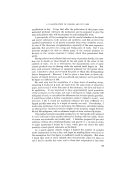
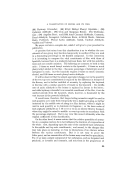
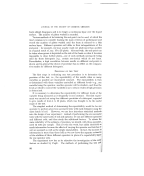
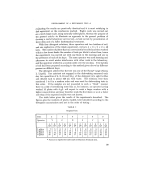
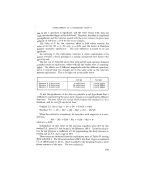
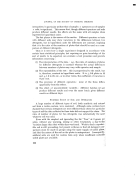
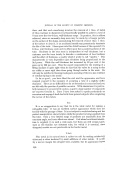
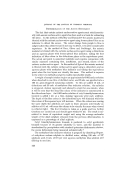
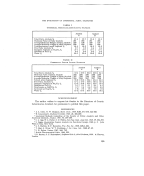
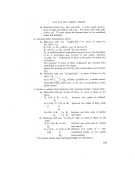
DEVELOPMENT OF A DETERGENT TEST--I ,, ! Group 6a 9p 6p 9a Total 1 g/1 8 1 1 1 11 2 g/1 0 11 -5 0 6 4 g/l 11 5 5 0 21 6 g/1 5 -2 -2 1 2 -- Total 24 15 -1 2 40 Four tests were made at 1 g/litre and the S.S. between them ---- 8' d- 1 • d- l'd-I s--I1•/4=36 i. Similar calculations for the other concentrations give I37, 60 i, and 33, making a total o/267«. This is the S.S./or the overall error, and is based on 4 x 3---- 12d.f. But part o/the error is known to be due to the difference between the soils and to the age effects of the soils, and the contribution of the last is (24 • d- 15 • d- (--1) • d- 22)/4 --40'/16---- 101«, with 3 d.f. Hence the residual of I66 is due to random errors in the work of operator X. Similar calculations for Y and Z give the results: , , d.i. S.S. M.S. Operator X 9 166 18-4 Operator Y 9 128 14-2 Operator Z 9 69 7-7 Total 27 353 -- Bartlett's test is the appropriate means of determining whether the vari- ances of the operators are significantly different, but simpler is the application of the F test to the hypothesis that operator Z is significantly more precise than the others. 16.3 F -- 7-• -- 2-10 for 18/9 degrees of freedom. The tabulated value for 24/9 d.f. and p = 0-05 is 2-9. The observed value of F is smaller and is based on fewer d.f., and therefore we conclude that the observed difference between operator Z and the others is not significant. CONCLUSION The experiment has furnished all the data that was required of it and very much more also. The new factor of a gradual change with age of soil has already been discussed, but certain other negative conclusions are of high importance. Chief amongst these is the fact that none of the samples 105
Purchased for the exclusive use of nofirst nolast (unknown)
From: SCC Media Library & Resource Center (library.scconline.org)